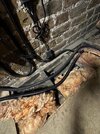
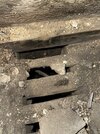
Hello All,
I am looking for some advice from someone familiar with the construction of old victorian terraced houses. I have posted my question in another forum already, but have not gotten quite the response I was after yet.
Long story short:
I want to know how the ceiling of my outrigger is constructed/supported, as I want to use the loft space and am concerned about weight. The loft is already fully boarded up, and I am looking to get some insights (educated guesses are fine at this stage) as to how the timber frame is constructed and supported.
I found a random video here, from someone who is doing a full loft conversion but a similar setup to my property. Below screengrab is from minute ~13.30
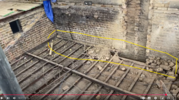
This is the outrigger/annex roof, not the main roof. I would like to know how the joist are supported on the (Party)Wall side highlighted in yellow. On the other side, the joists will obviously sit on a wall plate connected to the outside brick wall. From the video it looks like there is a timber running parallel to the wall and the joists are attached to it. But what is this resting on below?
Let me know if you need me to clarify anything.
Depending on how this is supported, it would help me to decide where the strongest loading capacity is. I thought it would be closest to the wall, but that was assuming that the joist are going into pockets into the actual brickwork, which I don't believe is the case.
I am looking for some advice from someone familiar with the construction of old victorian terraced houses. I have posted my question in another forum already, but have not gotten quite the response I was after yet.
Long story short:
I want to know how the ceiling of my outrigger is constructed/supported, as I want to use the loft space and am concerned about weight. The loft is already fully boarded up, and I am looking to get some insights (educated guesses are fine at this stage) as to how the timber frame is constructed and supported.
I found a random video here, from someone who is doing a full loft conversion but a similar setup to my property. Below screengrab is from minute ~13.30
This is the outrigger/annex roof, not the main roof. I would like to know how the joist are supported on the (Party)Wall side highlighted in yellow. On the other side, the joists will obviously sit on a wall plate connected to the outside brick wall. From the video it looks like there is a timber running parallel to the wall and the joists are attached to it. But what is this resting on below?
Let me know if you need me to clarify anything.
Depending on how this is supported, it would help me to decide where the strongest loading capacity is. I thought it would be closest to the wall, but that was assuming that the joist are going into pockets into the actual brickwork, which I don't believe is the case.