
Damp ingress after repointing.

Hello,
Yes, i have read many posts on here and looked at many websites, however it all seems quite confusing with many many different opinions.

With regards to your previous questions

1.I have attached photos of what I think you requested.
2. Again there is picturs in this thread
3. Of the 5 flues, 4 are redundant, only one of which is ventilated at the bottom, this is in the top room, which is seeing the most dampness, the one in my bedroom (middle floor) has no vent and is seeing no dampness, the other room on the same floor is seeing dampness and finally the one on the bottom floor only shows dampness on the underside on the flues where the fire used to be. The 3 that are not vented, never have been and I believe these have been blocked up for many years and never showed any sign of dampness prior to the new pointing.

4. I assume you are talking about between the house gable and the garage extension? This is all lower than were the dampness is and will most likely have to be changed at some point.

5. I assume you mean this?
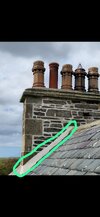
 

Attachments

  • Screenshot_20260508_232527_WhatsApp.jpg
    Screenshot_20260508_232527_WhatsApp.jpg
    194.2 KB · Views: 11
OP,
Did you read the posts I suggested that you read? Have you decided what to do about the faults I noticed?
Your new pics are interesting & suggest that there's more work needed on the chimney stack & possibly inside the house?
FWIW: I can advise you further eg. the moulded stone capping is becoming dangerous - but first are you up to speed with reading similar threads from the search facility?
Thanks, when you say inside the house? What do you mean? Vents?

With regards to the capping, I assume you mean that it could break and fall? Apart from that I've not read any other articles on their dangers
 
OP,
Did you read my previous posts, the posts that I had previously suggested you read so that you would have a better understanding of the advice being offered?
 
OP'
Then FWIW, I can only more or less repeat what I had historically written.
Fillets are bad practice - lead flashings are best practice.
The flaunching needs replacing.
All the flues should be swept. Blocked flues should be opened & swept. All the flues need bottom & top venting.
The left hand capping stone is loose.
The capital stones need lifting & re-setting.
There's a split in the middle capping stone.
One of the pots needs a clay venting cowl like the other cowls.
How the gable and the stack and the parapet could have been pointed & worked on without using scaffolding or a cherry picker I dont know - if scaffolding or a cherry picker was used then the flaunching, pots & capping stones would have been in easy reach.

We dont know how your walls were built eg. random rubble infill or even if a 25mm pointing rake out chase was done - but perhaps the failed flaunching, & unswept flues, & possibly the parapet fillet as the main culprits for any interior damp?
 
Hi,
The house has never had lead flashing installed in the areas that have fillets, its the same for the other houses in the street, so assume this wasn't common practice in Scotland when the house was constructed. The same with at the parapet, it was just tiled to the edge.

With regards to the chimney issues, I totally agree, we had scaffold and a mewp for around the chimney, so why he never did the flauncing is beyond me and he hasnt given me a straight answer why, sadly as I work away it was all done and stripped before I came home, He only mentioned it after I brought up the leak. I can only assume with the lose stones etc, he just didn't fancy breaking the old stuff out. However he has agreed to come back and fix it.

You mention another clay cap? I'm not sure if see where or why? The current uncapped one is still in use and the rest are clay as fsr as I can tell.

I'm not quite sure how I will be able to sweep out the abandoned flues, however i will be drilling a 3-4 inch hole in each( once i find the behind the wall) and adding a vent. In your experience will all the flues meet at the top or is each one bricked up individually to the chimney?

Thanks
 
OP,
You need a ventilating cowl on the open, active flue pot - cowls are not cappings.
I've already explained - sometimes twice - the answers to your questions. Perhaps if you go back & re-read my posts with careful attention then you will understand that you already have the answers.
 

If you need to find a tradesperson to get your job done, please try our local search below, or if you are doing it yourself you can find suppliers local to you.

Select the supplier or trade you require, enter your location to begin your search.


Are you a trade or supplier? You can create your listing free at DIYnot Local

 
Back
Top