• Looking for a smarter way to manage your heating this winter? We’ve been testing the new Aqara Radiator Thermostat W600 to see how quiet, accurate and easy it is to use around the home. Click here read our review.

Damp Plaster Behind and Above Skirting Board

I was expecting to see bare brick once plaster was removed ?
What's on the other side of that wall ?

 
  • Thanks
Reactions: WSB
To the left is the cooker kitchen units but about 1.5 foot behind that wall is the toilet I mentioned before.
In the hallway, not far away from this spot there's signs of historic water damage to a short section of skirting. This is also roughly the area where the ants were coming from in the summer. Think I'll take a look behind that tomorrow.
Off to sleep now but thanks for all the advice thus far. If ok with you, I'll keep you posted on this thread.
Thanks again!
 
Yes ,would be interested to know what you find after further investigation
 
  • Thanks
Reactions: WSB
Hi Terry,
Sorry for the late reply but have been conducting lots of experiments.
I think (hope) that the dampness issue is not related to the heating at all.
Don't think the dampness is coming through the brickwork but from the bottom ground concrete layer where there is a small gap between the wall and the ground concrete.
It could still be a pipe leakage that is somehow getting below that I guess but when I shove a knife down that gap, it's not sodden, just a slightly damp.
I think you were correct with the plaster going down to this gap, causing the damp to rise up in it, as since removing it, the brickwork behind is a lot dryer, if not completely dry.
Question is, what next?
Was planning on cementing the gap and replacing the plaster but only down to an inch above the floor. It will have a piece of skirting board covering it anyway.
Thanks for all your help. Always good to talk things through!
 
Have you exposed the Bare brick faces ? Your last pic doesn't show brick ? That area seems to be next to a doorway ,what is the wall like on the reverse ? I.e. if you drilled a hole right through the brick from where you removed the skirting ,where the drill comes through the other side,that area ? If this makes sense
 
  • Thanks
Reactions: WSB
Thanks Terry,
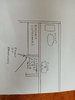
Probably easier if I show a diagram. The double lines are where there is a single layer of brick. I have taken away the boxing round the piping in the toilet under the sink an all is dry unless the leaking is below the concrete floor of course. Before we had the old boiler removed 15 years ago there were signs of some water leak, presumably from the old boiler so maybe some of this issue is historic.
 

Attachments

  • damp_wall.png
    damp_wall.png
    923.3 KB · Views: 101
Is there skirting on the other side of the wall ( boiler cupboard side) ,same bricks, just their other face ,that shows damp signs ?
Are there any pipes buried in the concrete floor ?
 
  • Thanks
Reactions: WSB
The boiler cupboard side is tiled on the floor as is all the kitchen. No skirting board in boiler cupboard, just plasterboard down to the floor. No sign of damp in there. There are pipes buried in the floor around that area as when the heating is on, the tiles in front of the area I've been talking about get quite nice and hot in places. Always been like this since we've lived here (16 years).

To be honest, when I shove a knife down the gap between the wall and the concrete base in the suspect area, it's only ever so slightly moist, possibly not much at all. Could be some condensation occurring due to the hot pipes and colder concrete. Am thinking about just cementing that small sliver of gap in and replastering that little area down to an inch above the bottom. Give it a while to ensure the plaster is no longer getting damp, then stick the skirting board piece back over.
 
Yes ,no need to go as low as 1inch close to the floor. I would leave a 2 inch gap at least.
 
  • Thanks
Reactions: WSB

If you need to find a tradesperson to get your job done, please try our local search below, or if you are doing it yourself you can find suppliers local to you.

Select the supplier or trade you require, enter your location to begin your search.


Are you a trade or supplier? You can create your listing free at DIYnot Local

 
Back
Top