
Dealing with embossed paper on lath and plaster ceiling

Joined
25 Nov 2006
Messages
896
Reaction score
22
Location
London
Country
United Kingdom
Hello

My landing/staircase ceiling is covered with embossed wallpaper (the bubbly stuff) which is also above a picture rail. It’s also got coving.
I’ve managed to removed the paper above the picture rail but the coving has obviously been added after the paper went up as I needed to carefully score it with a Stanley knife. The wall is not too bad, it’s had a few cracks that have already been filled so I plan smooth, Gardz and then put a plain lining paper on.

It’s a 1930s house and the wall is lath and plaster so I assume the ceiling is too.

The embossed paper came off relatively easily but I’m worried about opening a can of worms if the ceiling is in bad condition, especially as it’s a tall ceiling. It’s about 12 sq m and once I start there’ll be no going back.

It’s tempting to leave alone but the rest of the house has smooth walls and this area looks dated.

Anyone had any experience of this and/or advice on the best approach? Thanks
 
How old is the property? (edit- sorry you said 30's). I recall painting cabinets in Bedford Park (Chiswick). The property was 1830-1850. In conversation the owner told me that the ceilings were reaching end of life. Some fell down of their own accord. He overboarded and skimmed each of them.

If you are careful, you should be able to remove the embossed paper, but, you will probably find that it was used to hide cracks. If you are happy to feather out the cracks- go for it. You may need to use lining paper after. BTW Lining a ceiling on your own is relatively easy. As you concertina the paper on the pasting table, you can put tight creases in the folds (every 12" or so). The creases will disappear once the paper dries. A trestle and boards makes life much easier though. I have done it using a step ladder alone, was a bit of a chore. I used a wide filling knife (approx 16") to support the paper as I gingerly moved the step ladder.

Personally, I would be inclined to deal with the ceiling... but I am a decorator.
 
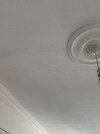
This is it beforehand. It’s only me that hates it and I wonder if I’m making a rod for my own back!
 

Attachments

  • IMG_0934.jpeg
    IMG_0934.jpeg
    723.2 KB · Views: 13
If you steam off the paper, there is a good chance that the skim will blow off and that paper has been put up to hide cracks anyway.

I'd be inclined to overboard what's there and then get it skimmed. If the coving and the ceiling rose aren't original to the house, you're not really losing anything and then you know you have a good ceiling that won't be at risk of collapse.
 
Thanks for the replies, all food for thought.

I wouldn’t steam, I’d just use soapy water but yes, it’s probably been papered to hide cracks.

Having ripped out several rooms of lath and plaster I’m not sure I want all that aggro again, or even the aggro of removing the coving (which matches other rooms).

I did read about over boarding where you leave the coving and create a shadow gap. That might be the way forward, I’ll have more of a think to see if that would fit. Thanks.
 
Thanks for the replies, all food for thought.

I wouldn’t steam, I’d just use soapy water but yes, it’s probably been papered to hide cracks.

Having ripped out several rooms of lath and plaster I’m not sure I want all that aggro again, or even the aggro of removing the coving (which matches other rooms).

I did read about over boarding where you leave the coving and create a shadow gap. That might be the way forward, I’ll have more of a think to see if that would fit. Thanks.

I too would try to avoid a steamer if possible but steamers tend to be ok on lath and plaster (assuming that it hasn't be skimmed with gypsum). Steaming ceilings is never pleasant- hot dripping water- and domestic steamers have very short hoses. I have a steamer (5m hose) which now retails at £480 (when I purchased it many years ago it only cost me £120). I haven't used it for about 5 years.
 

If you need to find a tradesperson to get your job done, please try our local search below, or if you are doing it yourself you can find suppliers local to you.

Select the supplier or trade you require, enter your location to begin your search.


Are you a trade or supplier? You can create your listing free at DIYnot Local

 
Back
Top