
Do I have cavity walls?

Joined
2 Feb 2017
Messages
8
Reaction score
1
Country
United Kingdom
Good morning all,

I have a third-floor Victorian flat (circa. 1900) and I have always assumed that it had solid walls, however the walls are 15.5" thick. The brick pattern doesn't help as the wall is so thick you would expect to see the ends of the bricks as well as sides, see below.
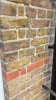
wall.jpg

Assuming it is solid, is it worth adding 50mm of internal insulation (I can't go thicker due to small room size)? I was thinking of using 45mm Celotex GD5000.

Many thanks
 
Possibly one and a half brick thick solid walls. You say your flat is on third floor how tall is the building? Brick pattern is not the best way to tell, they could be snapped headers.

As for insulation, depends on your feelings about energy saving. As it's a flat I assume external wall area is limited so personally I probably wouldn't bother.
 
Thanks for the reply.

The block has 4 floors.

What combination of bricks would give 15.5" thickness? 9" bricks are 4.25" wide, so 9+4.25=13.25. This leaves 1.25" for cement and then the internal lime render. Sounds plausible.

The motivation for the insulation is that the room gets cold quickly, however this is undoubtedly due to the large window. We are getting the room refurbished as the kids bedroom so I want it to be as comfortable as possible.
 
If it gets cold quickly then draught proofing/air tightness would probably be more effective.
 
Multi storey buildings of that age often had 18 inch walls at the bottom and 13 inch and 9 inch higher up.
Your wall thickness could be 13 - 14 inches thick, depending on the type of brick and how wide they made the internal wall joint.
3 coat lime work was often quite thick to achieve a really good finish.
Using snapped headers was more common in Flemish rather than English bond.
 
It's possible that you've got 2 bricks, and then battens with a lathe and plaster finish. If you drill a few holes in the wall about an inche apart, do you find some holes go straight in, and others have a resistance - where it hits the lathes. If this is the case, then you could take the plaster off, and add insulated plasterboard.
 
Last edited by a moderator:
I'd say that it would not be financially worth while due to a very long if any pay back time.

Neither worth it for what would be lost in room size, and no other gains.
 

If you need to find a tradesperson to get your job done, please try our local search below, or if you are doing it yourself you can find suppliers local to you.

Select the supplier or trade you require, enter your location to begin your search.


Are you a trade or supplier? You can create your listing free at DIYnot Local

 
Back
Top