• Looking for a smarter way to manage your heating this winter? We’ve been testing the new Aqara Radiator Thermostat W600 to see how quiet, accurate and easy it is to use around the home. Click here read our review.

Does all oil based gloss yellow / is Aquaguard Durable...durable?

by the time a decent oil based turns yllow (and it does) the water based would have cracked and needed replaced

about 8 years ago I did our two upstairs south facing windows, one in water based and the other in very old oil based (tins half full with thick crust on top) the water base lasted a couple of years, the oil base needs redone now
 
So I’m starting from scratch with my living room door by stripping off what was water-based paint, over water based undercoat over Zinsser primer over oil-based paint over shellac. It’s not a job I ever want to do again.

I’m now wondering what sort of primer to use. If I’m going to put water based on top should the primer also be water-based?

The door has got plenty of pits, dents and filler and I’ve read that water-based products are not as forgiving. Would an oil-based primer be a help or hindrance if I then switch to water-based on top?

Thanks
 
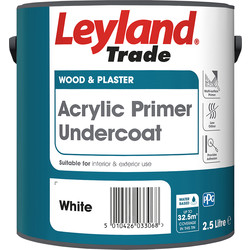
I suggest you keep to water based paints to avoid and clashing. Leyland Trade produce a white Primer/Undercoat as a single product.
 
Yes, that was my first thought but I’ve read that the molecules in oil-based primers are smaller and penetrate the wood more deeply. I’m still committed to water-based top coat and see the point of keeping it all the same, but am wondering if an oil-based primer would offer a more durable base.
 
I am a decorator...

I am not a fan of waterbased top coats. They are less durable. In areas subject to constant touching, the oils in our skin softens the paint and leaves it so soft that after a few years they no longer past the "finger nail" test. Additionally, if you go near them with anything ferrous. it leaves a black mark. I also find that they don't lay off as well as oil based paints.

I do however understand why people use them.

Oil based paints will yellow in the absence of UV light. Post the 2010 VOC compliance regulations, they would yellow within weeks of application. By 2012/13 the formulations had improved.

Regarding oil based primer. I seldom ever use it. I stick with the aforementioned Leyland acrylic primer. I use it as a "search coat" and then sand it back as required. Often ,sanding back to bare wood.
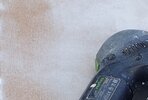
mdf2.jpg

The oil based eggshell or undercoat after will still penetrate below the surface. I have never taken the time to calculate how far it does so though.

At a guess, spirit based stains will penetrate about 0.25mm (softwood). I would guess that oil based paints are only about 0.1mm. Waterbased? Maybe 0.05mm. Again, I am only guessing.

If you do go for an oil based primer you will need to wait longer before you can overcoat with waterbased paints.

If you only leave it for a day or two, you risk getting fisheyes in the waterbased finish. They are tiny craters caused by the solvents in the primer pushing the waterbased paint out of the way. You can speed up the curing process (of the oil based primer) by adding some Terebene oxidising agent (to the oil based primer).

Additionally, if you go completely waterbased and find that the paint drags too much, you can add Floetrol to help maintain a wet edge.

 
Out of interest, how do you strip water-based painted doors? I’m guessing a heat gun or paint stripper won’t do the job when the layers accumulate years down the line.
 
Out of interest, how do you strip water-based painted doors? I’m guessing a heat gun or paint stripper won’t do the job when the layers accumulate years down the line.

Heat guns are useless on WB paint. That said, if there is oil based paint under it, the oil based paint will become soft and can be scraped off.

The majority of WB paints that I have come across are a mare to sand flat. They overheat and clog the abrasives on my sanders.

There have been times when I have used cellulose thinners to remove the paint. It starts to crease/bubble within seconds and can then be scraped off. A bit of a messy job though. The oil based paint under it is left undamaged.
 
Thanks, it was why I wondered about using an oil based primer.

I tried to sand a water-based door and, like you say, it clogged up the sander. ‘Luckily’ it had old oil-based gloss underneath so a heat gun lifted all the layers. (Then I had to use 2 litres of meths to get the shellac off!)

But I’ve got other doors that were stripped a while back. They’re water-based only and are already chipped. I’m hoping a local repair will do it but what would be the best way now to ‘future proof’ them so they could be stripped down the line? One thing I know, they’d be going off to be done professionally, I can’t see myself doing them

Would it be worth putting an oil-based layer on first followed by the water-based layers? I looked at some professional door strippers and they say they water-based doors have to be stripped by hand.
 

If you need to find a tradesperson to get your job done, please try our local search below, or if you are doing it yourself you can find suppliers local to you.

Select the supplier or trade you require, enter your location to begin your search.


Are you a trade or supplier? You can create your listing free at DIYnot Local

 
Back
Top