• Looking for a smarter way to manage your heating this winter? We’ve been testing the new Aqara Radiator Thermostat W600 to see how quiet, accurate and easy it is to use around the home. Click here read our review.

Filling under suspended floor questions

Joined
20 Oct 2020
Messages
142
Reaction score
4
Country
United Kingdom
Hi all,

I am revisiting my plan discussed here https://www.diynot.com/diy/threads/filling-void-under-suspended-floor.615142/ to fill my suspended floor.

I dropped a tape down into the floor and found that from the bottom to the top of the finished floor is 700mm.

What I am thinking:

700mm - 30mm for tiles
- 70mm for UFH in screed
- 120mm for PIR insulation
= 480mm of Type 1 MOT fill.

18m² floor area * 0.48 = a filled volume of 8.64m³ at 1.5ton/m³ = 13 tonnes of material.

The first price I saw for this online loose tipped was £800.

I am thinking about filling the "Dining Room" first, the red arrows show air brick locations so there will be reduced airflow to the rear room which I will tackle within a year.

1740993353567.png


The things I don't know:

1. Will there be any effect on the walls of the house by filling in the void? Could then bulge outwards or something daft ?

2. How much will the type 1 compact down by ?

3. Is there any settling time required?

4. How do I do the damp course? Presume it goes under the insulation and wraps up the sides? How far up the walls to take it, and how do I join it?

5. How do I get the type 1 level? I have seen other posts of people putting sand on top - does that help to get a level surface ?

6. What would the approx. cost for 70mm of screed cost for 18m²?

I have investigated at length a retro fit UFH seating, I either cannot get enough watts / m² to heat the room, of the height built up of a system to go on top of the floor boards is too much when taking into account the threshold of the front door etc.

Thanks in advance.
 
The previous thread received a lot of naysaying about this plan from construction industry professionals and experienced DIYers.
Phatboys solution was the one that seemed the most sensible. You don't lose floor height with UFH if it all goes between the joists. You can still use a screeded system between the joists, although you may need extra timbers.
Have you tracked down any sources of damp yet?
 
Yep. However the previous concerns were mainly about the amount of fill and I've got accurate figures on that part now.

The problem with the between joists UFH system is that they only output up to 70w/m2. I would guess this is because you put wood on top which is an insulator.

With a filled floor I could have 75mm of screed on top and get a system that gives a minimum of 100w / m2. I need 2000w to heat the room.

If anyone knows of a system that would work between joists and give me that output please let me know.

Would I aslo be correct in saying that a between joists system does not allow the pipe to run (not sure on exact terminology) but where the flow is next to the return to eliminate the chance of one end of the room being colder than the other?
 
One more idea, could I arrange a 100mm lower floor using joist hangers and put a screed on top of that ?

One person I spoke to fixed plates to the walls and hung joists if that to set the floor slightly lower. He also put a steel beam below that, I believe I have a dwarf wall.
 
It's getting complicated, but anything is better than barrowing and compacting 13 tons of stone!
You could probably get away with a 50mm screed flush with the joist tops, and use cement board flooring such no more ply on top of that.
Best speak to the various ufh suppliers to find out what your options are.
 
It's a good point - 13 tonnes is a lot of fill to move by hand.
I spoke to a couple of companies last month but no one mentioned using cement board for the sub floor.
 
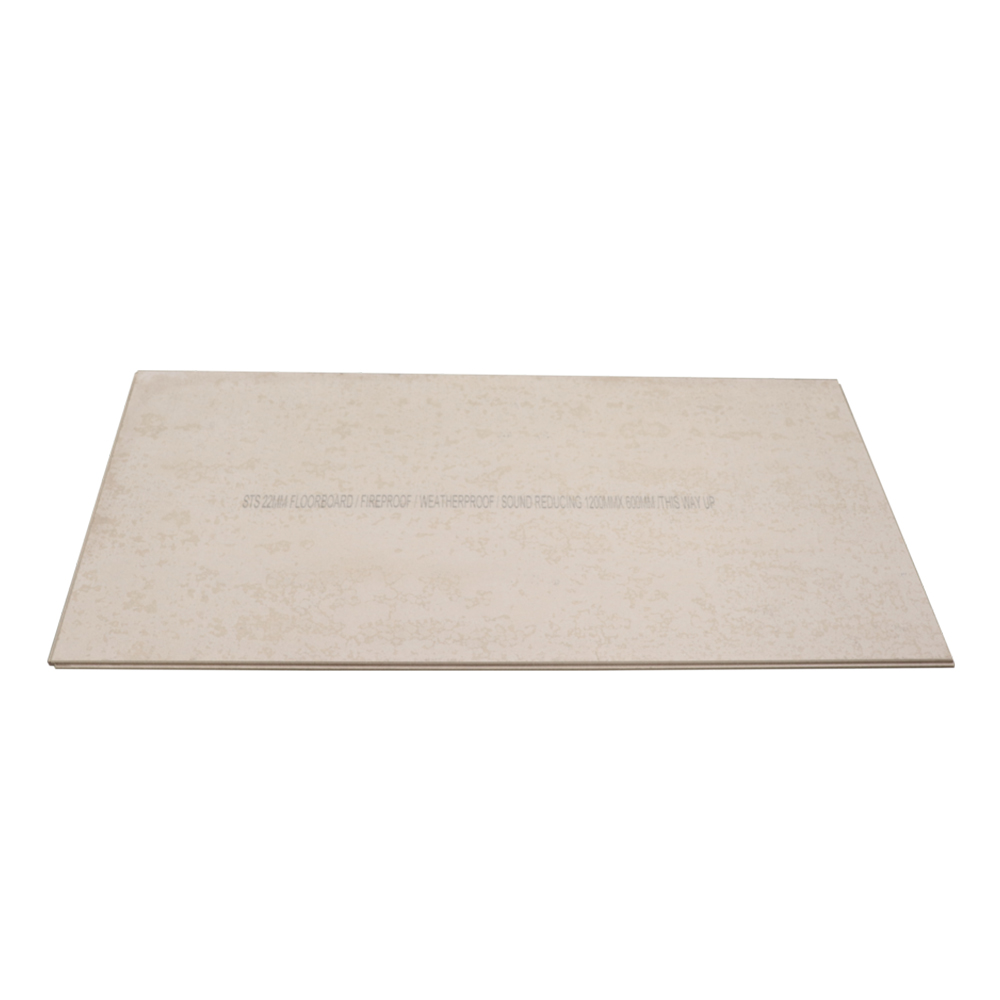
Cement board is available as t&g flooring planks. Over your joists and underneath your floor covering.
If your pipes were screeded in between the joists then these could sit on top, and transfer the heat better than a timber floor covering.
 
Thanks, entering "tongue and groove cement board" located these:


This would be far better for heat transfer and as you mention can replace the original floor boards. This would work with a between joists screed system.
 
I checked with a UFH manufacturer and their between joist screed system would allow for putting these boards on top.

Where would I put the damp course in this configuration?
 
As your existing floor has a vented void, you won't need one.
Underneath the screed, you must of course insulate. If using foil faced board, then you won't need to worry about moisture going in either direction.
My only concern would be if the screed was slightly under the top of the joists. Then goes down your cement board with a small air gap between it and the heated screed, you might not get full transfer of heat, so make sure you tamp the screed flush with the joist. Or bed the boards onto a weak mortar mix in any low spots.

Obviously you'll want to use the thickest insulation you can, but you'll have to investigate what will be the optimal depth of the screed.
 
For the insulation, I can put a batten at the bottom of each joist and slot the board down onto those.

One problem to solve is getting the joists level. Near the doorway into the hall the floor boards are nearly at the level of the finished floor. I'll need to get the floor up fully to investigate.
 
If you want a decent thickness of insulation you may have to get creative and fix it below the bottom of the joist.
 
OP,
For the expense, disturbance, & sheer complicatedness in your proposals - plus the possibilities of future ventilation difficulties - it might be far cheaper, and far less taxing to stick with conventional heating?
 
Yes, it's an ambitious plan. The property is cold and smells damp. Once the floor is up I'll investigate the reasons for that. In any case the floor will require insulating and UFH I hope will give more layout opportunities and a more even heat.
 

If you need to find a tradesperson to get your job done, please try our local search below, or if you are doing it yourself you can find suppliers local to you.

Select the supplier or trade you require, enter your location to begin your search.


Are you a trade or supplier? You can create your listing free at DIYnot Local

 
Back
Top