If for whatever reason, the low voltage output was shorted, would something blow internal , or could it be a fire hazard?

You are using an out of date browser. It may not display this or other websites correctly.
You should upgrade or use an alternative browser.
You should upgrade or use an alternative browser.
General mains adapter query
- Thread starter Coaster
- Start date

- Joined
- 15 Jun 2018
- Messages
- 215
- Reaction score
- 32
- Country

By mains adapter, I assume you mean a typical modern switch mode power supply with DC output e.g a phone or laptop charger. Generally speaking, the output should be able to withstand being shorted without causing damage to the power supply or creating a fire hazard. Not that I'd recommend doing it on purpose of course!
As has been said, if it is the type of device that fluorescence mentioned, it should be designed so that shorting the ELV output would not result in harm to anything. Even if it didn't, something on the ELV side ought to burn/blow up (thereby killing the device) without having any effect on the mains voltage side.It will surely be a fire hazard from the mains voltage perspective.
Of course, with 'Chinese tat', anything is possible!
Kind Regards, John
Reason I ask is
Output voltage matches and amps
Oh right, should it say " switched' on it? Or anything else? Ive uploaded a pic of it. Plugged in undoors and jack is outside for garden pest chaser.As has been said, if it is the type of device that fluorescence mentioned, it should be designed so that shorting the ELV output would not result in harm to anything. Even if it didn't, something on the ELV side ought to burn/blow up (thereby killing the device) without having any effect on the mains voltage side.
Of course, with 'Chinese tat', anything is possible!
Kind Regards, John
Output voltage matches and amps
Attachments
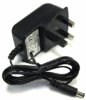
Last edited:
There's not really anything else which it 'has to' have written on it. What you say sounds fine - I don't think you need to have any concerns.Oh right, should it say " switched' on it? Or anything else? Ive uploaded a pic of it. Plugged in undoors and jack is outside for garden pest chaser. Output voltage matches and amps
Kind Regards, John
Thanks for the reply, just asked as i enjoy learning about things as a enthusiastic amateurThere's not really anything else which it 'has to' have written on it. What you say sounds fine - I don't think you need to have any concerns.
Kind Regards, John

Last edited:
D
Deleted member 18243
I used to work making products that had tiny little mains transformers inside. On the transformer primary there would be an extra solder tag, which was the fuse. This tag had a fusible link between it and the live tag proper, and this link would melt harmlessly if overloaded. If this happened it wasn't repairable - the transformer was scrap. In products where the transformer was soldered directly on to a PCB, often the track leading to the primary live pin would have a very narrow section somewhere along its length; this was the fusible link. Eventually, mains voltage was removed from most such products, everything went low voltage and had to have the separate power units now very common. Your modern mains adapters do not get repaired when they fail - I wonder if they contain these kinds of fuses today?
Judging by the autopsies I've conducted, I think they usually do - either an explicit fusible link or, as you also describe, a deliberately narrow track on a PCB which presumably serves the same purpose. ... and this doesn't just apply to 'mains adapters' - one sees it in many places, even mains-voltage LEDs (in which the 'fusible link' is commonly a tiny piece of very thin foil - which, despite its appearance, goes with quite a bang!).... Your modern mains adapters do not get repaired when they fail - I wonder if they contain these kinds of fuses today?
Kind Regards, John
- Joined
- 15 Jun 2018
- Messages
- 215
- Reaction score
- 32
- Country
Switch mode power supplies have some kind of fuse on the input (mains / high voltage side) but AFAIK they don't on the output as they're protected against overload and short circuit electronically.
Could be wrong on that, but I don't recall seeing fuses on the outputs side of the few SMPS's I've looked in before
Could be wrong on that, but I don't recall seeing fuses on the outputs side of the few SMPS's I've looked in before
I don't think you are (wrong) - I'm sure that, at least in general, you're right.Switch mode power supplies have some kind of fuse on the input (mains / high voltage side) but AFAIK they don't on the output as they're protected against overload and short circuit electronically. Could be wrong on that....
There usually has to be electronics to regulate the output (particularly if it's DC), so one might as well use that electronics to provide short-circuit protection to the output. Indeed, most off-the-shelf chips would do both those things.
In fact (and it may be me who is wrong this time) I have a feeling that, even without explicit short-circuit protection, with many designs of SMPSU a short of the ELV output might just shut down the 'oscillator', and therefore remove the problem.
Kind Regards, John

DIYnot Local
Staff member
If you need to find a tradesperson to get your job done, please try our local search below, or if you are doing it yourself you can find suppliers local to you.
Select the supplier or trade you require, enter your location to begin your search.
Please select a service and enter a location to continue...
Are you a trade or supplier? You can create your listing free at DIYnot Local

