• Looking for a smarter way to manage your heating this winter? We’ve been testing the new Aqara Radiator Thermostat W600 to see how quiet, accurate and easy it is to use around the home. Click here read our review.

Green and yellow wires not used as earth and missing earths.

I think it’s pointless debating unicorn devices for the point of proving the regulations wrong.
I'm not trying to 'prove the regulation wrong', not the least, because I don't believe that it is necessarily 'wrong'. Rather, I'm trying to determine whether the regulation applies to what the OP is now talking about ...

I'm not really sure what you mean by a 'unicorn device'. I'm merely referring to what the OP described ...
... I’m talking about 5 core flex running from a combi boiler to a double insulated receiver - still don’t see the logic of supplying a cpc...
Can you provide an example of a 5 pin plug and socket arrangement which does not require an earth connection?
I don't really understand what you are asking, particularly what you mean by "...which does not require an earth connection". If there is 5 pin plug/socket and a 5-core cable going to the device (none of which cores goes is a CPC), with all 5 non-CPC cores required, then I can't see how earth could come into it. If there were a 6th pin, connected to earth at the boiler, there still would not be a conductor in the cable to connect to the 6th terminal. Am I being dim?

Kind Regards, John
 
Just to confirm I’m not the OP, Ericmark is, I took it a little OT.
 
I have re-read @JohnW2 comments, and with a flex we would assume not fixed, and if not fixed I can see when not considered part of an installation, so for example a class II extractor fan to a FCU one would consider that being OK without an earth, but supply to FCU would have one.

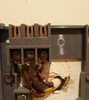
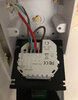
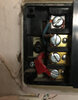
But this temp.jpg may be wired in flex, but where the wires are routed means it is fixed and that brown tape does not really comply with how I read the regulations. The same here temp.jpg @stem referred to it as bad practice, I would say it boarders on being a C2. If we look at the plumbing section it seems to be the norm temp.jpg again and again earth coloured wires being used as line, being over marked. There is normally an expensive way around the problem Nest e for example, or very cheap mechanical thermostats will often work without a neutral, although with a large hysteresis, not even sure a large hysteresis is bad, as the thermostat is often only there to stop the boiler cycling once all rooms satisfied. The TRV controls temperature.

However there seems to be a desire to use geofencing today, not sure why, we are not allowed out, but in the main it is a lack of a neutral, be it a light switch or a thermostat, this temp.jpg thermostat does not need a neutral or an earth, so there is a way to get it working, but so many seem to want the ability to alter heating and lighting from their phone, and I have to admit I can do my heating, lighting, battery charging, AC, tumble drier from phone, not that I want tumble drier on a smart socket, but it is a double socket and other one of pair works outside light.

But a number of issues have risen in resent months, including the EICR and what it covers, and what is considered as potential dangerous. And personally I think using a green/yellow wire for anything other than earth is potential dangerous.
 
I have re-read @JohnW2 comments, and with a flex we would assume not fixed, and if not fixed I can see when not considered part of an installation ...
I don't think you can use the type of cable to define what is, and is not, 'part of the installation'. After all, it would be theoretically possible for nearly all of an installation to be wired with flexible cables, but that would not alter the fact that it was part of the installation.
But a number of issues have risen in resent months, including the EICR and what it covers, and what is considered as potential dangerous.
Very much so - and, of course, all the recent interest has arisen because both of those issues have suddenly gained a lot more (potentially costly) importance (for landlords).
And personally I think using a green/yellow wire for anything other than earth is potential dangerous.
That statement potentially opens up a can of worms. With appropriate over-sleeving, use of a G/Y-insulated conductor of a multi-core cable (necessarily not T+E) is, in itself, compliant with BS7671 - but are you suggesting that, despite that, you would give it a C2 on an EICR?

In practice, of course, the use of G/Y in that way would often/usually result in what was at end of the cable not being supplied with a CPC, so (if that place was regarded as 'a point in the installation') you could cite that as a non-conformity on an EICR, but I think you would probably be fairly hard-pressed to give a C2 to that. After all, an EICR is meant to reflect the 'current condition' of the installation at the time of the inspection, and I really don't see how that could said to be in any way dangerous - the only conceivable issue arising if someone alters the installation (in a non-compliant way) in the future....

... and then, of course, there's the issue we've been discussing recently - if what is at the end of the (necessarily 'flexible') cable is not considered to be part of the installation, then there's no requirement for a CPC to be run to that 'point', anyway.

Kind Regards, John
 
@JohnW2 makes a good point, which has been talked over many times, it is up to the person working on an installation to ensure it is safe, not up to the person before him to wire in a way the next person is unlikely to make errors. With some exceptions.

Borrowed neutral is the one that comes to mind, today with clamp-on meters it is easier to detect, but the neon screwdriver is your friend with borrowed neutrals.

If we accept a borrowed neutral is potentially dangerous, one has to consider if any other hard to detect fault is also in the potentially dangerous category. I seem to remember a spade connector with a boiler causing a problem, the spider earth tag had a load of earth wires on it, the plumber needed to remove the panel so disconnected them all, and after he reconnected them all, and turned on the boiler and used a insulation and low ohm meter to check continuity to earth pin of plug and insulation between earth and all live parts and it passed.

He was called back as the occupant had got a shock, he retested with same results, and then some one was injured, can't remember if a death or just hospital, but now HSE is involved, it seems there was a change over switch, with a green N/C contact, but he had tested with boiler turned on, so it was the N/O contact made when he tested, and he had put the green wire on the earth spider. Plus there was no earth to the socket it was all plugged into.

The tradesman was found guilty as it was said had he not been called back it was an understandable error, but since he had been called back, he should have done more tests.

This was a long time ago, and today the socket tester with loop would have found the missing earth so fast, there would be no excuse. However I felt there was also no excuse for using a green wire with a spade connector on the V3 micro switch.

As you have pointed out, and I have also pointed out, we are looking for potential dangerous not non compliance. So is using a green/yellow wire for a line connection potential dangerous, I would say yes, use it for a neutral and not so cut and dried, but using a green/yellow wire with a over mark which can easy fall off is an accident waiting to happen, so I would have no hesitation in awarding a C2.

However if some one else only awarded a C3 I would not say they were wrong, it is up to the inspector.

I remember working in Algeria with a Turkish/Dutch electrician, born in Turkey but worked and lived in the main in Holland, and he claimed neutral and earth were the same, and would swap between 4 and 5 core cables and use one core for both neutral and earth on the 4 core. He was above me in rank, so I could do nothing. However I can to a point see his reasoning, and to use a green/yellow cable for neutral would not result in any great danger.

However I know what I think, the whole idea was to see what the team thinks, maybe I should have done a pole.
1) Say nothing.
2) Point out not correct.
3) Say it needs rewiring with an extra core.

It is the same with other items, do you point out low voltage is 230 volt? or that an electronic transformer is a switched mode power supply, or MR16 means multifaceted reflector 16/8th inch across, or even L stands for line not live. I know what is and isn't dangerous, I have found out the hard way with a mauled hand to prove it, and I am dead against recycling, after my hand was recycled in a concrete recycling machine.

But it seems from replies people feel using a green/yellow wire for a line supply is not that bad, which is not what I expected.

 
@JohnW2 makes a good point, which has been talked over many times, it is up to the person working on an installation to ensure it is safe, not up to the person before him to wire in a way the next person is unlikely to make errors. With some exceptions.
Yes, I essentially agree. As I keep saying there is clearly a limit to how far one should, or can, go in attempt, by regulations, to 'idiot-proof' and electrical installation in relation to the infinite spectrum of crazy (and non-compliant) things that people might do to the installation in the future.
But it seems from replies people feel using a green/yellow wire for a line supply is not that bad, which is not what I expected.
I don't think it's so much a question of "not so bad", since I imagine most people would say that it's a less-than-desirable practice that should one should generally avoid, but more the fact that using a correctly-oversleeved G/Y in a multicore flexible cable as a line conductor is, per se, fully-compliant with BS7671, which seems to make 'coding' it on an EICR as very questionable.

Kind Regards, John
 
I'd always prefer not to use green/yellow as a current carrying conductor but sometimes it is not possible to avoid it without significant expense or disruption.
There has been lots of reference to using the green/yellow wire means no earth exists at a point but what if there is an earth there. Much of my work has multiple cables coming together at a point I had very little option with this simple example:
upload_2020-3-27_18-43-17-jpeg.186951

I'd spec'd '6x1.5mm²L & 6x1.5mm²N & 10mm² green/yellow' to be provided by the main contractors electricians and left the implementation to them. As the rest of the building [new school] was wired in T&E I fully expected a bunch of T&E's. Somewhere along the line discussions had taken place and various options had been put forward and I then expected a 12C armoured. I ended up with 12C 1.5mm² SY and 6mm² green/yellow, their own electricians had decreed my 10mm² was bigger than needed as this was fed by 6xB6 MCBs.
 
I'd always prefer not to use green/yellow as a current carrying conductor but sometimes it is not possible to avoid it without significant expense or disruption.
Exactly - that's what I wrote very recently.
There has been lots of reference to using the green/yellow wire means no earth exists at a point but what if there is an earth there. Much of my work has multiple cables coming together at a point I had very little option with this simple example:
Ive already indicated that, in that situation there is no issue as far as compliance with BS7671 is concerned.

As I've said, BS7671 does not require that every cable has a CPC - it merely requires that a CPC is run to 'each point and accessory' in an installation. If the point/accessory already has a CPC by virtue of some other cable, then no cable but that one necessarily has to have a CPC, and if one (or more) of those other cables is a multi-core cable which has an appropriately over-sleeved G/Y core being used as a live conductor, then that is also fully compliant.

Kind Regards, John
 
Exactly - that's what I wrote very recently.
Ive already indicated that, in that situation there is no issue as far as compliance with BS7671 is concerned.

As I've said, BS7671 does not require that every cable has a CPC - it merely requires that a CPC is run to 'each point and accessory' in an installation. If the point/accessory already has a CPC by virtue of some other cable, then no cable but that one necessarily has to have a CPC, and if one (or more) of those other cables is a multi-core cable which has an appropriately over-sleeved G/Y core being used as a live conductor, then that is also fully compliant.

Kind Regards, John
That is as I understand the situation, despite some peoples interpretation, but I still don't like doing it.

Someone has asked why I've shown that picture; F6N, top right of blacks, is oversleeved.
 
That is as I understand the situation, despite some peoples interpretation, but I still don't like doing it.
As I've said, I don't like doing it, either, but I have been known to.

I don't really see how anyone (who can read and understand English) can really have an interpretation different from ours, since all the relevant regulations are very clearly worded as far as this issue is concerned.

However, what is far less than clear, and we have been extensively discussing, is what does (and does not) constitute 'part of the installation', hence what is 'a point in the installation' to which a CPC has to be run. In the above, we are assuming that we are talking about is 'a point in the electrical installation' (hence requiring a CPC, from somewhere) but, as has been discussed, I feel that some of the things which have been discussed (e.g. table/standard lamps, or maybe even wireless thermostat receivers) are not sensibly regarded as 'parts of the installation' (which would require CPCs) even if, in a literal/physical sense, they are 'hard-wired' (rather than 'plugged in').

Kind Regards, John
 
A

However, what is far less than clear, and we have been extensively discussing, is what does (and does not) constitute 'part of the installation', hence what is 'a point in the installation' to which a CPC has to be run. In the above, we are assuming that we are talking about is 'a point in the electrical installation' (hence requiring a CPC, from somewhere) but, as has been discussed, I feel that some of the things which have been discussed (e.g. table/standard lamps, or maybe even wireless thermostat receivers) are not sensibly regarded as 'parts of the installation' (which would require CPCs) even if, in a literal/physical sense, they are 'hard-wired' (rather than 'plugged in').

Kind Regards, John
That's another old chestnut, my view is - if it is fixed to the builing OR it's wired in to the remainder of the fixed wireing, ie not plugged in - then it's not portable. Personally I'd like to say that anything connected to a FCU etc should contain an earth wire, but I totally accept it's not the case.
But lets not open that one again.
 
That's another old chestnut, my view is - if it is fixed to the builing OR it's wired in to the remainder of the fixed wireing, ie not plugged in - then it's not portable. Personally I'd like to say that anything connected to a FCU etc should contain an earth wire, but I totally accept it's not the case. But lets not open that one again.
Well, it has been very much 'open' throughout the last page or two of this discussion.

As you will realise from what I've been writing, my view is not always the same as yours (per the above). If something is Class II and "designed to" be supplied with a 2-core cable and is usually (or even just sometimes) connected via a plug/socket (when no-one would suggest that it was 'part of the installation'), then I don't think that much actually changes if/when it is connected to an FCU and/or 'fixed to the building'.

Standard/table lamps and hairdryers etc. have already mentioned, but there are probably countless examples of other potential candidates. Indeed, given your "OR" ('fixed to the building'), I have plenty of things which, although they are 'plugged in' are 'fixed to the building' (like several TVs and monitors) and I'm pretty sure that at least some, perhaps many/most, of those are Class II with 2-core supply leads. Do you really think that all such things should be classed as 'parts of the installation' and hence non-compliant if their leads don't have CPCs?

Kind Regards, John
 
Well, it has been very much 'open' throughout the last page or two of this discussion.

As you will realise from what I've been writing, my view is not always the same as yours (per the above). If something is Class II and "designed to" be supplied with a 2-core cable and is usually (or even just sometimes) connected via a plug/socket (when no-one would suggest that it was 'part of the installation'), then I don't think that much actually changes if/when it is connected to an FCU and/or 'fixed to the building'.

Standard/table lamps and hairdryers etc. have already mentioned, but there are probably countless examples of other potential candidates. Indeed, given your "OR" ('fixed to the building'), I have plenty of things which, although they are 'plugged in' are 'fixed to the building' (like several TVs and monitors) and I'm pretty sure that at least some, perhaps many/most, of those are Class II with 2-core supply leads. Do you really think that all such things should be classed as 'parts of the installation' and hence non-compliant if their leads don't have CPCs?

Kind Regards, John
As I said it's an old chestnut that will never be resolved.
If you excluded your TV which is connected to a FCU on ring final from an EICR would you feel just as comfortable excluding a spur with several outdoor sockets from an EICR which is powered by a FCU immediately adjacent to the TV FCU? Or a row of fluo lights screwed to corridor ceiling because they happen to be plugged into a power socket instead of having their own dedicated lighting circuit?

Don't get me wrong, I do appreciate the difficulty but without a defined line in the regs we don't stand a chance of getting it right.

One of the classic situations is stage lighting circuits, tens or hundreds of 15A sockets all around a stage and auditorium and cabled back to a 'patch panel' where they terminate on 15A plugs - effectively extention leads but using a whole range of wiring techniques: TRS flex, singles in conduit/trunking, pyro, T&E, multicore flex, multicore SWA etc - quite often the earth wiring is earthed to the building earth [and subsequently the flex tail with the 15A plug may only be 2 core] and the whole lot is most definitely fixed into a building.

EDIT: I'll leave this now as gone far too far off topic.
 
Last edited:
As I said it's an old chestnut that will never be resolved. If you excluded your TV which is connected to a FCU on ring final from an EICR would you ....
Yes but, as I said, in view of your "if it is fixed to the building OR..." your argument applies to my TV even if (as is the case) it is not 'connected to a FCU'. That's what I find a little silly - that, if one applies your 'rules', even if plugged in with a BS1363 plug/socket, if it is 'fixed to the building' it is part of the installation and hence, non-compliant with BS7671 if it has a 2-core 'mains cable'. Do you regard that as 'sensible', rather than silly?

Kind Regards, John
 

If you need to find a tradesperson to get your job done, please try our local search below, or if you are doing it yourself you can find suppliers local to you.

Select the supplier or trade you require, enter your location to begin your search.


Are you a trade or supplier? You can create your listing free at DIYnot Local

 
Back
Top