How do they do it?

  • Thread starter Thread starter steviez
  • Start date Start date
S

steviez

Anyone know how YEDL / YEDL Contractors cut and joint live cables without it going bang?

 
Yes!

Oh you want to know.

We all have very carefully worked out techniques to open and expose the insulated cores, stuff like: -
never having more than one piece of live conductor exposed
shrouding earthed metalwork
maintaining the integrity of the earth or neutral/earth
use of approved insulated tools (generally not the ones you can buy at the local wholesalers)
use of insulated gloves & wellies
Specific training

The whole issue of working live is also monitored closely by authorities and carries with it very careful risk assessments.

Overhead teams generally work live at LV and some can work live on specified duties up to 11kV
 
Oh and having very strict procedures that dictate when it needs to be made dead, how we work on it if made dead (treat it as live until proved dead)
and having it within the Safety Rules that if a jointer wants it made dead we do so!
 
Oh and having very strict procedures that dictate when it needs to be made dead, how we work on it if made dead (treat it as live until proved dead)
and having it within the Safety Rules that if a jointer wants it made dead we do so!

Im only asking because they replaced my broken mains cable last night at about 11pm and nobody else was affected.
 
When they connected my supply to the cable in the street they used two insulating clamps around the insulated conductors. In the clamp were two bolts with insulated heads. These bolts when screwed in cut through the insulation and then into the conductor to form a connection without exposing any live metal. The tips of the bolts were shaped to cut a circle out of the insulation and then somehow discard it enable the bolt to have good contact with the conductor.
 
Paradise!

When I passed through jointers' training school at Ilkeston in the early 1960's there were no plastic cables. All PILC. So we were trained to wipe lead joints too. :mrgreen:
 
Not a job for the faint hearted but very interesting! We needed the 11kv cable to our sub moved a few years ago as the building was being extended over where it ran. The DNO came and ran a new cable around the perimeter and they simply spiced the new cable into the old then removed the old one, the power didnt even need to go off and everyone carried on as normal.
 
So we were trained to wipe lead joints too.

I still use a sweated ferrule, I did as a trainee, as a paper weight.
In reality there will be more paper cables on the system than plastic.

The DNO came and ran a new cable around the perimeter and they simply spiced the new cable into the old then removed the old one, the power didnt even need to go off and everyone carried on as normal.

We don't work live on underground 11kV, more than likely the sub has two circuits into it, so supplies could be maintained.
 
In the real world most of the live jointing is done in a muddy wet hole and usually in the rain!!! the modern stuff is mainly plastic and sheer-off connections are used so it does take a lot (not all) of the risk/hazzards away.....as westies says 20 years ago everything was "sweated" or soldered live using a pot of moulton metal and two insulated ladels to pour over a ferrule on the stripped cable that had been brushed with a highly toxic flux paste.....it was quite a skill.. and the HV jointing was another level on top of that... BUT there is still very strict guidlines on live jointing and the use of the insulated tools......In SP we have 3 levels of Jointer Service,HV and 33kv......but only LV is carried out live, that is unless your unlucky enough to open up an HV cable...
 
The DNO came and ran a new cable around the perimeter and they simply spiced the new cable into the old then removed the old one, the power didnt even need to go off and everyone carried on as normal.
That's the advantage of a real ring main. Any section between substations on the ring can be isolated.

In the good old days every sub and HV consumer was connected to the ring main with a ring main unit, which allows for s section of HV to be isolated without anyone losing power. Nowadays I understand that one connection in two is by a tee, so that unfortunate consumers off a tee lose the security advantage of a ring main.
 
In Scot Power most urban areas are on an 11 or 6kv ring which as stoday mentions is a good thing as sections can be isolated with out turning the whole ring off. However A lot of this network has no unit protection, so in the event of a fault on that ring the whole ring is tripped out and hence all consumers loose supply, until the faulty section is isolated, and the power can be restored.....Scot Power also have a system called SOLKOR which is a unit protection that allows interconnection between 11 or 6kv subs..and automatically isolates a faulty section rather than the whole ring....so that in an ideal world all LV consumers should stay on.....However as Stoday also says in todays modern world of cost savings a lot of networks are indeed being "Tee'd" of exisitng cables which is both cheap and easy to install rather than running a ring and isntalling a substaion, and in the event of faults more consumers loose supply...
 
...However as Stoday also says in todays modern world of cost savings a lot of networks are indeed being "Tee'd" of exisitng cables which is both cheap and easy to install rather than running a ring...
It's interesting to hear that householders are not the only ones to resort to less-than-ideal (but 'cheap and easy') approaches when wanting more connections (sockets in their case) to a ring (in their case ring final) circuit!

Kind Regards, John.
 
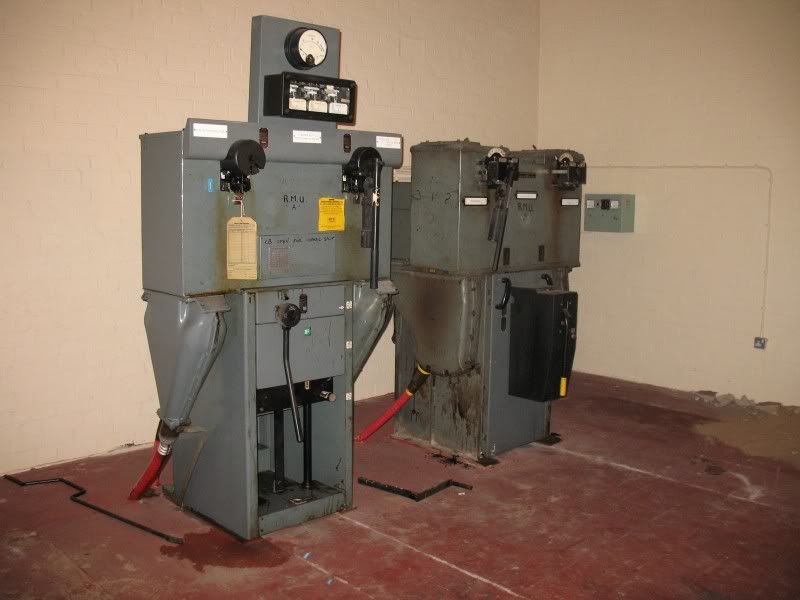
Not live jointing whilst being on the ground, but hopefully of interest to anyone who's not seen them before...


In Scot Power most urban areas are on an 11 or 6kv ring
As a matter of interest, just how much 6.6kV distribution still exists in that area? I remember seeing some statistics for this area (former Eastern Region) some months ago which suggested that 6.6kV now accounts for only a tiny percentage (less than 5%) of all local distribution.
 
the remaining 6KV or even 6.6Kv areas are in Merseyside for the SP DNO area and that has had a lot of uprating work carried out....I am not aware of any going on at the moment, however, the priorty seems to be to get a certain type of 50 year old RMU's off the system due to them having a switching ban due to failures.....the one on the right is the major culprit...
1q.jpg
 

If you need to find a tradesperson to get your job done, please try our local search below, or if you are doing it yourself you can find suppliers local to you.

Select the supplier or trade you require, enter your location to begin your search.


Are you a trade or supplier? You can create your listing free at DIYnot Local

 
Back
Top