
• Looking for a smarter way to manage your heating this winter? We’ve been testing the new Aqara Radiator Thermostat W600 to see how quiet, accurate and easy it is to use around the home. Click here read our review.

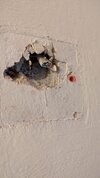
How to safely fill this whole in the wall?

Joined
29 Sep 2025
Messages
2
Reaction score
0
Country
United Kingdom
I’ve removed an old battery-powered thermostat from the wall, but the previous owner left a large unfilled hole and an exposed power cable sticking out. Could this be a fire hazard? Also, what’s the best way to safely seal the hole and deal with the cable?
 

Attachments

  • WhatsApp Image 2025-09-25 at 02.56.55.jpeg
    WhatsApp Image 2025-09-25 at 02.56.55.jpeg
    108.9 KB · Views: 72
Also, to add. I live in a flat, so I have no idea where this cable leads..
 
If the cable was for a mains powered thermostat removed before the battery one was installed then the other end could be near the CH boiler.
I doubt it will be a fire hazard but would use a meter check for a voltage across the cores then insulate the end of the cable then just plaster it into the wall. Or fit your new thermostat over it
 
Make sure it isn't live and try to pull out as much of it as you can & do what JJ said, I'd cut it at an angle so there's no chance the conductors can touch one another.
 
Identify the circuit and turn off at CU. Terminate in wagos or connector block and wrap in tape. Plaster over
 
Identify the circuit and turn off at CU. Terminate in wagos or connector block and wrap in tape. Plaster over
That's no good.


You must find the other end of the cable and disconnect it.

Then at each end of the cable all three conductors should be joined together in one connector.
This will show anyone coming across it in the future that it is not being used.

Then fill the hole.


If you cannot do that then the cable must be left visible.
 
I have no idea where this cable leads..

It probably leads to near the boiler, or maybe if you have a hot water cylinder with some valves in a cupboard it could emerge there. Take some time to look carefully and try to find the other end. Maybe post pictures of the boiler area so we can make suggestions.

If you’re in a block with many similar flats, it might be helpful to check with your neighbours.

It really would be much better to find both ends, rather than trying to deal with just one.
 
Also, to add. I live in a flat, so I have no idea where this cable leads..
Do you have a boiler or heating pump for radiators?
Does anything click when you change the set point above and below the current temperature?
Is it all electric?
 
A neat way of dealing with the situation from an electrical point of view would be fitting a back box with a blank cover and any type of mains-rated connector to each individual wire inside that box.
 
A neat way of dealing with the situation from an electrical point of view would be fitting a back box with a blank cover and any type of mains-rated connector to each individual wire inside that box.

The red, yellow, and blue wires in the cable will likely be the only disused cable, with those colours in it, and it will be easy to find, either at your boiler, or more likely in your airing cupboard, where your hot water cylinder is/was - but left coiled up. If so, just add a 4 terminal choc (including the earth wire) block on the end, in the wall, after isolating the power, then fix a white, plastic blacking plate over the top, to hide the hole.

Also add a four terminal choc block, in the airing cupboard.
 
Last edited:
Identify the circuit and turn off at CU. Terminate in wagos or connector block and wrap in tape. Plaster over
Nooo..

It would be better if all four wires were put in one terminal block at both ends.
(And connected to earth)

A neat way of dealing with the situation from an electrical point of view would be fitting a back box with a blank cover and any type of mains-rated connector to each individual wire inside that box.
Good approach, and provides a decent mounting point for any future thermostat
 
I prefer making each conductor safe individually over shorting and earthing them in case someone might want to use a tone tracer to find that cable in the future.
 
I prefer making each conductor safe individually over shorting and earthing them in case someone might want to use a tone tracer to find that cable in the future.
Is that an issue then?
 

If you need to find a tradesperson to get your job done, please try our local search below, or if you are doing it yourself you can find suppliers local to you.

Select the supplier or trade you require, enter your location to begin your search.


Are you a trade or supplier? You can create your listing free at DIYnot Local

 
Back
Top