Long story first....
I've just removed some failed cement render, along with a base coat, and rusty old mesh from the side of my house.
It was a bodge job when applied 25 years ago and probably failed 20 odd years ago, when a chunk fell off.
I think it's been causing damp problems ever since.
Now it's gone though, it's revealed a thin grey render, that was probably applied when the house was new, in the late 40s.
It's hard, and brittle, and I suspect it's cement.
However, the house was built during post war shortages, and the mortar in the garage brickwork seems to have very little cement in it.
(When I raked out the garage mortar it had turned back into sand.)
That makes me think the builders would have minimised the use of cement in the render.
I'd like it to be lime render, as I think it would be easier to remove, and also that it would allow the house to breathe again.
(I have a mold allergy, and my breathing seems to have got better)
Here's the question...
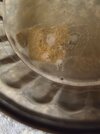
I've just soaked a fragment of it in white vinegar, and it's fizzed a wee bit, but not exactly like an alka-seltzer.
It's too dark to photograph the wall now, but I've attached a pic of the render in white vinegar.
Does it look like it's fizzing enough to be lime?
(Also, it soon softened up after being soaked in vinegar)
I've just removed some failed cement render, along with a base coat, and rusty old mesh from the side of my house.
It was a bodge job when applied 25 years ago and probably failed 20 odd years ago, when a chunk fell off.
I think it's been causing damp problems ever since.
Now it's gone though, it's revealed a thin grey render, that was probably applied when the house was new, in the late 40s.
It's hard, and brittle, and I suspect it's cement.
However, the house was built during post war shortages, and the mortar in the garage brickwork seems to have very little cement in it.
(When I raked out the garage mortar it had turned back into sand.)
That makes me think the builders would have minimised the use of cement in the render.
I'd like it to be lime render, as I think it would be easier to remove, and also that it would allow the house to breathe again.
(I have a mold allergy, and my breathing seems to have got better)
Here's the question...
I've just soaked a fragment of it in white vinegar, and it's fizzed a wee bit, but not exactly like an alka-seltzer.
It's too dark to photograph the wall now, but I've attached a pic of the render in white vinegar.
Does it look like it's fizzing enough to be lime?
(Also, it soon softened up after being soaked in vinegar)