


Hi All
I am in the process of buying a small 3.3Kwh generator to act as a backup power supply for the house. Although I could run extension leads into the house ideally I would like to be able to plug the generator into the house mains wiring so the central heating and lights work as normal. I live in central London and power outages lasting more than a few minutes are extremely rare so hopefully this is not something I am going to need. Working in IT I am, however, concerned that for the next few years we are at risk of the energy companies being AI hacked and having outages that might last for a few days, hence the purchase now!!
I am assuming that I can get away with a 125 Amp 240V Generator Changeover Transfer Switch and a suitable socket in the basement where the meters are (see photo). My system already has an isolation switch from when the smart meters were installed so I assume it would be a quickish job for an electrician to fit the transfer switch. What sort of socket socket should I specify for the generator? My generator has a 13A socket as a power out and my plan is to run a heavy duty extension cable from the shed into the house connecting to a short cable coming from the transfer switch. Some of the YouTube videos I have seen show a standard 13A plug at the end of a cable coming out of the transfer box, this instinctively feels wrong but then that cable is receiving not delivering powers so maybe it is OK. Any thoughts?
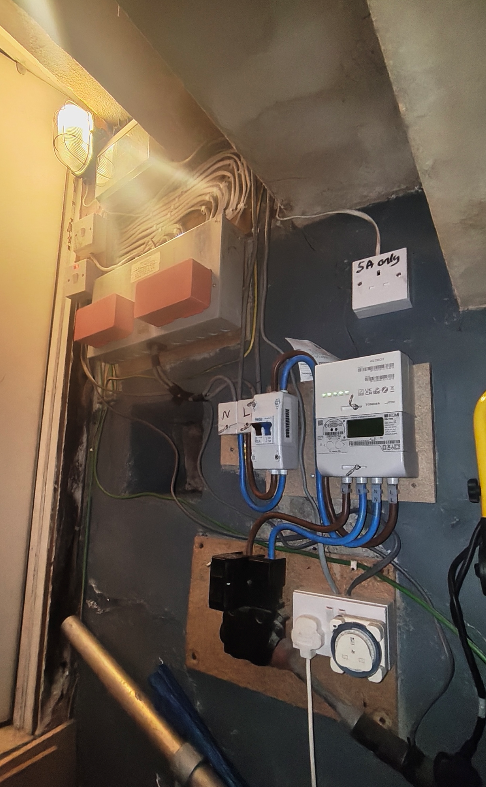
The house typically runs at about 400w - 600w during the winter (providing I don't use the kettle, dishwasher etc.) so the generator should be more than up to powering essentials. We have gas central heating and a gas hob and I could use the air frier if I were careful with what else is running at the same time.
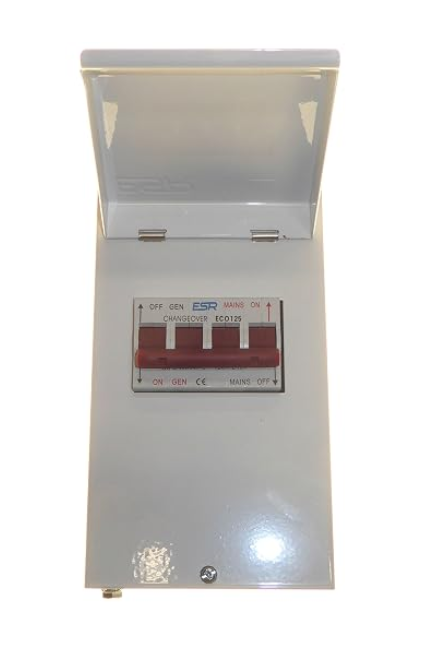
This is the sort of transfer box I am thinking of (125A) and are about £45 on Amazon.
I want to keep the system as simple and basic as possible, whilst still being compliant and safe to use.
Any advice or suggestions gratefully received and an idea of which I should be budgeting in terms of installation cost.
Thanks
Jasper
I am in the process of buying a small 3.3Kwh generator to act as a backup power supply for the house. Although I could run extension leads into the house ideally I would like to be able to plug the generator into the house mains wiring so the central heating and lights work as normal. I live in central London and power outages lasting more than a few minutes are extremely rare so hopefully this is not something I am going to need. Working in IT I am, however, concerned that for the next few years we are at risk of the energy companies being AI hacked and having outages that might last for a few days, hence the purchase now!!
I am assuming that I can get away with a 125 Amp 240V Generator Changeover Transfer Switch and a suitable socket in the basement where the meters are (see photo). My system already has an isolation switch from when the smart meters were installed so I assume it would be a quickish job for an electrician to fit the transfer switch. What sort of socket socket should I specify for the generator? My generator has a 13A socket as a power out and my plan is to run a heavy duty extension cable from the shed into the house connecting to a short cable coming from the transfer switch. Some of the YouTube videos I have seen show a standard 13A plug at the end of a cable coming out of the transfer box, this instinctively feels wrong but then that cable is receiving not delivering powers so maybe it is OK. Any thoughts?
The house typically runs at about 400w - 600w during the winter (providing I don't use the kettle, dishwasher etc.) so the generator should be more than up to powering essentials. We have gas central heating and a gas hob and I could use the air frier if I were careful with what else is running at the same time.
This is the sort of transfer box I am thinking of (125A) and are about £45 on Amazon.
I want to keep the system as simple and basic as possible, whilst still being compliant and safe to use.
Any advice or suggestions gratefully received and an idea of which I should be budgeting in terms of installation cost.
Thanks
Jasper