My neighbour's kitchen extension (flat roof) has a leak and there is visible cracking and water staining on the ceiling. One of the water stains is very close to a light fitting but so far the lights still work. The kitchen lights are on a breaker labelled 'lights downstairs' - it's a dual RCD board, so if that trips half the house will go off. He's asked me to ask you guys if it's prudent to switch off that particular breaker (he can manage with plug-in lights downstairs for a few days) or should he leave it and see what happens? The main issue is that the house alarm is on the same side of the CU as these lights, and it's a pain to re-set if it loses power. Is there any effective way of isolating this particular circuit without opening up the CU, which I realise is a no-no for non-electricians. Roofer is coming this week to have a look, by the way.

You are using an out of date browser. It may not display this or other websites correctly.
You should upgrade or use an alternative browser.
You should upgrade or use an alternative browser.
Isolate lighting circuit after leak?
- Thread starter Vicario
- Start date

switching off the breaker wont stop the RCD from tripping if water gets into the circuit
depends on whats in the roof and what the water can short out - if its Just a cable direct to the light itself , then maybe disconnecting the light and isolating the cables - so the water cannot short anything out - if there is a junction box in the roof itself and water can get in and short out then switching the mcb wont stop the earth leakage
shorting earth to neutral for example - its not just the load

That's the answer, its a 2 minute job.
If it’s looped at the switch it might be easier as it would allow the remainder of the circuit to stay live
What type of light fitting is it?
What type of light fitting is it?
maybe some photos would help of switch and light fitting

- Joined
- 27 Jan 2008
- Messages
- 29,704
- Reaction score
- 3,677
- Location
- Llanfair Caereinion, Nr Welshpool
- Country

The ceiling rose often works with a loop in and out
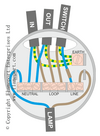 This often means you can disconnect the ceiling rose in question at the ceiling rose before it. Unlike sockets, the lights are not normally wired as a ring, so what can or can't be disconnected depends how the lights are wired, and if the kitchen is at start or end of the radial circuit.
As to if a DIY job, well there is no single qualification that makes anyone an electrician, it is down to you to if you feel you know what you are doing, but since you have asked the question, I would say you should not be doing the work, but to know easy enough to do, may mean prudent to get some one in to disconnect it.
Once electric arcs, it forms a carbon track, so it is better done before it all goes wrong. But not done at the light which may get wet, but the light before that.
This often means you can disconnect the ceiling rose in question at the ceiling rose before it. Unlike sockets, the lights are not normally wired as a ring, so what can or can't be disconnected depends how the lights are wired, and if the kitchen is at start or end of the radial circuit.As to if a DIY job, well there is no single qualification that makes anyone an electrician, it is down to you to if you feel you know what you are doing, but since you have asked the question, I would say you should not be doing the work, but to know easy enough to do, may mean prudent to get some one in to disconnect it.
Once electric arcs, it forms a carbon track, so it is better done before it all goes wrong. But not done at the light which may get wet, but the light before that.
All very useful stuff, so thanks everyone. I'll post here when I know the outcome. A question from me now....I have very much the same setup and was wondering if it's a big (=expensive) job to change a dual RCD board to RCBOs on every circuit to avoid this kind of worry.
All very useful stuff, so thanks everyone. I'll post here when I know the outcome. A question from me now....I have very much the same setup and was wondering if it's a big (=expensive) job to change a dual RCD board to RCBOs on every circuit to avoid this kind of worry.
Depends on the current board (photo please)
That looks like a metal CU - it’s a shame the installer didn’t fit the RCBO version

It's not so much buying rcbos to fit but getting the appropriate link leads/ bus bar etc to connect to the existing main switch
- Joined
- 27 Jan 2008
- Messages
- 29,704
- Reaction score
- 3,677
- Location
- Llanfair Caereinion, Nr Welshpool
- Country
The RCDs takes up 4 slots, and modern RCBOs are not much taller to a MCB, so theory not much of a problem, but as said it is the kit of small parts which is the stumbling block, new bus bar ect, and I have no idea how easy to get, as never tried, I went all RCBO when I got rid of my fusebox.
However, it has raised an idea, which I had not considered, modern bi-directional type A RCBOs are often double pole switching, so swapping the lighting MCB for a RCBO would mean turning it off, isolates, where a MCB does not, so it would stop any neutral earth faults, the fact it is a RCD and well as MCB would be no benefit, it would still trip the main RCD.
The other option is to swap one RCD for an isolator and replace all the MCBs it feeds with RCBOs.
However, I have not got the current edition of BS 7671, so don't know if that is permitted, and it would need someone skilled to do the work, it is not really a DIY job.
So the question is not can I get around the problem, as to if the options are worth while?
My old house had two RCDs feeding two old Wylex fuse boxes, but the reason was more down to what I had spare in my tool box, rather than this was the way it should be done. Had I needed to go out and buy the parts, that option would not have been the route taken.

DIYnot Local
Staff member
If you need to find a tradesperson to get your job done, please try our local search below, or if you are doing it yourself you can find suppliers local to you.
Select the supplier or trade you require, enter your location to begin your search.
Please select a service and enter a location to continue...
Are you a trade or supplier? You can create your listing free at DIYnot Local
Similar threads
- Replies
- 2
- Views
- 284

- Replies
- 7
- Views
- 3K
