• Looking for a smarter way to manage your heating this winter? We’ve been testing the new Aqara Radiator Thermostat W600 to see how quiet, accurate and easy it is to use around the home. Click here read our review.

Light switches wired wrongly

Concentrate on something distant, such as the clock or light switch, then without breaking that concentration pass a single finger across your vision, it may work better if you try it say 6-12" in front of your face.
That's rather different from what I was talking about but, in any event, it doesn't work for me. In fact, if I am concentrating on the distant object, I can't really tell if there are one or two fingers at 6-12" with re-focussing onto them (in which case I obviously see just one).

Having said that, it wouldn't surprise me if what you said happened, since stereoscopic vision only works with the whatever one in concentrating/focussed on - the brain then combines the two slightly different images from the two eyes to produce a single'3D' one. Something much closer will be out of focus, so the two different images will not get combined properly, so one might well see 'two fingers' if they are much closer than whatever one is focussed on. However, as said, that does not work for me.

In any event, this is not what II described as the way of determining eye dominance. It is a totally standard test and, as I said, one holds a finger at arm's length, in line with some distant object, and then closes each eye in turn. It was in response to that that morqthan a said that he saw two fingers or two distant objects, and I still don't understand that.
 
Im playing with this now and I'm shocked it's not blatantly obvious to you, physics make it impossible to not be there.
As I've just written, it's not 'blatently obvious' to me because it doesn't happen for me, regardless of whatever you say about physics. We're not arguing about theory, I'm merely describing how my vision actually behaves!
 
I've tried to simulate what I see.
I set up a pencil 450mm from the PC screen and took 2 photos at 600mm approximately 30mm apart and roughly took the same image of the screen lining up the 2 orange arrows:
1749598851202.png

When I look at it this is what I see
1749599046747.png

I'm merely describing how my vision actually behaves!
I get that but I'm really struggling to work out how you don't see the same thing, assuming of course you have reasonally effective eyesight in both eyes.
In any event, this is not what II described as the way of determining eye dominance. It is a totally standard test and, as I said, one holds a finger at arm's length, in line with some distant object, and then closes each eye in turn. It was in response to that that morqthan a said that he saw two fingers or two distant objects, and I still don't understand that.
I also read your suggested test and like Morgthan all I saw was 2 objects and fail to understand what your test is supposed to achieve
 
I've tried to simulate what I see.
I set up a pencil 450mm from the PC screen and took 2 photos at 600mm approximately 30mm apart <2 images>
These two images are what one would expect of those first two photos, essentially showing 'parallax' (i.e. the pencil in different positions relative to screen background)
.and roughly took the same image of the screen lining up the 2 orange arrows: When I look at it this is what I see <image>
I don't really understand this or what it is meant to illustrate - could you perhaps explain a little more. It looks like a simple superimposition of your first two photos.
I get that but I'm really struggling to work out how you don't see the same thing, assuming of course you have reasonally effective eyesight in both eyes.
I'm still not really clear as to what you are seeing. What you've been saying would seem to imply that everything in your field of vision that you're not focussed on is seen 'double' - which obviously can't be the case and would make no sense. My eyesight is fine in both eyes, and very similar in the two eyes.
I also read your suggested test and like Morgthan all I saw was 2 objects and fail to understand what your test is supposed to achieve
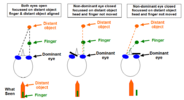
It's not 'my test'. It's the standard test of eye dominance that I was first taught over 50 years ago and which remains one of the standard tests today. As for 'what it is supposed to achieve', I thought I had adequately explained and illustrated that way back in post #24 on page 2. However, maybe the more detailed diagram below will help you to understand...

As I explained, when, with both eyes open one concentrates/focusses on an object, one's dominant eye looks directly towards it ('perpendicular' to one's face), whilst the non-dominant one rotates towards the dominant one in order to also look at that object. Hence, if one concentrates/focusses on a distant object and aligns a finger (held at arm's length) with that distant object, the situation is per the left-hand bit of diagram below, and one hence obviously sees the finger and distant object to be aligned (since that iis how one has positioned one's finger!).

If, without moving one's head or finger, one closes one's non-dominant eye, nothing actually changes. The dominant eye is still looking directly forwards at both the finger and distant object, which are therefore still seen as aligned - as in middle bit of diagram.

However, if (again without moving head or finger) one closes one's dominant eye, then the non-dominant one, looking a little 'sideways' towards the dominant side, sees finger and distant objects at different angles, hence being seen as laterally separated, not 'aligned'.

.
1749644046884.png
 

Attachments

  • 1749606277731.png
    1749606277731.png
    24 KB · Views: 54
Last edited:
I also read your suggested test and like Morgthan all I saw was 2 objects and fail to understand what your test is supposed to achieve
Having just read the (more explicit) comments I wrote in the diagram I've just created and posted, I wonder if I was perhaps less clear than I should have been in explaining 'the test' ... what one needs to do (with both eyes open) is to focus on the distant object (clock or whatever) and then interpose one's finger, at arm's length, so that it aligns with that distant object.

Things might go wrong if one doesn't focus on the distant object and, in particular, one certainly should not focus on the finger (which is one of the things that morqthana mentioned).
 
Yes - when I have both eyes open, before I do the alternating closing.
Thanks for confirming - but, as I've said to Sunray, I can't reproduce that in myself - and that's just an empirical fact, not any sort of theoretical argument :)

However, I'm still rather confused by what you and he are saying. There''s obviously nothing special about the finger and clock (or whatever) that we've been talking about but, although it's what you both seem to be implying, I'm sure it's not the case for either of you that if you focus on a nearby object, all distant objects appear 'double', or vice versa, so I suspect I still don't really understand what either of you is telling me!

Whatever, what do you experience if, with both eyes open, you focus on something 'distant', interpose a finger at arm's length so that it aligns with that distant object and then alternately close your eyes?
 
Hmm. When I try that, if I focus on the distant object I see two fingers, and if I focus on the finger I see two distant objects.
Yes - when I have both eyes open, before I do the alternating closing.
However, I'm still rather confused by what you and he are saying. There''s obviously nothing special about the finger and clock (or whatever) that we've been talking about but, although it's what you both seem to be implying, I'm sure it's not the case for either of you that if you focus on a nearby object, all distant objects appear 'double', or vice versa, so I suspect I still don't really understand what either of you is telling me!
@morqthana .... having thunk a bit more, I'm still confused about what you (and quite possibly also Sunray) are experiencing...

"before you do the alternating closing", all you will be doing is looking at a semi-distant object (like a clock) with a finger interposed between your eye and that object - and, generalising, the clock and finger could obviously be 'anything'.

Are you really saying that if you focus on one of those two things you see two of the other thing??

The 'other thing' will obviously be out-of-focus but, at least for me, it certainly isn't 'duplicated'.
 
These two images are what one would expect of those first two photos, essentially showing 'parallax' (i.e. the pencil in different positions relative to screen background)
Yes my whole point
I don't really understand this or what it is meant to illustrate - could you perhaps explain a little more. It looks like a simple superimposition of your first two photos.
I'm unable to mix photos but essentially if I were to look at the screen without the pencil I'd see the text with both eyes, adding the pencil obscured the left of my view for the right eye and the right of the view for the left eye, what I haven't been able to show is the text superimposed on the pencil
I'm still not really clear as to what you are seeing. What you've been saying would seem to imply that everything in your field of vision that you're not focussed on is seen 'double' - which obviously can't be the case and would make no sense. My eyesight is fine in both eyes, and very similar in the two eyes.
Anything that is not at the same distance as the focussed image will automatically be double as the brain is unable to tell the difference between the 2 pencils it sees
It's not 'my test'. It's the standard test of eye dominance that I was first taught over 50 years ago and which remains one of the standard tests today. As for 'what it is supposed to achieve', I thought I had adequately explained and illustrated that way back in post #24 on page 2.
Quite frankly no as I'm unable to see what you seem to describe, IE if I hold up a finger it will be in front of the object but the other finger will appear in front of something else
However, maybe the more detailed diagram below will help you to understand...

As I explained, when, with both eyes open one concentrates/focusses on an object, one's dominant eye looks directly towards it ('perpendicular' to one's face), whilst the non-dominant one rotates towards the dominant one in order to also look at that object. Hence, if one concentrates/focusses on a distant object and aligns a finger (held at arm's length) with that distant object, the situation is per the left-hand bit of diagram below, and one hence obviously sees the finger and distant object to be aligned (since that iis how one has positioned one's finger!).

If, without moving one's head or finger, one closes one's non-dominant eye, nothing actually changes. The dominant eye is still looking directly forwards at both the finger and distant object, which are therefore still seen as aligned - as in middle bit of diagram.

However, if (again without moving head or finger) one closes one's dominant eye, then the non-dominant one, looking a little 'sideways' towards the dominant side, sees finger and distant objects at different angles, hence being seen as laterally separated, not 'aligned'.

.View attachment 383941
Okay I'll humour you, I look at the pot of cooking utensils 18ft away then hold up a finger at arms length and position it without refocussing from the utensil pot... result:
1749641780802.png


Which of the 2 fingers I see should I position in front of the pot?

To put it another way: with one eye I see this
1749644810515.jpeg


with the other I see this
1749644843490.jpeg


and both together I see this albeit the text will appear across the 2 pencils
1749644963812.png
 
@morqthana .... having thunk a bit more, I'm still confused about what you (and quite possibly also Sunray) are experiencing...

"before you do the alternating closing", all you will be doing is looking at a semi-distant object (like a clock) with a finger
2 fingers, one
interposed between your eye and that object
and the other interposed between the eye and something adjacent to the object
- and, generalising, the clock and finger could obviously be 'anything'.

Are you really saying that if you focus on one of those two things you see two of the other thing??
Yes that is EXACTLY what we see
The 'other thing' will obviously be out-of-focus
Yes of course, as shows in my pics of the PC and pencil
but, at least for me, it certainly isn't 'duplicated'.
And I for one don't/can't understand why not
 
Do you wear glasses, John?
Only for very close stuff (less than about 500mm) - reading books/papers, writing, phone & tablet - even a laptop screen is usually far enough away for me not to need glasses.

Everything I've said/reported relates to the situation without glasses.
 

If you need to find a tradesperson to get your job done, please try our local search below, or if you are doing it yourself you can find suppliers local to you.

Select the supplier or trade you require, enter your location to begin your search.


Are you a trade or supplier? You can create your listing free at DIYnot Local

 
Back
Top