
Lighting fault

Joined
13 Jul 2010
Messages
60
Reaction score
0
Location
West Midlands
Country
United Kingdom
Hi,

I've got an issue with a light not working and was hoping for some advice:

Basically, I removed a bodged arrangement that was done to put the lights for two rooms onto one switch, putting them back to one switch each.

When I put the power back on all was ok, but when I switched on one of the lights it blew the fuse, and there was a spark from the switch. I replaced the switch, and the circuit is working fine, but one light is not.

I was thinking the likely issue is a problem with the light fitting itself, so was going to swap this next.

Any thoughts?

Thanks
 
did you change anything in the switch when you replaced the blown one?

Or did you wire it back up exactly as it was when you took it off?

Are you sure you haven't confused a switched live for a neutral and this is what caused the spark?

Does the circuit not trip when you use this new switch?
 
Don't just swop things to see if it works - it could cost a lot of money! First we need more information. How many light fittings are there? When you say one light is not working, do you mean that the one and only light in a room is not working but the light in the other room is working? Have you tried changing the lamps for ones which are known to be satisfactory?
If the lamp change works, then OK, but if not you need to test the whole circuit. How exactly did you separate the switches and wiring at the lamp. How did you identify the switched live and neutrals at the roses?
 
did you change anything in the switch when you replaced the blown one?

Or did you wire it back up exactly as it was when you took it off?

Are you sure you haven't confused a switched live for a neutral and this is what caused the spark?

Does the circuit not trip when you use this new switch?

The switch on it now is wired the same as the one that blew. It was an old switch I was re-using that blew.

After it had blown I checked the connections and all seemed secure.

I'm confident live/switched live are correct - I've tested for permanent live with the switch off.

No the circuit does not trip - the switch just does nothing!
 
Don't just swop things to see if it works - it could cost a lot of money! First we need more information. How many light fittings are there? When you say one light is not working, do you mean that the one and only light in a room is not working but the light in the other room is working? Have you tried changing the lamps for ones which are known to be satisfactory?
If the lamp change works, then OK, but if not you need to test the whole circuit. How exactly did you separate the switches and wiring at the lamp. How did you identify the switched live and neutrals at the roses?

Fair point about costing a lot of money - I had intended to swap the light at some point anyway so not too fussed about that.

I meant there is one light fitting in each room, and it is only this rooms fitting that doesn't work. The fitting holds three bulbs - I've tried a known working bulb in each to no avail.

The previous installation was (I assume) done when the lounge / dining room were knocked through. The switches for each were on opposite sides of the same wall, and someone had used a chock blok to extend l/sl/e from the diner side to lounge side, and used a double switch the lounge side. I just removed the extended bit, and wired in a single switch on each side.

I hope this makes sense?
 
have you got two cores at each switch location now then?

How many were at each location before?
 
have you got two cores at each switch location now then?

How many were at each location before?

2 cores + earth at each location now.

Previously you could see 1 twin and earth down each side of the wall, with both cores + earth of one extended through to the other side so there were 4 cores + 2 earths terminated on the double switch.
 
Sorry struggling to get my head round this somewhat,

So previously at the 2 way switch there were 2 cores in each way of the switch? and were the cables extended in a connector block or were they in a switch?

Don't suppose you took any before photos did you?
 
Sorry struggling to get my head round this somewhat,

So previously at the 2 way switch there were 2 cores in each way of the switch? and were the cables extended in a connector block or were they in a switch?

Don't suppose you took any before photos did you?


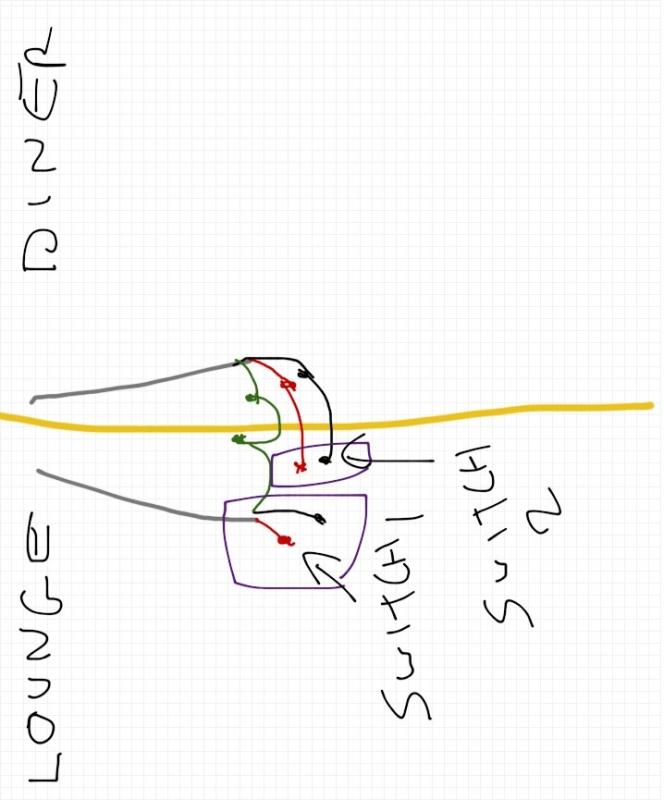
No afraid I didn't take any pictures... This drawing might help (apologies it's so bad - best I could do on paint....)
 
ok Im assuming that that black in Switch 2 is supposed to go to the cable and not join onto the CPC? :shock:
 
A bit of confusion. Before you started work, were there two working switches? Were these two-way switches - i.e. if you turned either one on both lights would switch on or off? Your description sounds as though this could have been the case with the added cable being a strapper. If this was the case then the wiring to the light fitting would have been changed.
Your drawing shows a simple connection between the switched lives which would work, but to turn the lights off both switches would have to be off. Was this the way it worked?
 
A bit of confusion. Before you started work, were there two working switches? Were these two-way switches - i.e. if you turned either one on both lights would switch on or off? Your description sounds as though this could have been the case with the added cable being a strapper. If this was the case then the wiring to the light fitting would have been changed.
Your drawing shows a simple connection between the switched lives which would work, but to turn the lights off both switches would have to be off. Was this the way it worked?

No - the lights were wired to a double switch. Each of the switches controlled one rooms light. There was no other link between them, other than being on the same faceplate.

There was no switch in the dining room.
 
Right. So, if the circuit is loop-in (where power goes to a rose then to the switch and via rose to lamp) the original power came down to switch two and the connection provided power to switch one. By taking away the link there is no power to switch one. However, just linking the terminals in the double switch which wouldn't make sense anyway as, according to your description, there was a live and switched live to both switches.

This would not explain the short with a flash at the switch and tripped MCB.
If the power was not to the rose, but to the switch and then lamp you would have neutrals and earths joined in the box - not connected to the switch. In this case, if you connected black and red to the terminals on the switch you would not be connecting live and switched live, but live and neutral. This would give a bang!
I suspect that this is what has happened.
Sorry, but you need to do a bit of tracing. Have you a multimeter?
 
Right. So, if the circuit is loop-in (where power goes to a rose then to the switch and via rose to lamp) the original power came down to switch two and the connection provided power to switch one. By taking away the link there is no power to switch one. However, just linking the terminals in the double switch which wouldn't make sense anyway as, according to your description, there was a live and switched live to both switches.

This would not explain the short with a flash at the switch and tripped MCB.
If the power was not to the rose, but to the switch and then lamp you would have neutrals and earths joined in the box - not connected to the switch. In this case, if you connected black and red to the terminals on the switch you would not be connecting live and switched live, but live and neutral. This would give a bang!
I suspect that this is what has happened.
Sorry, but you need to do a bit of tracing. Have you a multimeter?

Yes I have a multimeter - what should I be testing?
 

If you need to find a tradesperson to get your job done, please try our local search below, or if you are doing it yourself you can find suppliers local to you.

Select the supplier or trade you require, enter your location to begin your search.


Are you a trade or supplier? You can create your listing free at DIYnot Local

 
Back
Top