Mastic to walk on?

Joined
1 Oct 2012
Messages
95
Reaction score
4
Location
Edinburgh
Country
United Kingdom
Hi

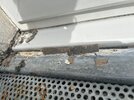
I’m looking to fill a gap at floor level in a balcony and wondered what might work best. See pics - it’s poorly designed with door sill ending short of lead covering leading to galvanised balcony, leaving a 15mm channel that will occasionally be walked upon.

Previously some oil based mortar seems to have been used. Should I go for same?

Cheers

 

Attachments

  • IMG_6209.jpeg
    IMG_6209.jpeg
    941.6 KB · Views: 27
  • IMG_6210.jpeg
    IMG_6210.jpeg
    892.8 KB · Views: 27
Not my area of expertise but the fact that someone used a screw to hold down the lead looks a bit worrying.

Someone like @crank39 might be worth deferring to.
 
You don't normally walk on door thresholds or cills, but walk over them. Or should.
No mastic is designed to withstand foot traffic

Anyway, your problem there is that the lead is not dressed properly and is creating a dip and a back-fall which is actively holding and directing water under the cill.

You need to dress the lead flat, and if possible with a fall away from the cill. Then use a quality polymer or polysulfide mastic. Not cheap silicone for bathrooms.

Or perhaps a premium product such as Sikaflex PRO-3 Purform, together with Sika's primer and activator products

If you can't remove the dip and there is a requirement for a wide mastic fillet, then seal the joint under the cill with a quality sealant as above, then use a traditional trowel mastic to form the fillet - which you can smooth nicely with a trowel. Check for compatibility between the mastic and the sealant. The mastic may need replacing every five years or so, but the sealant would maintain the waterproof joint for approximately 30 years.
Or instead of trowel mastic, a liquid roof sealant product could be poured into the dip, but more care would be needed to smooth it off.
 
It needs new lead, either instead of or on top of the existing, which extends under the threshold. You're messing about trying to fill it with sealant, the plastic and lead will have very different thermal expansion rates so will split any sealant, especially after a bit of sun and a winter or two.

You may be able to clear out enough space under the threshold to slip some in, but honestly the best way would be to remove the door and frame then do it properly. Removing and refitting a UPVC door is a fair old task but really isn't a huge deal.

The principle needs to be that one surface drips onto another, which takes it away. Just like roof tiles.
 

If you need to find a tradesperson to get your job done, please try our local search below, or if you are doing it yourself you can find suppliers local to you.

Select the supplier or trade you require, enter your location to begin your search.


Are you a trade or supplier? You can create your listing free at DIYnot Local

 
Back
Top