Kitchen sockets on a 40A without RCD protection - really ?

You are using an out of date browser. It may not display this or other websites correctly.
You should upgrade or use an alternative browser.
You should upgrade or use an alternative browser.
MCB v RCD operation
- Thread starter yartin
- Start date

- Joined
- 27 Jan 2008
- Messages
- 29,550
- Reaction score
- 3,637
- Location
- Llanfair Caereinion, Nr Welshpool
- Country

Missed that, I suppose, with 6 mm² radial one could, but installation methods 101 to 104 will not allow 40 amps with 6 mm² and one would not get larger cables into the sockets, so yes something seems wrong there. Also, sockets on non RCD protected circuit.Kitchen sockets on a 40A without RCD protection - really ?
Let's see the other side of the consumer unit.
True, but the majority of domestic wiring is Method C, in which case 6mm² cable would support 40 A.Missed that, I suppose, with 6 mm² radial one could, but installation methods 101 to 104 will not allow 40 amps with 6 mm²
However, I would have thought that a 6mm² radial sockets circuit would be very unlikely - unless, I suppose, it had been intended as, and/or 'repurposed from', a 'cooker circuit'.
True, but the majority of domestic wiring is Method C, in which case 6mm² cable would support 40 A.
However, I would have thought that a 6mm² radial sockets circuit would be very unlikely - unless, I suppose, it had been intended as, and/or 'repurposed from', a 'cooker circuit'.
maybe a lollipop circuit - still don't think a 40A MCB is appropriate
I don't think that would make any difference (and would offer no real benefit over a 6mm² radial), since the 'ring part' of the lollipop would presumably also have to be 6mm², since even Method C 4mm² doesn't have quite enough CCC to be adequately protected by a 40 A OPD - and a bit of that cable would carry almost 40A if the total design current were applied close to 'the origin of the ring-part of the lollipop' (and there's obviously no corresponding 'dispensation' in relation to overcurrent protection such as exists in BS 7671 for 30/32 A ring finals)maybe a lollipop circuit - still don't think a 40A MCB is appropriate
I don't think that would make any difference (and would offer no real benefit over a 6mm² radial), since the 'ring part' of the lollipop would presumably also have to be 6mm², since even Method C 4mm² doesn't have quite enough CCC to be adequately protected by a 40 A OPD - and a bit of that cable would carry almost 40A if the total design current were applied close to 'the origin of the ring-part of the lollipop' (and there's obviously no corresponding 'dispensation' in relation to overcurrent protection such as exists in BS 7671 for 30/32 A ring finals)
You’re speculating and lots of cheap accessories won’t accept 2 x 6mm cables
Best the OP pays to get the install inspected properly
Eyes on site trumps random internet advice
Speculating about what? I merely stated the facts about the CCCs of cables and the maximum rating of OPD which would adequately protect them (at least, in the eyes of BS 7671).You’re speculating ...
It would certainly be a bit of a struggle with many, maybe most.... and lots of cheap accessories won’t accept 2 x 6mm cables
However, why are you telling me this (which we all already knew)? The idea of having any sockets circuit wired with 6mm² cable seems totally far-fetched to me - it was eric who brought 6mm² cable into the equation, but merely to indicate that it was the smallest cable that could be ('compliantly') protected by a 40 A OPD (which is correct), but I don't imagine that even he believed that 6mm² cable was what the OP has!
Speculating about what? I merely stated the facts about the CCCs of cables and the maximum rating of OPD which would adequately protect them (at least, in the eyes of BS 7671).
It would certainly be a bit of a struggle with many, maybe most.
However, why are you telling me this (which we all already knew)? The idea of having any sockets circuit wired with 6mm² cable seems totally far-fetched to me - it was eric who brought 6mm² cable into the equation, but merely to indicate that it was the smallest cable that could be ('compliantly') protected by a 40 A OPD (which is correct), but I don't imagine that even he believed that 6mm² cable was what the OP has!
Well let’s allow the OP to have a proper inspection so they can tell us how it’s actually configured but how ever you look at it it’s currently impossible to say it’s ok - simply not enough data or facts to go on
We might even find what’s labelled kitchen sockets may actually be a shower or out building
I don't think anyone has said it's "OK" - as you say, we don't know enough.Well let’s allow the OP to have a proper inspection so they can tell us how it’s actually configured but how ever you look at it it’s currently impossible to say it’s ok - simply not enough data or facts to go on
Maybe, but all of this has got absolutely nothing to do with the OP's question about his light, which may well not have been plugged into a socket in the kitchen, anywayWe might even find what’s labelled kitchen sockets may actually be a shower or out building
What you suggest is something which requires "a proper inspection" appears to be totally unrelated observation you made about the labelling of the OP's CU in a photo he showed us, and which resulted in eric's confusing comments about 6mm² cables (none of which may exist in the OP's house!). So, I wonder who it is that is doing any 'speculating', since it seems that, between the two of you, you and eric have somewhat confused and complicated this thread, with something which, albeit 'electrical', is about s divorced from the OP's question as it could be

- Joined
- 27 Jan 2008
- Messages
- 29,550
- Reaction score
- 3,637
- Location
- Llanfair Caereinion, Nr Welshpool
- Country
From the random MCB sizes, it seems likely it was a populated consumer unit, and the installer has worked on the near enough idea. Or it originally fed something else?
We have had standard sizes for MCBs for years, 6 amp lighting, 16 amp immersion heater, 32 amp ring finals and cooker, and 40 or 45 amps for the shower. And in the main all B curves, I know there was a move to C curve for fluorescent lighting, but D was normally only used for motors. The 20 amp often used for radials, I have seen 10 amps used for down lights, but need to have no ceiling roses, or technically overloaded, although I can't see a 5 amp ceiling rose having a problem with 10 amps.
But an MCB can't really be compared to an RCD, as they do completely different jobs. An MCB + RCD can be compared to a RCBO. So the question raises the question is there an error with the wiring? I did look at changing my own RCBOs from type AC to type A, at nearly £17 each, I asked myself if really required, if I was on a TT supply I would say yes, but on a TN supply only secondary protection anyway, so decided no need to change.
At £3.54 for an MCB, no reason not to change. Hager RCBOs between £18 and £22, so I would consider if worth £90 to go all RCD protected. Swapping the unprotected MCBs for RCBOs.
This house, no children, my answer is likely no, but if I had children then likely yes I would upgrade. Well, maybe just the one for kitchen sockets, £22 not so bad for the sockets.
We have had standard sizes for MCBs for years, 6 amp lighting, 16 amp immersion heater, 32 amp ring finals and cooker, and 40 or 45 amps for the shower. And in the main all B curves, I know there was a move to C curve for fluorescent lighting, but D was normally only used for motors. The 20 amp often used for radials, I have seen 10 amps used for down lights, but need to have no ceiling roses, or technically overloaded, although I can't see a 5 amp ceiling rose having a problem with 10 amps.
But an MCB can't really be compared to an RCD, as they do completely different jobs. An MCB + RCD can be compared to a RCBO. So the question raises the question is there an error with the wiring? I did look at changing my own RCBOs from type AC to type A, at nearly £17 each, I asked myself if really required, if I was on a TT supply I would say yes, but on a TN supply only secondary protection anyway, so decided no need to change.
At £3.54 for an MCB, no reason not to change. Hager RCBOs between £18 and £22, so I would consider if worth £90 to go all RCD protected. Swapping the unprotected MCBs for RCBOs.
This house, no children, my answer is likely no, but if I had children then likely yes I would upgrade. Well, maybe just the one for kitchen sockets, £22 not so bad for the sockets.

If, as you frequently say, the U.K. light circuit is 6A because the switches etc. are only rated for 6A, how do you feel about 13A sockets being on 32A circuits?
- Joined
- 27 Jan 2008
- Messages
- 29,550
- Reaction score
- 3,637
- Location
- Llanfair Caereinion, Nr Welshpool
- Country
Since there is a 13 amp fuse in the plug, it can not be overloaded, the bulb should also contain a fuse, so that the 2 amp rating of a B22d lamp holder rated at 2 amp is not overloaded.If, as you frequently say, the U.K. light circuit is 6A because the switches etc. are only rated for 6A, how do you feel about 13A sockets being on 32A circuits?
The ceiling rose doubles as a junction box, so it could well be overloaded. As to damage as a result, it seems unlikely, I would think the ceiling rose could carry the full 16 amp permitted for lamps using B15. B22. E14. E27 or E40 lamp holders.
I had a problem with an Ikea bulb, which clearly did not have a built-in fuse. When the lamp when faulty, it welded itself to the holder, so I feel it is prudent to keep to the 5 amp at which the ceiling rose is rated.
I think the quartz halogen spotlight caused overloads in many homes, my son has 14 x GU10 4.5 watts bulbs in his kitchen, some 63 watt, the old fluorescent with fat tube was 65 watt, so around the same load and light, but had he used quartz halogen at 50 watt, then total of 700 watt or 3 amp, repeat this in a few rooms, and easy to exceed 6 amps.
So there was a move to split the lighting, and to also use 10 amp overloads, and no one reduces them again as we went to compact fluorescent or LED.
In the same way, with the glass B22d bulb even at 40 watt, it was too hot to be changed when powered, we would always use a cloth of some type, but with CFL and LED, they are far cooler, and plastic, so changing without any PPE is now possible. So any line wire is now more of a danger, and we do now need RCD protection for bathroom lighting.
well, not overloaded beyond 22 A or so.Since there is a 13 amp fuse in the plug, it can not be overloaded ...
incandescent bulbs did, implicitly, have a 'fuse', otherwise known as its filament - which would almost certainly blow at currents a lot less than 2A. I think that most/all LED lamps/bulbs have a 'fusible link', which very commonly has melted when the lamp dies., the bulb should also contain a fuse, so that the 2 amp rating of a B22d lamp holder rated at 2 amp is not overloaded.
- Joined
- 27 Jan 2008
- Messages
- 29,550
- Reaction score
- 3,637
- Location
- Llanfair Caereinion, Nr Welshpool
- Country
They should have an independent fuse, the idea was if when the filament ruptures you get ionisation, the bulb's fuse will rupture before the main fuse ruptures, however when we changed from fuse to MCB, the MCB was too fast, and would often trip before bulb fuse ruptured.incandescent bulbs did, implicitly, have a 'fuse', otherwise known as its filament - which would almost certainly blow at currents a lot less than 2A. I think that most/all LED lamps/bulbs have a 'fusible link', which very commonly has melted when the lamp dies.
The old LoadMaster MCB by Dorman Smith
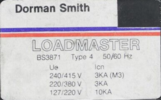 this one type 4, but many no marking as to type. And on the caravan site I was stopping at, someone worked out by screwing in the yellow screw,
 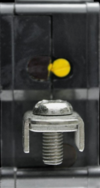 they would trip at a higher current, we had 6 amp supplies as the whole supply to the site was 100 amp split phase, and this resulted in the standard kettle not working, I remember talking to the site owner, and he would go around with a 2 kW heater and see if they would trip, if not change them.
I think that is the only time I have seem MCB's tested. But as a result of what happened on that site, I would never buy second hand MCB's.

DIYnot Local
Staff member
If you need to find a tradesperson to get your job done, please try our local search below, or if you are doing it yourself you can find suppliers local to you.
Select the supplier or trade you require, enter your location to begin your search.
Please select a service and enter a location to continue...
Are you a trade or supplier? You can create your listing free at DIYnot Local
Similar threads
- Replies
- 20
- Views
- 5K
- Replies
- 24
- Views
- 9K