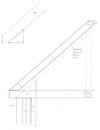
Hi all, first time poster - been reading on this site for years, it's excellent. Anyway, I'm renovating a 1970's built double block house. Back to block, ground floor lifted and void filled with 75tn type 1 for slab/PIR/UFH and screed. Now onto the roof. Half the house will be open plan, approx 7.5m x 6.5m. A 145mm panel will be built at the gable end and another at halfway along the length of the house, to support a 115 x 400 Glulam beam. The original rafters - 50 x 125 will stay put but adding 47 x 195 rafters in between existing. The current rafter/ceiling ties will be cut level with the inside face of the inner leaf blocks. The problem I have is the distance between the bottom of the new rafters and the top plate. A SE spec'd the Glulam/rafters and wall panels but is there a best practice way of connecting the new rafters to the wall plate? I am thinking of adding short lengths of timber between the current ceiling ties (what will be left of them), fixing these to the top plate until I can get them high enough for the new rafters to sit on. Another idea (much less feasible) would be to cut triangles and screw/glue to the bottom of the new rafters with ply gussets nailed on each side. The inner and outer leafs of the walls have been closed (concrete) at the top of the walls (not shown on diagram), similar to a ring beam. Another idea might be to run a new top plate along the top of the current ceiling ties. While I'm waiting on a reply from my SE I thought I might post here and start a conversation. Great Site. Many Thanks