

- Joined
- 27 Jan 2008
- Messages
- 29,619
- Reaction score
- 3,657
- Location
- Llanfair Caereinion, Nr Welshpool
- Country

Yes, OK, stop losses first, or at the same time, but if the heat pump does not work with poorly insulated homes, neither will it work with well insulated homes.
Yes, I see we have a 60 amp fuse in the supply to many homes, so 40 amps for the house we have 20 amps for the heat pump, so 4.6 kW they can be 400% efficient it seems, so 18.4 kW into the home, so if the home had a 25 kW gas boiler, then either the boiler was well oversized to start with, or a heat pump is not going to work.
I have not got a gas smart meter, but would think it is similar to electric, so this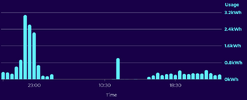 shows me what I am using with electric if there is something similar for gas, then it should be easy to see how much any house needs if using gas, oil not so easy, I used around 1200 litres a year, well none in the summer, so that's around 12,000 kWh divided by 182 days so around 65 kWh per day, so around 12 amps average, (at 400% 3 amps) so it is clear likely for me the heat pump could produce enough. Supported by during the coldest days, the 20 kW boiler has coped.
But working out how much power an existing home needs, should be easy, we have records to work with. New home OK, we don't know what the losses will be, but will an existing home, if it needs a 35 kW gas boiler, then it needs a 9 kW heat pump if working at 400% or 38 amps, clearly you can't run a house on 20 amps, so the 60 amp fuse would need up rating to at least 100 amps.
The only way a heat pump can fail is if it's not 400% efficient. Or if it can't deliver the output due to the evaporator freezing up, so heat pumps should work if outside above 10°C or lower than zero only if outside is between 0 and 10°C do we have a problem. At 0 to 10°C there is a high possibility of condensate freezing, below zero and very little humidity in the air, so very little condensate, so very little to freeze. And above 10°C also unlikely the condensate will freeze.
So unless the winters in the UK are between zero and 10°C heat pumps should be fine. Can anyone see the flaw with heat pumps? I do not think down to not enough insulation on the home.
I am sure a heat pump powered by a 28 sec gas oil engine will work fine, the main problem is trying to use an electric motor. I think it would be a Sterling idea, pun intended.
Yes, I see we have a 60 amp fuse in the supply to many homes, so 40 amps for the house we have 20 amps for the heat pump, so 4.6 kW they can be 400% efficient it seems, so 18.4 kW into the home, so if the home had a 25 kW gas boiler, then either the boiler was well oversized to start with, or a heat pump is not going to work.
I have not got a gas smart meter, but would think it is similar to electric, so this
shows me what I am using with electric if there is something similar for gas, then it should be easy to see how much any house needs if using gas, oil not so easy, I used around 1200 litres a year, well none in the summer, so that's around 12,000 kWh divided by 182 days so around 65 kWh per day, so around 12 amps average, (at 400% 3 amps) so it is clear likely for me the heat pump could produce enough. Supported by during the coldest days, the 20 kW boiler has coped.But working out how much power an existing home needs, should be easy, we have records to work with. New home OK, we don't know what the losses will be, but will an existing home, if it needs a 35 kW gas boiler, then it needs a 9 kW heat pump if working at 400% or 38 amps, clearly you can't run a house on 20 amps, so the 60 amp fuse would need up rating to at least 100 amps.
The only way a heat pump can fail is if it's not 400% efficient. Or if it can't deliver the output due to the evaporator freezing up, so heat pumps should work if outside above 10°C or lower than zero only if outside is between 0 and 10°C do we have a problem. At 0 to 10°C there is a high possibility of condensate freezing, below zero and very little humidity in the air, so very little condensate, so very little to freeze. And above 10°C also unlikely the condensate will freeze.
So unless the winters in the UK are between zero and 10°C heat pumps should be fine. Can anyone see the flaw with heat pumps? I do not think down to not enough insulation on the home.
I am sure a heat pump powered by a 28 sec gas oil engine will work fine, the main problem is trying to use an electric motor. I think it would be a Sterling idea, pun intended.


