Evening all. I'm hoping the community can offer me some advice, and maybe an alternative, to a patio drainage problem that I am going round and round in my head on how best to solve.
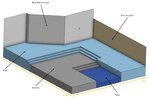
I am re-landscaping the garden and as part of the work re-modelling an old decking area, and introducing a 3 tiered patio and decking mix, as shown below. The reason I'm adding in the middle decking is just to break up such a large patio area and create some contrast.
The problem I am trying to solve, is finding the best solution for the drainage, to set the fall of the patio.
Points to note that are not shown in the attached images.
1) There is a grassed garden extending on from the patio/decking area.
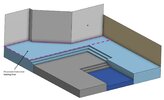
2) In due course (likely next year) an outdoor undercover eating area will be built, represented by the dashed area in the 3rd image.
3) Slabs are likely to be 800x400 Bradstone Romeli porcelain.
4) I'm an engineer by day, but keen, and pretty handy on the tools. Downside is I overthink things!
In terms of drainage, two of the areas are easy:
1) The lower patio (dark blue) can drain off straight into the garden, which is beyond.
2) The decking can drain into a existing drainage that will be under the decking itself.
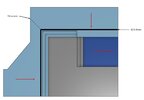
It is the upper patio area that I am unsure of how best to manage. As there will be steps around 2 of the edges, I feel it is best to either drain towards the steps, and have an ACO drain at the start of the steps, or the inverse and drain away from the steps to the house/boundary wall, and have the ACO drain along those edges.
I do not think it is wise to have a fall along the length of the steps, purely from a build perspective. But maybe I am wrong on this?
Whilst the drainage solution proposed in the image seems sensible, I am not sure how the finished result will be with a mitre joint in the patio.
If you were posed with this problem, what would your proposed drainage solution, and fall direction, be?
The fact that a large portion of the upper area is likely to be covered makes me think I don't need to worry about drainage on that portion, as water will be minimal. However, if built sometime next year, that would be ~12 months of no cover, and potential problems?
Any help or advice you can give would be greatly received.
I am re-landscaping the garden and as part of the work re-modelling an old decking area, and introducing a 3 tiered patio and decking mix, as shown below. The reason I'm adding in the middle decking is just to break up such a large patio area and create some contrast.
The problem I am trying to solve, is finding the best solution for the drainage, to set the fall of the patio.
Points to note that are not shown in the attached images.
1) There is a grassed garden extending on from the patio/decking area.
2) In due course (likely next year) an outdoor undercover eating area will be built, represented by the dashed area in the 3rd image.
3) Slabs are likely to be 800x400 Bradstone Romeli porcelain.
4) I'm an engineer by day, but keen, and pretty handy on the tools. Downside is I overthink things!
In terms of drainage, two of the areas are easy:
1) The lower patio (dark blue) can drain off straight into the garden, which is beyond.
2) The decking can drain into a existing drainage that will be under the decking itself.
It is the upper patio area that I am unsure of how best to manage. As there will be steps around 2 of the edges, I feel it is best to either drain towards the steps, and have an ACO drain at the start of the steps, or the inverse and drain away from the steps to the house/boundary wall, and have the ACO drain along those edges.
I do not think it is wise to have a fall along the length of the steps, purely from a build perspective. But maybe I am wrong on this?
Whilst the drainage solution proposed in the image seems sensible, I am not sure how the finished result will be with a mitre joint in the patio.
If you were posed with this problem, what would your proposed drainage solution, and fall direction, be?
The fact that a large portion of the upper area is likely to be covered makes me think I don't need to worry about drainage on that portion, as water will be minimal. However, if built sometime next year, that would be ~12 months of no cover, and potential problems?
Any help or advice you can give would be greatly received.