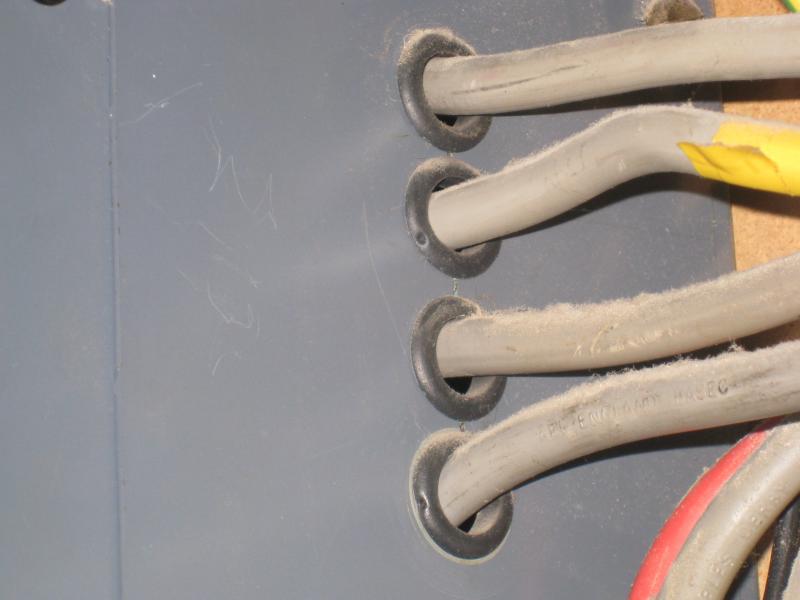
Yes, but they seem to include the 'slots' joining the holes which I mentioned earlier ... or was that your point??Used to often see it on older installs
Kind Regards, John

Yes, but they seem to include the 'slots' joining the holes which I mentioned earlier ... or was that your point??Used to often see it on older installs

Oh, fair enough.yes that was the point ...
All other than mwatsonxx, that would be... im sure its something we all know about ....

Well, I certainly haven't, but I've seen very little in the way of commercial/industrial installations, and metal CUs have been pretty unusual (unless they were very old) in domestic environments until recently.... but rarely see it.

I've never thought of that, but I suppose what you say is theoretically true. I'm not sure whether the currents can be "high" enough under non-fault conditions for it to be a significant issue, but I certainly can't see any reason for not doing what you suggest, 'just to be sure'.Given that we know that "high" earth currents are possible in PME installs in non fault conditions, if we use the CU earthing bar as the MET, by this logic we should also make sure any bonding cables go through the same hole as the main earth cable.

Should we be very surprised that a man with his qualifications and experience has never even heard of it?All other than mwatsonxx, that would be... im sure its something we all know about ....
I can't say that I'm particularly surprised. Maybe you know something I don't, but I don't really know anything about his qualifications and experience (if any). If I recall correctly, the only thing he's told us is that he is not a 'domestic electrician', or something like that.Am I the only person here very surprised that a man with his qualifications and experience has never even heard of it?
Indeed. As I said, that's the main reason why I have personally seen very little of it, since my limited experience is almost exclusively of domestic installs (and nearly all with insulated CUs).it seems to me that slotting is taken very seriously in commercial and industrial installations, but often doesn't get a thought in domestics. My guess it's because domestic is (was) usually in insulated boxes, and the currents are so low that it would mostly not be significant.
It's an electromagnetic phenomenon, and so, as far as I can see, should occur regardless of the potential etc. of the metal. In other words, if a single ('unpaired') current-carrying conductor passes through a hole in a ferromagnetic material, it will inevitably result in eddy currents in the metal around that hole - regardless of whether the metal is earthed, 'floating' of anything else.p.s. I don't know (does anyone?) that passing an earth or bonding connector through a hole in a metal enclosure that is itself earthed or bonded can produce eddy currents. I'd have thought not.
Your quote overlapped my "on second thoughts" edit.I can't say that I'm particularly surprised. Maybe you know something I don't, but I don't really know anything about his qualifications and experience (if any). If I recall correctly, the only thing he's told us is that he is not a 'domestic electrician', or something like that.
OOI, how many people here would consider making good the slot having cut it? Bit of epoxy, a can of spray paint....

in a domestic context eddy currents won't be a problem.
I don't know, but I can well believe that the magnitude of eddy currents would be such as not to be particularly significant in most domestic installations.IIRC I read once that in a domestic context eddy currents won't be a problem.

If you need to find a tradesperson to get your job done, please try our local search below, or if you are doing it yourself you can find suppliers local to you.
Select the supplier or trade you require, enter your location to begin your search.
Are you a trade or supplier? You can create your listing free at DIYnot Local