Predictions please...

id say at least double the temperature and the flex may feel warm to touch
Assuming you mean double the Celcius/Centigrade temperature, I think it would have to be a fair way above 13.6 °C before it felt remotely warm to the touch! [if you mean double the absolute temperature, you'd be advised not to touch it to test :-) ]

Kind Regards, John
 
It would be quite interesting to see the effect of passing it through 50mm of thermal insulation
 
Er is not the cable rating at an ambient temp of 30C, if so you need to apply a correction factor as at 6C it's ccc will be greater surely?
 
id say at least double the temperature and the flex may feel warm to touch
Assuming you mean double the Celcius/Centigrade temperature, I think it would have to be a fair way above 13.6 °C before it felt remotely warm to the touch! [if you mean double the absolute temperature, you'd be advised not to touch it to test :-) ]

Kind Regards, John

Sorry john you lost me there with the absolute temp
I meant at least double the reading shown assuming that was at the start of the 2 hours
I thought the heatgun was pointed at the flex
I have felt 1.5 flexes loaded at 13 amp that felt quite warm
 
Sorry john you lost me there with the absolute temp


I was going to say the same but there's been a lot of negative talk about being pedantic recently.

The point is that since different temperature scales have different and arbitrary zero points, the concept of doubling a temperature has no meaning. The only possible scale where it could have a meaning in one where 0 meant absolute zero. On this scale room temperature would be 293 degrees Kelvin, and doubling it would therefore be 586 degrees K or 313 degrees C.
 
Sorry I meant at least double the reading shown assuming that was at the start of the 2 hours
Indeed so. 'The reading shown' was 6.8 °C. Double that would be 13.6 °C, which I don't think anyone would describe as 'warm to the touch'.

Sorry john you lost me there with the absolute temp
Well, it is Saturday night, and nearly Christmas! ..... 6.8 °C is an absolute temp of about 279.9 °K. Double that would be 559.8 ° K- i.e. about 286.7 °C ...hence my advice not to touch it :-)

Kind Regards, John
 
RF,

Just to note, i have to use the same sort of laser thermometers in my job. We find they read most accurate if reading a 'black surface'

We apply a 1" square of black duct tape to anything we need to take temp of.

:D
 
RF,

Just to note, i have to use the same sort of laser thermometers in my job. We find they read most accurate if reading a 'black surface'

We apply a 1" square of black duct tape to anything we need to take temp of.

:D

Emissivity. Grey or white PVC is pretty much fine. Materials like bare aluminium are very low, and require correction(most thermometers actually have an adjustment for this). Anodised aluminium (usually black) is fine.

Putting some black duct tape or PVC tape on something is often easier than working out the emissivity, though!

Angle is also important.
 
RF,

Just to note, i have to use the same sort of laser thermometers in my job. We find they read most accurate if reading a 'black surface'

We apply a 1" square of black duct tape to anything we need to take temp of.

:D

Emissivity. Grey or white PVC is pretty much fine. Materials like bare aluminium are very low, and require correction(most thermometers actually have an adjustment for this). Anodised aluminium (usually black) is fine.

Putting some black duct tape or PVC tape on something is often easier than working out the emissivity, though!

Angle is also important.


How do you work out emissivity?
 
RF,

Just to note, i have to use the same sort of laser thermometers in my job. We find they read most accurate if reading a 'black surface'

We apply a 1" square of black duct tape to anything we need to take temp of.

:D

Emissivity. Grey or white PVC is pretty much fine. Materials like bare aluminium are very low, and require correction(most thermometers actually have an adjustment for this). Anodised aluminium (usually black) is fine.

Putting some black duct tape or PVC tape on something is often easier than working out the emissivity, though!

Angle is also important.


How do you work out emissivity?

By identifying exactly what the material is and looking it up. Hence why the tape is easier.
 
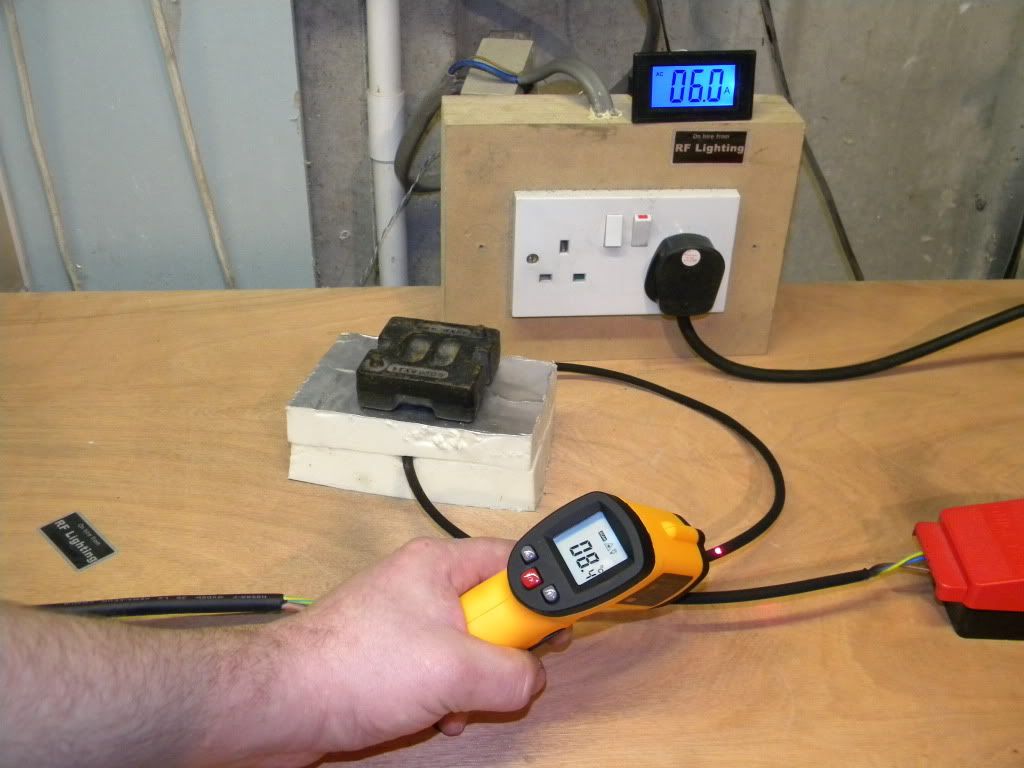
Well it appears there were a couple of issues with yesterday's test so I've made a few alterations and started it again.

I've sprayed the flex mad black to hopefully get a more accurate reading, and I've also fitted some insulation to part of the flex to see what difference that makes.

I can't do much about the ambient temperature I'm afraid, although it is a little bit warmer today at 8.4°C


DSCN0808.jpg


I'll let you know the results ain a bit.
 
...I've sprayed the flex mad black to hopefully get a more accurate reading....
I think that's probably a slightly flawed approach. Spraying it matt black will cause it to radiate (i.e. 'lose') more heat, thereby reducing its temperature. The answer you get will therefore relate to 'black sprayed flex', not flex in its birthday suit, as normally used - which is what we're really interested in.

Kind Regards, John
 

If you need to find a tradesperson to get your job done, please try our local search below, or if you are doing it yourself you can find suppliers local to you.

Select the supplier or trade you require, enter your location to begin your search.


Are you a trade or supplier? You can create your listing free at DIYnot Local

 
Back
Top