

Hi all,
First off let me apologise for my ignorance, I'm quite new to heating systems and this will be my first attempt at fiddling around with things so I apologise if I ask some stupid questions!
My situation is as follows, I've currently got the setup below which I believe is known as a "double pipe" system. There are flows (red) and returns (blue) which come from the kitchen to feed 2 single rads in the living room and one double in the hall.
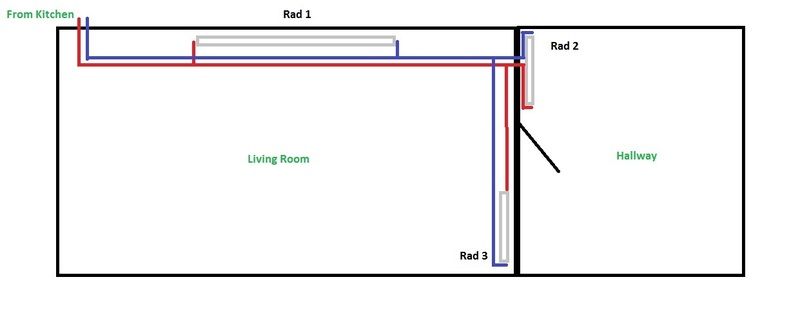
Now I would like to replace the 2 rads in the living room for one large double P+ rad, but I'm unsure of the best way to layout the pipes. This is my preferred layout (because I'm burying the pipes in concrete and this means less work!). My worry with this option is that the system is split and if either rad is turned off this disturbs the flow of the rest of the system - is this something to be worried about? Also, I'm assuming I would need drains on both radiators instead of just the end one (currently on rad 3 in my current setup)?
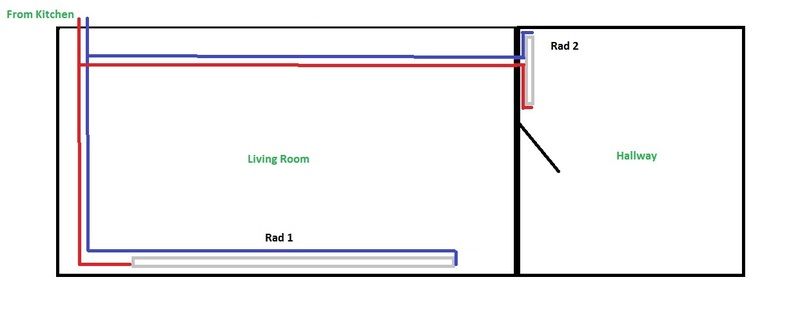
This would be option 2, in this case the rads are connected and shutting either of them off would not disturb the flow of the system.
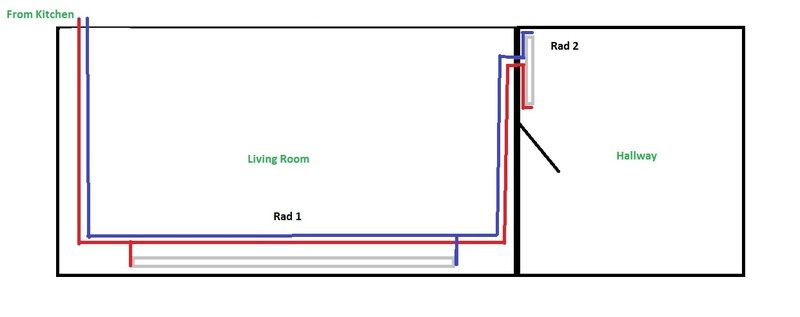
Also, can the flow / return be input to either end of the rad? I've noticed in my house that it's not always on the left. Oh and for reference I've got a gravity fed system with an F&E tank in the loft, and a hot water tank in an airing cupboard upstairs if that makes any difference!
Any help would be greatly appreciated!
Thanks!
First off let me apologise for my ignorance, I'm quite new to heating systems and this will be my first attempt at fiddling around with things so I apologise if I ask some stupid questions!
My situation is as follows, I've currently got the setup below which I believe is known as a "double pipe" system. There are flows (red) and returns (blue) which come from the kitchen to feed 2 single rads in the living room and one double in the hall.
Now I would like to replace the 2 rads in the living room for one large double P+ rad, but I'm unsure of the best way to layout the pipes. This is my preferred layout (because I'm burying the pipes in concrete and this means less work!). My worry with this option is that the system is split and if either rad is turned off this disturbs the flow of the rest of the system - is this something to be worried about? Also, I'm assuming I would need drains on both radiators instead of just the end one (currently on rad 3 in my current setup)?
This would be option 2, in this case the rads are connected and shutting either of them off would not disturb the flow of the system.
Also, can the flow / return be input to either end of the rad? I've noticed in my house that it's not always on the left. Oh and for reference I've got a gravity fed system with an F&E tank in the loft, and a hot water tank in an airing cupboard upstairs if that makes any difference!
Any help would be greatly appreciated!
Thanks!


