Radiator valve advice

Joined
16 Sep 2006
Messages
7,504
Reaction score
2,222
Location
Fife
Country
United Kingdom
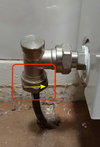
This valve is leaking (very slightly) from the vertical nut. I want to nip it up.

Am I right in thinking I need to hold the nut located at the copper pipe at the same time to avoid any movement?
Am I also right in thinking I don't need to touch the nut at the radiator? i.e. it won't move?
Finally, direction wise, am I tightening the nut away from me?

Correct anything I've got wrong.

connector.jpg
 
Firstly, you need to be careful with that. Looks like they may have used a snap reducer (15mmx8mm) and usually it's not as simple as tightening it up, unless it's actually loose of course. If it isn't then tightening it up can actually make the leak worse.

if it's the bottom nut then you would tighten in anti-clockwise (yellow arrow direction), as you look at it.

1738759602009.png
 
Firstly, you need to be careful with that. Looks like they may have used a snap reducer (15mmx8mm) and usually it's not as simple as tightening it up, unless it's actually loose of course. If it isn't then tightening it up can actually make the leak worse.

if it's the bottom nut then you would tighten in anti-clockwise (yellow arrow direction), as you look at it.

View attachment 371873
Cheers.

This is my concern i.e. making it worse.

It's not the bottom nut that's leaking, it's the vertical nut in the middle. I was thinking to brace/support either the bottom nut or the body of the valve itself (to stop the bottom having any unwanted pressure added) whilst tightening the middle nut.
 
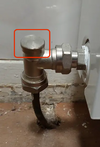
Are you talking about this one?

1738766384604.png If so that's just a cover for the (Danfoss) lockshield valve below it. 1738767026142.png

When you remove that nut, you'll find the allan key valve below it, that's the actual lockshield. If that's leaking, which they can do when they get older, then little you can apart from either getting a rubber seal to fit the cap or tape the threads.
 
Are you talking about this one?

View attachment 371891 If so that's just a cover for the (Danfoss) lockshield valve below it. View attachment 371894

When you remove that nut, you'll find the allan key valve below it, that's the actual lockshield. If that's leaking, which they can do when they get older, then little you can apart from either getting a rubber seal to fit the cap or tape the threads.
No, I'm referring to the vertical nut to the right of that.
 
I think you mean the horizontal nut . Try tightening it whilst holding the valve body with grips to stop it moving.
Tighten the nut upwards towards the ceiling.
 
I think you mean the horizontal nut . Try tightening it whilst holding the valve body with grips to stop it moving.
Tighten the nut upwards towards the ceiling.
It's the one with the arrow pointing towards it. I'm referring to it as vertical cause the actual nut is aligned that way, however it goes horizontally so I'm likely mis-labeling it!

Cheers re advice.

rad valve.jpg
 
Yeah, the description would come from the pipe orientation - therefore it would the horizontal part of the valve.

If you haven't done it already, if you back it off 1/4 turn before re-tightening, it just allows the olive mating surfaces to re-engage.
 
I don't think that nut has an olive in it. It is not a compression joint but is instead a standard radiator connector with domed tail screwed into the radiator and the valve having a matching socket which is held tight to the dome by the nut in question. Originally these types of joints were plain metal to metal but recently they have had rubber O-rings fitted into a groove on the domed part. It's possible that, if your radiator valve is the new type, the O-ring has deteriorated and is causing the leak.
I wouldn't back off the nut before tightening it, but would just try tightening a bit, without being too heavy handed. If that doesn't stop the leak, you may have to drain the radiator and take the joint apart to examine it and perhaps replace the O-ring
 
I don't think that nut has an olive in it. It is not a compression joint but is instead a standard radiator connector with domed tail screwed into the radiator and the valve having a matching socket which is held tight to the dome by the nut in question. Originally these types of joints were plain metal to metal but recently they have had rubber O-rings fitted into a groove on the domed part. It's possible that, if your radiator valve is the new type, the O-ring has deteriorated and is causing the leak.
I wouldn't back off the nut before tightening it, but would just try tightening a bit, without being too heavy handed. If that doesn't stop the leak, you may have to drain the radiator and take the joint apart to examine it and perhaps replace the O-ring
It does have an olive in it. and It is a compression joint.
 
It'll have an olive in the connection to the copper pipe below, but I very much doubt there's an olive in the connection to the radiator.
 
It'll have an olive in the connection to the copper pipe below, but I very much doubt there's an olive in the connection to the radiator.
It's a danfoss lockshield, they do have a version that uses 3/4" unions but the OP's one is a 15mm compression with an olive. The tail actually comes with the olive and nut already attached to rather than it's loose and will happily back off a 1/4 turn before re-tightening, stops the olive getting over compressed but allows the faces to re-mesh and re-seal

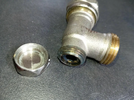
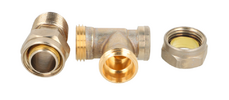
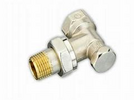
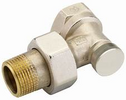
OP's 15mm lockshield
1738880915367.png

15mm compression v's 3/4" union lockshield, Note the different nut shapes
1738881151140.png[1738881325575.png
 
Last edited:
It's the one with the arrow pointing towards it. I'm referring to it as vertical cause the actual nut is aligned that way, however it goes horizontally so I'm likely mis-labeling it!

Cheers re advice.

View attachment 371927
What app is that that using the arrow.
Is it a measurement app as well?
 

If you need to find a tradesperson to get your job done, please try our local search below, or if you are doing it yourself you can find suppliers local to you.

Select the supplier or trade you require, enter your location to begin your search.


Are you a trade or supplier? You can create your listing free at DIYnot Local

 
Back
Top