
Raising kitchen floor by a few centimetres...

Joined
23 Dec 2007
Messages
745
Reaction score
10
Location
Barnsley
Country
United Kingdom
Hi all,

I have this kitchen that I'm extending to be a kitchen diner and the kitchen units will come out beyond the square area you see here. The floor in the kitchen is tiled and dry and it's a couple or a few centimetres lower than the dining room.

My plan is to raise that floor by using concrete...
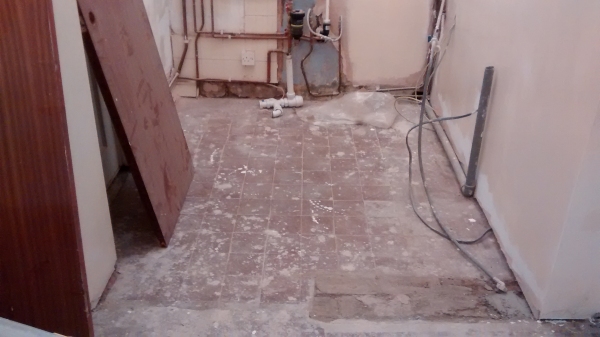
kitchenfloor.jpg


I figured it would be smart (I have no idea what's under the tiles) to install some kind of damp protection between the existing tiles and the concrete I would put down.

First question - would you advise the same?

If so, should I use something in a tin that I can paint onto the tiles and lay concrete over or should I preferably be buying a sheet of something more easy to manage and, I assume, strong?

If the latter, am I correct in thinking I would size it to be slightly bigger than the horizontal area I want to cover, so I can have it come up the sides of the concrete as well and then trim it?

Please ignore all the other crap in the picture. Hopefully my intentions here sound sensible?

Oh - in the end there'll be a laminate floor going down (not sure if that's relevant, but added it). I understand some pipes will need their position tweaking.
 
Unless you get some one to do it, screeding is more or less like plastering, it looks easy but is hard to get it smooth and flat. if you have enough depth to fill, I would go for P5 T&G chipboard on thin wooden "joists" at 12" centres.
Frank
 
Do it out of insulation, maybe even the stuff with grooves in and lash some underfloor heat pipe in as you go, tile over the top for nice warm toes in themorning
 
I don't think I relish the idea of building, like, a floating floor. I thought concrete would be easiest. Disappointed it might be a no-go. I'm curious why the 75mm minimum thickness recommendation for a "debonded screed"... what about a bonded screed, is that a stupid question? Just laugh at me if it is.
 
Conceptually even your concrete raft is a floating floor; it just sits on the mud, on a sheet of plastic no less - it's not bonded to the core of the earth..

I couldn't understand why the screeders that poured my liquid screed wouldn't lash a 20mm coat straight on the uneven floor in the garage.. Lay out some polythene sheet and pour 50mm in the house, that's no problem, but ask them to do a levelling coat in the garage that was stuck to the floor and it was no way Josee. I was talking toa sales rep though so I didn't get the technical. Something about differential thermal behaviour leading to cracks. Blah, I'll hire a screed pump and order a tanker myself one day. It's not rocket science - if you can pour gravy and/or jiggle your woman's arse you're qualified to spread and dapple screed

That said, the min thickness is to inhibit cracking. Liquid screeds sit more densely so they can be thinner, down to 40 mm with additives. Trad screed is 75mm because it has air pockets/isn't dense. too thin and it'll just break up and revert to sand
 
I can jiggle my woman's arse, so I must be an expert at this already.

I still don't know what to do.

Can't the mix be, er, mixed with something to stop it cracking? It's going on a flat floor and a flat floor will be above it... are we just talking about cold / frost being the possible reason for it cracking over time?

You think concrete and you think tough and strong, right? Not soft and brittle.
 
Latex compound can be baulked up to 20 or 25mm but it does need to be bonded. Latex will bond to dpc paint so you could go that way or, if the thickness is more than 25mm, a cs screed will bond also. Personally I'd make up the levels with pir insulation (e.g. kingspan k3) and lay 22mm t&g chipboard direct on top. No joists needed. If you go that way put a 1200g membrane between the t&g and the insulation.
 
I'm going to "thank" you for this entry, even though I'm going to spend the rest of the morning deciphering it, but that's my problem not yours. :D
 
You think concrete and you think tough and strong, right? Not soft and brittle.
Reinforced concrete is strong. But a large thin area of (unbonded) concrete will snap like a twig. Hence the 75mm figure.

I agree with you though, if it's poured directly on the tiles (no DPC), then that counts as bonded, right? Or would it not stick well enough? Anyone?
 
I take it the way of reinforcing concrete is by putting steel wire mesh into it? Which is obviously not what I'll be doing here.

The tiles are nice and smooth, maybe stickiness is not their strength. Maybe I have to consider a more woodworking approach after all.
 
Maybe you could just chip off the tiles to get back to the underlying concrete? It can't be that hard. Hire one of those vibrating chisel chippy thingies? (As you can see I'm no expert!)
 
I have a bolster and a big hammer. I was thinking of doing some building rather than further destruction, though. :confused:
 
I know what you mean, it's a fag for sure. But I get the feeling this could be one of those times when 'preparation is everything', and in the long run you'll forget how hard it was and be glad you went to the trouble. But I can be a bit philosophical at times...
 

If you need to find a tradesperson to get your job done, please try our local search below, or if you are doing it yourself you can find suppliers local to you.

Select the supplier or trade you require, enter your location to begin your search.


Are you a trade or supplier? You can create your listing free at DIYnot Local

 
Back
Top