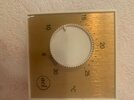
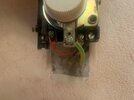
I’m trying to replace my old acl (Drayton?) thermostat with potentially a Honeywell DY4R (unless anyone has a better/cheaper option?). My issue is that the current stat only has a live, neutral and earth input whereas it seems that I need a common live too? I attach a photograph of the current stat. Any help would be greatly appreciated, thank you

You are using an out of date browser. It may not display this or other websites correctly.
You should upgrade or use an alternative browser.
You should upgrade or use an alternative browser.
Replace old room thermostat
- Thread starter PeterS100
- Start date

- Joined
- 5 Nov 2024
- Messages
- 5,788
- Reaction score
- 2,748
- Country

That's a 2 wire thermostat, so you don't even have neutral, just live and switched live. Either a battery operated 2 wire thermostat or wire in the wiring center or from the boiler if combi and decommission existing or set to maximum
- Joined
- 5 Nov 2024
- Messages
- 5,788
- Reaction score
- 2,748
- Country
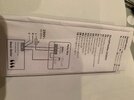
Locate your wiring center, locate a permanent live and permanent neutral along with earth and connect to the relay unit. Locate the switching wires of the existing thermostat and put these into a and b.Apologies, further question please. I am trying to wire in a Honeywell DT4R to replace the old thermostat pictured above. I have a gravity boiler. Not sure how to connect per the attached diagram, any help gratefully received!
Thank you, I’m sure I’m being slow on the uptake here but if I connect the live, neutral and earth (i.e. the only 3 wires currently connected to the thermostat) to the earth, neutral and live terminals in the relay, there are no more wires to connect to a and b unless I jump them? Thanks again
- Joined
- 5 Nov 2024
- Messages
- 5,788
- Reaction score
- 2,748
- Country
Yep, re-read what I said. You need to locate your wiring center, unless you have a combi boiler?Thank you, I’m sure I’m being slow on the uptake here but if I connect the live, neutral and earth (i.e. the only 3 wires currently connected to the thermostat) to the earth, neutral and live terminals in the relay, there are no more wires to connect to a and b unless I jump them? Thanks again

there are no more wires to connect to a and b unless I jump them?
That is correct! A and B are what are known as 'voltage free contacts', you have to connect one of the terminals, to the appropriate voltage.
Sorry Harry, what is correct?
That the jumper from the L to A needs to be fitted.

- Joined
- 27 Jan 2008
- Messages
- 29,576
- Reaction score
- 3,644
- Location
- Llanfair Caereinion, Nr Welshpool
- Country
The existing wires go to A and B, you need a new supply to line, neutral and earth. The new supply could be from a plug, but this means easy for heating to be unplugged. A simple battery powered is likely the best option, 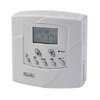 unless you want to measure remotely. I would only use wall thermostats in small homes or open plan homes on their own, in the main the TRV (thermostatic radiator valve) controls room temperature, but we need some way to turn off the boiler once all rooms are satisfied.
The old way was to put a wall thermostat in a room kept cool, so it would not trigger heating on a warm day, downstairs as heat raises, with no alternative heating, including sun through windows, and no doors to the outside. Don't know about your home, but in my room no such room.
One thing it missed, was the room also needs to cool faster than other rooms, one can adjust how fast a room heats with the lock shield valve, but not how fast it cools.
Early central heating was to take off the chill in the mornings, latter we lit fires, today we tend to do all the heating with the central heating, so we need more control. The wall thermostat is often used more like a switch, where we turn it up to turn on the heating and down when warm enough, and we don't really use the thermostatic function. And heart of winter a simple switch would likely work just as well, OK, maybe a switch on a timer, but the boiler with either modulate, or switch on/off (mark/space) to control output to what the TRV heads demand, only problem is, it can't turn fully off.
The simple mechanical thermostat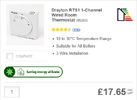 if it is used to control room temperature needs a method not to fire the boiler too often, but also not to cause too much of a hysteresis, so often we find a heater inside the thermostat to reduce the hysteresis and a large difference between on and off temperatures. This large difference can be an advantage when using TRV heads to control the room temperature, so it only turns off on a warm day, the rest of the time the TRV controls the temperature in an analogue manner, which with modern boilers means they work in a more efficient way. So the neutral wire is not used in the mechanical thermostat.
More modern systems use a hub, which connects to the TRV head, there is no need for a wall thermostat, and where a wall thermostat is used, it often connects to the TRV head, not the boiler direct. Some makes give more options to others, and it is really a mine field working out which make does what.
Hence, KISS (keep it simple, silly) this advert says it will work with two wires, I looked for high street shops selling thermostats, and the cheapest battery powered on
 at £54.98 seems very expensive, it seems the cheap ones, now internet only. My hunt found this
 battery powered, so two wire, £26.59, and it is a smart version, so one can understand why this one is no longer around. It shows on the add how fitted
 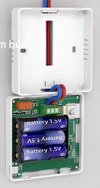 clearly two wire. It seems things have moved on.
unless you want to measure remotely. I would only use wall thermostats in small homes or open plan homes on their own, in the main the TRV (thermostatic radiator valve) controls room temperature, but we need some way to turn off the boiler once all rooms are satisfied.The old way was to put a wall thermostat in a room kept cool, so it would not trigger heating on a warm day, downstairs as heat raises, with no alternative heating, including sun through windows, and no doors to the outside. Don't know about your home, but in my room no such room.
One thing it missed, was the room also needs to cool faster than other rooms, one can adjust how fast a room heats with the lock shield valve, but not how fast it cools.
Early central heating was to take off the chill in the mornings, latter we lit fires, today we tend to do all the heating with the central heating, so we need more control. The wall thermostat is often used more like a switch, where we turn it up to turn on the heating and down when warm enough, and we don't really use the thermostatic function. And heart of winter a simple switch would likely work just as well, OK, maybe a switch on a timer, but the boiler with either modulate, or switch on/off (mark/space) to control output to what the TRV heads demand, only problem is, it can't turn fully off.
The simple mechanical thermostat
if it is used to control room temperature needs a method not to fire the boiler too often, but also not to cause too much of a hysteresis, so often we find a heater inside the thermostat to reduce the hysteresis and a large difference between on and off temperatures. This large difference can be an advantage when using TRV heads to control the room temperature, so it only turns off on a warm day, the rest of the time the TRV controls the temperature in an analogue manner, which with modern boilers means they work in a more efficient way. So the neutral wire is not used in the mechanical thermostat.More modern systems use a hub, which connects to the TRV head, there is no need for a wall thermostat, and where a wall thermostat is used, it often connects to the TRV head, not the boiler direct. Some makes give more options to others, and it is really a mine field working out which make does what.
Hence, KISS (keep it simple, silly) this advert
says it will work with two wires, I looked for high street shops selling thermostats, and the cheapest battery powered on this one is no longer around. It shows on the add how fitted clearly two wire. It seems things have moved on.
- Joined
- 5 Nov 2024
- Messages
- 5,788
- Reaction score
- 2,748
- Country
You could do that and trip your electrics likely with a bang. I said in post 2 you don't have a neutral.Thank you, I’m sure I’m being slow on the uptake here but if I connect the live, neutral and earth (i.e. the only 3 wires currently connected to the thermostat) to the earth, neutral
You could do that and trip your electrics likely with a bang. I said in post 2 you don't have a neutral.
That is correct! You are lacking the neutral at your present stat.

DIYnot Local
Staff member
If you need to find a tradesperson to get your job done, please try our local search below, or if you are doing it yourself you can find suppliers local to you.
Select the supplier or trade you require, enter your location to begin your search.
Please select a service and enter a location to continue...
Are you a trade or supplier? You can create your listing free at DIYnot Local
Similar threads
- Replies
- 2
- Views
- 3K
- Replies
- 9
- Views
- 5K