• Looking for a smarter way to manage your heating this winter? We’ve been testing the new Aqara Radiator Thermostat W600 to see how quiet, accurate and easy it is to use around the home. Click here read our review.

Sealed Heating System – 3-Year Air Ingress & Poor Heating Battle

Joined
23 Jun 2025
Messages
3
Reaction score
0
Country
United Kingdom

Could a Split Hot water cylinder coil be the cause of all my long-standing heating system pain?

Core Issue (Summary):

For 3 years, we've had persistent issues with our sealed heating system:
  • Air ingress into the system
  • Poor heating performance, especially downstairs
  • Sludge build-up despite regular flushing and inhibitor use
  • Pressure changes when the system is off
I now suspect a split coil in the hot water cylinder may be the root cause. I’d really appreciate expert insights on whether this could explain the symptoms and if replacing the cylinder is now justified.


Recent Observation – Possible Split Coil?

During a 7-day holiday:
  • I vented the system of some water to reduce the pressure so
    • Boiler pressure gauge dropped to 0.5 bar, and old upstairs gauge (near cylinder) dropped to 0 bar
  • System was switched off during the holiday
  • On return, pressure had increased to 0.7 bar (boiler) and 0.2 bar (upstairs)
Could this indicate a split cylinder coil allowing mains water ingress? Are there other causes for pressure increase while the system is off?


General Symptoms:

  • Downstairs radiators barely get hot, upstairs radiators get very hot
  • Air accumulation: water noise in boiler especially when hot water runs alone - sounds like running water
  • AAV near cylinder vents pressurised gas after a few days
  • No visible leaks, if anything pressure seems to creep up ~0.1 bar over 1–2 months
    • Generally keep system at ~1.2bar when cold, noticed has notched up to 1.3bar in last 2 months
  • Sludge returns within months despite flushing and inhibitor use

System Overview:

  • House: 4-bed detached (~20 years old)
  • Boiler: Glowworm Energy System 30kW (new, in downstairs garage)
  • Radiators: 5 downstairs (via drops/wells due to concrete floors), 5 upstairs, 2 towel rails
  • Hot Water Cylinder: Upstairs airing cupboard
  • Expansion Vessel: On mains feed to the cylinder
  • Controls: Two 2-port valves (heating & hot water)
  • MagnaClean: Installed on boiler return
  • Towel Rails: Get feed when either heating or the hot water is running
  • AAV: Near cylinder, left open to vent accumulated air

Diagnosis Attempts:

  • Gas from system seems inert – likely air, not hydrogen - does not seem to burn
  • New boiler & power flush made no improvement
  • Two Downstairs rads replaced – negligible effect
  • Balancing attempts – no success from myself or heating engineers
    • Towel radiator returns barely open to try and force hot water elsewhere
  • During Professional Power flush downstairs rads got hot all over - suggests given enough power hot water can reach downstairs rads just fine.
  • Multiple mains flushes performed by myself with either Sentinel X800 on the day, or X400 in system left prior to flush - would generally help return downstairs heating to an acceptable level. But issues with downstairs heat would return after just a few months
    • Hard to be sure how effective mains flushes have been on downstairs rads which I cannot drain. Tried to flush each rad in turn by locking others off
    • Over the 3 years I have also taken each rad off and flushed outside with mallet to ensure no residue sludge left in.
  • Inhibitor (X100) always added correctly
  • Some Sludge seems to return within months

History:

  • Moved in 3 years ago – issues began immediately
  • Original boiler replaced recently - annoyingly downstairs lack of heat seems worse with the new boiler
    • I wonder if old boiler may have worked better as pump set to max output. Whereas new boiler pump seems to have more dynamic power output.
    • I (and heating engineer) had assumed the old 20-year boiler could have been contributing to the issues - the pump looked very corroded! But seems was fine!
  • Corroded 2 port valve replaced – no improvement
  • Suspect trapped air in downstairs drop pipes
    • Best explanation I have for symptoms over the years. Almost seems we lose heat to random rads before a mains flush was performed. Generally, the downstairs rads are worse but have had one or two of upstairs rads stop heating up too.
    • At the time I assumed deep rooted sludge was to blame and could be blocking some of the system, but I now wonder if trapped air blocks the flow, which a mains flush maybe helped clear to some degree
  • Heating Engineers have struggled to diagnose confidently

Final Thoughts & Questions:

  • Could a split coil in the hot water cylinder explain:
    • Air ingress from aerated mains water?
    • Dilution/loss of inhibitor, leading to sludge?
    • Pressure increase while system is off?
I’ve spent over £3.5k and the system is now worse than before. I just want a reliable heating system.
Any expert advice or similar experiences would be hugely appreciated!
Thankyou.
 
Sounds bad, have you any non barrier piping anywhere?.
Does the AAV vent regularly?,
Maybe look at installing a Spirovent or similar,

Is the filling loop disconnected completely after any/every top up?
 
Not sure on non barrier piping. When I inspected there is some plastic piping under upstairs floorboards, with plastic push connectors I assume. All exposed piping to rads, cylinder and boiler seems to be 16mm copper pipe.

How could I confirm if non barrier piping is used?
I may be able inspect under floorboards again and look for markings on plastic pipe.

Yeah AAV left in auto vent position to try and get rid of air. If I shut the AAV for a few days, get a hiss of air when opened.

Filling loop disconnected completely. Has two values on filling loop which are both fully closed after filling.

So could a spirovent be used at high point near cylinder instead of AAV to better remove the air bubbles? Or would it be installed in addition to the cheap AAV?

Could non barrier piping explain pressure rise of 0.2bar during 7 day holiday of unpressurized/unused system?

NOTE - the noise of running water near boiler is worst when system firsts turns on to heat the hot water cylinder, seems to quieten down a bit after running for several minutes.
 
Probably not directly related to your problems, but 30 kW almost certainly way oversized. Half that would be enough for 10 rads
 
Not sure on non barrier piping. When I inspected there is some plastic piping under upstairs floorboards, with plastic push connectors I assume. All exposed piping to rads, cylinder and boiler seems to be 16mm copper pipe.

How could I confirm if non barrier piping is used?
I may be able inspect under floorboards again and look for markings on plastic pipe.

Yeah AAV left in auto vent position to try and get rid of air. If I shut the AAV for a few days, get a hiss of air when opened.

Filling loop disconnected completely. Has two values on filling loop which are both fully closed after filling.

So could a spirovent be used at high point near cylinder instead of AAV to better remove the air bubbles? Or would it be installed in addition to the cheap AAV?

Could non barrier piping explain pressure rise of 0.2bar during 7 day holiday of unpressurized/unused system?

NOTE - the noise of running water near boiler is worst when system firsts turns on to heat the hot water cylinder, seems to quieten down a bit after running for several minutes.

You say both filling valves are closed but still doesnt guarantee full isolation.
I think non barrier pipe absorbs oxygen but one might think not much in 7days but again how does (if) air get in with a shutdown system, not to mention that its a sealed, pressurized one. Try and post any writing on yours.
Corrosion would still be a prime suspect but again no signs of hydrogen, maybe get a water sample test.

You also mentioned a possible split in the heating coil, a possibility of fresh water ingress but only if you have a unvented cylinder, how old is the cylinder?

I would install the Spirove t on the highest point in the systembut where the water is circulating whether on CH or HW
 
Thanks for the advice all.
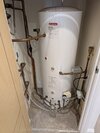
I've attached some pics of the hot water cylinder cupboard for reference.

Yeah I think it's an unvented cylinder, which is 20 years old now. It's the last original bit of the system, so seems reasonable idea to replace?

I think I will try adding the spirovent cheers. Looks like an upgrade on a AAV

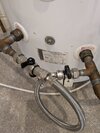
Good shout on the filling loop. See pic, looks okay to me, but I guess it's possible both are leaking mains into the system.
I assume could replace system side valve next time system is drained as a matter of course
 

Attachments

  • PXL_20250624_175906675.jpg
    PXL_20250624_175906675.jpg
    267.3 KB · Views: 34
  • PXL_20250624_175858144.jpg
    PXL_20250624_175858144.jpg
    121.1 KB · Views: 38
  • PXL_20250624_175823072.jpg
    PXL_20250624_175823072.jpg
    212.9 KB · Views: 37
  • PXL_20250624_175811645.jpg
    PXL_20250624_175811645.jpg
    260.5 KB · Views: 35
Re Filling Loop, you can first slacken off/remove the flexible hose to check for any valve leakage.
 

If you need to find a tradesperson to get your job done, please try our local search below, or if you are doing it yourself you can find suppliers local to you.

Select the supplier or trade you require, enter your location to begin your search.


Are you a trade or supplier? You can create your listing free at DIYnot Local

 
Back
Top