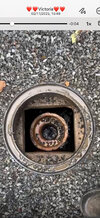
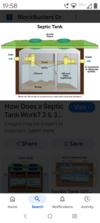
First and foremost, if you've no experience with septic tanks, they are a deathtrap if poorly maintained, fall in and you are unlikely to be getting back out again. Ensure any covers and/or lids, (including roof of the tank) are solid, if in any doubt, secure the area from any possible intrusion, human or animal. Certainly wouldn't be wandering around on top of it, especially if alone.
Sewage produces Hydrogen Sulfide as part of the decomposition process, it's highly toxic, doesn't take much to kill you, and rots both metal and concrete, so don't assume the condition of anything, especially if you cant see it!
Various types and sizes have been built or installed over the years, from the early brick built type to the later 'Onion' shaped Glass fibre offerings from Klargester etc. All work on the same principle, raw sewage comes in, the solids are allowed to settle out, and the clarified effluent is discharged either into a leachfield/soakaway, or in some cases a nearby ditch or watercourse. However
the Legal position for Septic Tank Owners has changed in recent years, and it may be wise to read up on the rules as if your installation isn't compliant, getting it so can become very expensive, very quickly!
Klargester's version is probably easier to navigate than the Environment Agency's but I'll link to both.
How to meet the general binding rules if your septic tank or small sewage treatment plant releases (discharges) waste water to the ground.

www.gov.uk
Remember, virtually everything going into the Tank will need to displace the equivalent volume back out, so rainwater and groundwater needs to be kept out of the system, otherwise you risk waterlogging the soakaway/leachfield, which will render the tank useless, and result in expensive Tankering on a constant basis. (It is illegal to remove effluent from a Septic Tank unless you are a Licenced Waste Carrier.) Solid matter doesn't simply 'disappear', it breaks down and forms sludge, it is this sludge then needs removing periodically, to maintain the health and functionality of the system. Failure to do so, will result in poor quality final effluent leaving the tank, carrying a higher suspended solids % than it should, which will then likely sludge up the soakaway, (more expensive repairs...)
Treatment of the Sewage in the tank relies completely on natural processes, with bacteria breaking down the solids to form sludge and helping to clarify the final effluent, these bugs are your friends, so be nice to them. Excessive usage of detergents, bleach, anything to kill bacteria in the home, will also kill them in the tank. No Bugs=no digestion=no effective treatment in the tank.
Lastly, if looked after, and provided the Soakaway works as it should, a well built/installed septic tank can give many years trouble free service. Need any more advice, come back and ask.