
So why hasn't my house fallen down?

Joined
18 Aug 2010
Messages
1,012
Reaction score
27
Location
London
Country
United Kingdom
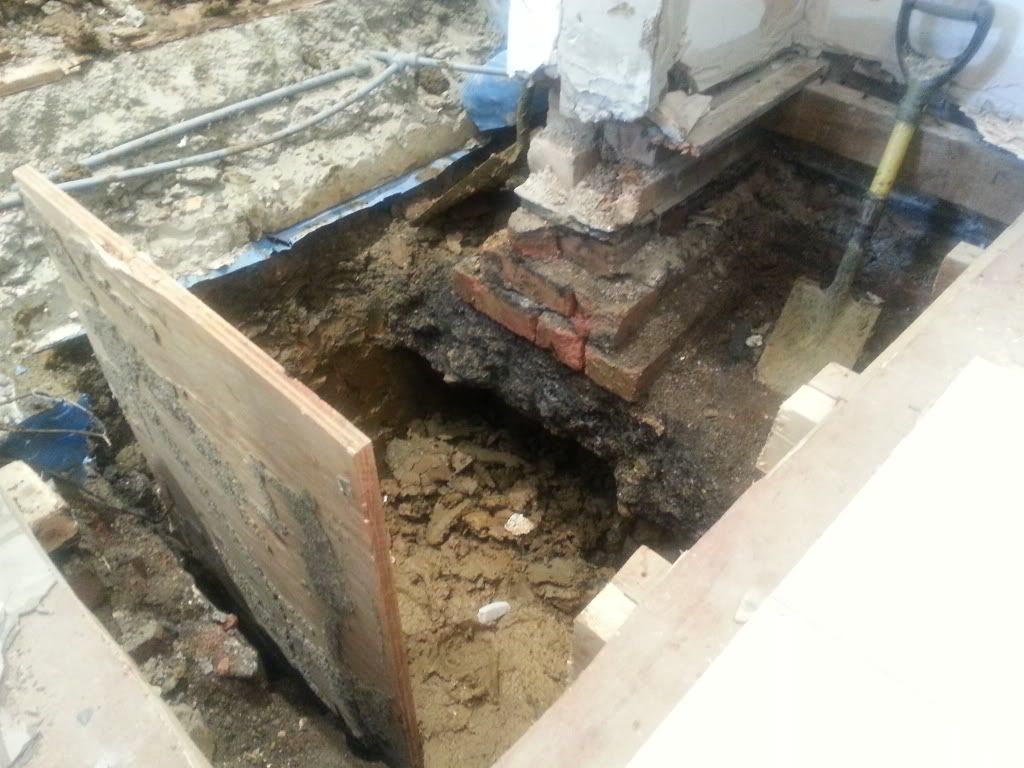
I'm having some work done on my house and as a result some of the existing foundations have had to be exposed and then will be underpinned. This is because I'm building a two storey extension and loads of supporting walls are coming out to make open plan living spaces.

Anyway, the house was built circa 1902 and the foundations are basically six inches of concrete and three lines of bricks. The house as not moved or collapsed in over 100 years.

So why is it when we've dug the trench foundations for the side part of the extension BC asked for a depth of 1.5m!

I know things move on and there is improvement but if a few bricks and six inches of concrete has caused no problems for over 100 years then why now do we need 1.5m deep trenches? :)
 
Indus;
The existing foundations of your house would be regarded as 'slight' by modern standards. But this is due in part to how the house was built.

In those days, lime mortar was used for the brickwork. This stuff is flexible and will accomodate small movements due to settlement, without any undue cracking.

Modern build uses hard cement mortar, which will not tolerate any ground movement without cracking. Hence the modern preoccupation with deeper and more substantial foundations.
 
Thanks, but it does suggest that perhaps we over spec a little these days?
 
Thanks, but it does suggest that perhaps we over spec a little these days?

Perhaps. But it would only take a small amount of movement to crack a modern wall and for the small additional cost of more substantial foundations, it's not worth the risk not doing it.

Think - old walls heavy but supple, modern walls light but brittle.
 
Hi

We also spend millions of pounds on building research now and come up with these figures. I think the minimum you can go now is 700mm below finished ground level. Then it goes deeper if it is clay soil and deeper still if there are trees near by. Your spreader foundation looks like it is circa 700mm wide at the base and 500mm down which is quite subtantial really.
 
Thanks.

I'm having to under pin the existing foundations at certain points where there will be a lot of load.

1mx1mx1m pads are being dug under these points and then filled with concrete. All being dug by hand!
 
I think the point here is that it's actually highly unlikely that a house would ever fall down from the type of ground movement associated with subsidence and heave.

For a house to suffer sufficient movement that it could fall down you would need it to be struck by a very large vehicle, a meteorite, or suffer the effects of natural phenomena such as high intensity earthquakes, or tornadoes or hurricanes.
The last three at least are highly unlikely in the UK.

However, we have become much less tolerant of any movement within our dwellings. Where in the past a crack would have been papered over or filled in, and doors slightly planed when they started to stick, now such movement is cause for panic from home owners, insurance claims, and significant loss of property value.

If you look along the ridge line of a typical Victorian terrace you might notice that the roof line isn't perfectly flat, straight, and true. While some of this could be due to movement of the roof structure itself, it's just as likely there has been differential movement along the terrace. The properties themselves are still perfectly serviceable.
Maybe, with deeper foundations, newer terraces will not have this look in a century's time.

Think about very old properties. Much of the quirkiness that people like so much about these properties comes from the fact that they have moved a bit over the years, doors don't align perfectly, ceilings slope a bit, as do floors, walls lean a little. I guarantee they weren't, for the most part, built like it!
 
For a house to suffer sufficient movement that it could fall down you would need it to be struck by a very large vehicle, a meteorite, or suffer the effects of natural phenomena such as high intensity earthquakes, or tornadoes or hurricanes.
The last three at least are highly unlikely in the UK.
What am I talking about...they're all highly unlikely :roll:
 
For a house to suffer sufficient movement that it could fall down you would need it to be struck by a very large vehicle, a meteorite, or suffer the effects of natural phenomena such as high intensity earthquakes, or tornadoes or hurricanes.
The last three at least are highly unlikely in the UK.
What am I talking about...they're all highly unlikely :roll:


We might start to see more earthquakes with all this fracking though. :)
 
Much of the quirkiness that people like so much about these properties comes from the fact that they have moved a bit over the years, doors don't align perfectly, ceilings slope a bit, as do floors, walls lean a little. I guarantee they weren't, for the most part, built like it!
By no means an extreme example.
 
There is also the aspect of Survivor Bias (q.v.)

Your house hasn't fallen down therefore you are tempted to think that houses with poor foundations don't fall down (or suffer from subsidence, and cracking, which they often do). However some other similar houses will have fallen down, or been underpinned, over the past 100 years, but you aren't aware of them.

In the same way, you might see an 80-year old man who's smoked 40 cigarettes a day since he was 12, and deduce that smoking is not harmful. Your assessment would not include the 19 out of 20 men who did the same and died early, because you don't see them.
 

If you need to find a tradesperson to get your job done, please try our local search below, or if you are doing it yourself you can find suppliers local to you.

Select the supplier or trade you require, enter your location to begin your search.


Are you a trade or supplier? You can create your listing free at DIYnot Local

 
Back
Top