SPD's compulsory

Joined
16 Jan 2012
Messages
10,865
Reaction score
2,462
Location
Uk
Country
United Kingdom
Going on from my earlier posts (I have not fully decided not to use the guy who quoted, but I need to fully understand a few things) I just noticed that he has included 3 SPD alongside 3 RCBO's.
Having done a bit of Googling, it has (as is inevitable) left me a little confused.
Some articles state that SPD's have been compusory since 2019, another states that Edition 18 excludes single occupancy dwellings.

Can anyone explain or sum up the correct position please?

Thanks
 
Whether they are compulsory or not,
it would be a "Good Idea" to fit appropriate Surge Protection Devices at the CU of any installation.

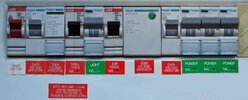
The following installation (for a Two Bedroom Australian house)
has two "Over Voltage Arrestors" - of different "capacities" -
along with the RCBOs and MCBs.

IMG_6939c.jpg
(RCBOs would now be required in a "new" installation for the Wall Oven and Air Conditioner circuits.)
 
Type 1 main board

Type 2 sub boards

Type 3 close to sensitive equipment.

For the price you might aswell, not convinced they do anything mind.
 
For the price you might aswell, not convinced they do anything mind.
That very much understates my personal view of the situation :-)

I am certainly no expert or authority on such matters, but I've spent most of my life working in 'evidence-based' environments - and I think that in this case the evidence (for the usefulness of SPDs in domestic installations) is not only seriously lacking but will probably never be usefully available - since it is, in most cases, very hard to know that damage to electronic equipment has very probably been caused by 'surges'/'spikes'.

I am also concerned that BS7671 has moved away from its traditional position of producing regulations which relate to 'personal safety' to matters of 'risks to equipment', since one has to scrape the barrel pretty deeply to argue that SPDs 'save lives or reduce serious injuries'!

On the other hand, these devices offer considerable benefit to those who manufacture, distribute and sell them, and maybe even slightly to those who install them :-)
 
I am of the same feeling, however I have them fitted, my son does not, and he renews more LED bulbs to me, but no way to prove due to the SPD.
On the other hand, these devices offer considerable benefit to those who manufacture, distribute and sell them, and maybe even slightly to those who install them :)

Lots of electronics here, lots of LED's, I have no SPD's, and no failures to report.
 
Lots of electronics here, lots of LED's, I have no SPD's, and no failures to report.
One can be fed from overhead or underground cables, and be surrounded with houses, or next to an industrial estate. Because one person does not have a problem, it does not mean everyone will have no problems, and if your neighbours have SPD fitted it will also help you.

My 5 kW inverter is an expensive lump, so I would not take the chance, it is up to the owner, unless the owner says don't fit, default it to fit them, but they do not protect personal, only equipment, so the owner can decide.
 
Lots of electronics here, lots of LED's, I have no SPD's, and no failures to report.
Same here. As I've often said, I lived with what is probably a lot more than 'usual' electronics for many decades, in particular way back (in 60s and 70s) when the electronics around was theoretically likely to much more susceptible to 'surge/spike damage' but I can't say I've ever experience a failure which seemed at all likely top be due to surges/spikes.

I therefore stick with my view that it is probably a solution looking for a problem to solve, whilst in the meantime making a fortune for those in the SPD manufacture/supply chain.

Don't forget that it is not all that long ago that, even in this forum, any mention of 'surge protection' generated a lot of responses referring to 'snake oil' :-)
 
... it is up to the owner, unless the owner says don't fit, default it to fit them, but they do not protect personal, only equipment, so the owner can decide.
It seems that a lot of electricians are not making sure that their customers understand that.

Mind you, the ways these things evolve I suppose the day is going to come when BS7671 also 'supersedes' that way of thinking and 'requires' SPDs, even in installations of which the owner doesn't want one. ... and, as I recently wrote, I personally don't think it 'right' that they have slid onto issues which have got virtually nothing to do with personal protection/safety
 
I am certainly no expert or authority on such matters, but I've spent most of my life working in 'evidence-based' environments - and I think that in this case the evidence (for the usefulness of SPDs in domestic installations) is not only seriously lacking but will probably never be usefully available - since it is, in most cases, very hard to know that damage to electronic equipment has very probably been caused by 'surges'/'spikes'.

I am also concerned that BS7671 has moved away from its traditional position of producing regulations which relate to 'personal safety' to matters of 'risks to equipment', since one has to scrape the barrel pretty deeply to argue that SPDs 'save lives or reduce serious injuries'!

I wasn’t paying attention when this was introduced, and for a while I was actually under the impression that it was arc fault detection that was being mandated, not surge protection. Detecting arcs seems likely to be a more effective way of preventing fires than surge protection, IMHO.

I wonder if there are any statistics?
 
I wasn’t paying attention when this was introduced, and for a while I was actually under the impression that it was arc fault detection that was being mandated, not surge protection.
Even SPDs are not (yet!) 'mandated' (well, 'required by BS7671') for normal owner-occupied domestic properties, the owner theoretically able to make a (hopefully 'informed') decision as to whether or not they want them.

AFDDs are 'next in the queue' (even more 'benefit' for manufacturers, distributors, sellers etc.!), but I think a fair way away from being 'required'.
Detecting arcs seems likely to be a more effective way of preventing fires than surge protection, IMHO.
It does, (although I remain sceptical, but partially because I don't know much about this topic) but ....
I wonder if there are any statistics?
I suspect that there may never be any particularly useful statistics (just profit for those mentioned above!) - since I have to wonder how on earth one can determine whether any particular fire (if any!) started as a result of arcing??

I suspect that, as with many things, AFDDs have appeared because it became technologically possible to produce them, without enough (if any!) consideration as to whether they were actually needed to address a significant actual problem, let alone being 'cost-effective'!
 
One can be fed from overhead or underground cables, and be surrounded with houses, or next to an industrial estate. Because one person does not have a problem, it does not mean everyone will have no problems, and if your neighbours have SPD fitted it will also help you.

Most/all delicate electronics, are fed via SMPSU's with a very wide range of acceptable input voltages. Of more use, might be some form of over voltage alarm, than an SPD.
 
Most/all delicate electronics, are fed via SMPSU's with a very wide range of acceptable input voltages. Of more use, might be some form of over voltage alarm, than an SPD.
Alarm could be too late . I think damage could be done
Got below type for my place not fitted yet
 

Attachments

  • IMG_0477.png
    IMG_0477.png
    475.6 KB · Views: 28
Alarm could be too late . I think damage could be done

It depends how quickly, it increases. Many years ago, we had our supply go up to 260v, it was obvious from the tungsten lamps, the voltage had gone up. I was able to simply switch things off, to protect them, then ring the DNO. I have nothing like that now, which would respond to slight over voltage, but a 'voltage alarm' might be handy. Nothing would be damaged, by under voltage.
 

If you need to find a tradesperson to get your job done, please try our local search below, or if you are doing it yourself you can find suppliers local to you.

Select the supplier or trade you require, enter your location to begin your search.


Are you a trade or supplier? You can create your listing free at DIYnot Local

 
Back
Top