
Stopcock weeping

Joined
2 Feb 2016
Messages
488
Reaction score
12
Country
United Kingdom
My home was a newbuild around 15ish years now and under the kitchen sink is one of those brass stopcocks labelled main water stopcock. It’s been fine all these years but recently I had to turned the water supply off and on a few times to do some bathroom work. Since then I’ve noticed that the stopcock seems to be weeping water. I’ve put a little container under it for now as I’m still going to have to turn it off and on a few more times. But wondering is this normal for this to start leaking when it’s used? Is it matter of maybe just tightening the top nut ? Below is a pic of the type of stopcock I have
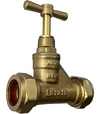
IMG_2970.png
 
And if that does not work open the stopcock to fully open and see if that stops the drip. If that does not work then undo the top nut, slide the body up the spindle and then either wrap 6 turns of PTFE loosely around the spindle and then retighten the top nut forcing the PTFE down into the stopcock body, or instead of PTFE go old fashioned and wrap 4 or 5 turns of suitably sized string that you have waxed by rubbing it with a candle around the spindle and as per PTFE tighten top nut and force it down into the stuffing box, If that doesn't work get a new valve.
 
Quick update on this, it seems it mainly weeps if it's not open enough. I opened it fully and the closed it about 1 full turn and so far it seems to be staying dry. Will keep an eye on it. And when i go to shut it off, as I am shutting it off it starts weeping as it gets closer to the shut position.
 
Quick update on this, it seems it mainly weeps if it's not open enough. I opened it fully and the closed it about 1 full turn and so far it seems to be staying dry. Will keep an eye on it. And when i go to shut it off, as I am shutting it off it starts weeping as it gets closer to the shut position.
Probably the gland packing seal, but still trying tightening it first
 
Stop cocks need to be exercised every three months to avoid any risk ofetting jammed when needed in the event of a serious leak.

In addition the gland nut needs to be kept very slightly tight to avoid the packing leaking as yours is doing.
 
To fix a leaking gland nut on a stop valve.

  • Close the valve completely. Turn clockwise looking down on the handle.
  • Undo the gland nut. This is the small nut, usually hexagonal but occasionally a knurled ring.
  • If the “T” piece for the handle is screwed on in the centre, try and loosen the screw.
  • If possible, remove the handle and the gland nut. If not possible, carry out 6 and 7 below as far as you can.
  • Clean any limescale from the shaft of the tap as far as possible. Use a limescale remover like Kilrock if possible. For any remainder, use fine sandpaper (120 grit or greater) or a fine file.
  • Clean the shaft as much as possible, and make sure there is no roughness to it. A polish with grade 00 wire wool or Brasso is good.
  • Cut a length of PTFE tape. Start with about 10 inches / 250 mm. Twist it into a “string”
  • Wrap the string around the spindle, clockwise looking down from the handle end.
  • Put the gland nut back on the spindle if removed.
  • Push the PTFE down into the body of the tap with something like a thin flat bladed screwdriver.
  • Screw the gland nut back into the body of the valve.
  • Tighten the gland nut so that the spindle can just be turned by hand (with the handle back on if removed).
  • Open the valve and check for leaks.
  • For a slight weep, try tightening the gland nut a little more.
  • For a more serious weep, repeat as above and use more PTFE.
 
Time to replace the stop tap for a new 1/4 lever valve. it's done it's job and is worn now.

PTFE tape is a great stop gap and it will work for a bit but it doesn't stand up for long and the gland will just start to leak again when used in the future.

Find the outside toby, shut it down and replace the stop tap for a nice new full bore lever valve.
 

If you need to find a tradesperson to get your job done, please try our local search below, or if you are doing it yourself you can find suppliers local to you.

Select the supplier or trade you require, enter your location to begin your search.


Are you a trade or supplier? You can create your listing free at DIYnot Local

 
Back
Top