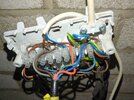
The whole idea of having a micro switch in the motorised valve, is so the valve is open before the boiler and pump fires up. I noted with my father-in-law the by-pass valve was after the motorised valve, had it been before the motorised valve when the micro switch got stuck closed, then the water would have still circulated through the by-pass valve, but since it was not the case, the pump was damaged.
I am not a plumber, just an electrician, but I do wonder over some things I find. However, when setting the lock shield valves in my mother's house, I realised the flow through each radiator is not that much, and I note many boiler's minium output is around 6 kW so if radiators sink less than that amount the boiler needs to cycle on/off.
In the main, mechanical TRV heads do not fully close, but when we start using electronic heads, they tend to have a smaller droop (the temperature between fully on and fully off) I only have one linked TRV head, and at what point they switch and close I don't know what would seem to be a good idea is if two heads demand heat then run boiler, but IFTTT is if this then that, not if these then that.
What I have done is only have one linked TRV head, and I hope if it does call for heat, one or more other TRV will also be at least slightly open.
I am using Wiser, and one can have multi wall or TRV heads, not sure how Tado works, my boiler does not modulate anyway, so always cycles on/off, but with gas it can modulate, both controlled by return water temperature, or direct with something like OpenTherm. Wiser does have OpenTherm, but Tado it depends on the model, in the UK the OpenTherm was for a time stopped, but think it has returned?
I would be interested in comments, and how boilers work with a blocked or seriously reduced output.