

- Joined
- 11 Dec 2024
- Messages
- 17
- Reaction score
- 0
- Country

Hi
I would like to use forms to make turfstone paving.
The 1st batch, I released after 24hr (time constraint), they were solid enough, but it would of benefitted from release agent; (the slabs broke upon removal from mold).
What release agent is recommend for plastic molds? Most products cite metal/ wood use-case. I am considering a silicone aerosol spray…
Another question pertains to finish, of the surface to be walked on.
Consider that council slabs are poured in a form and 10mm basalt is rolled in the top to give an exposed agg finish.
However this is not possible with these forms because the walking surface is at the bottom of mold/form (upside down).
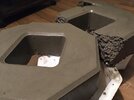
The first batch were smoother than desired. See attachment.
When preparing the cement, Instructions re: water volume were followed, but it seemed too dry to pour into the molds (& for level finish) so i added watrr (maybe too much).
Is it just a question of water volume in a given mix, to attain a finish like that seen on e.g. breeze blocks? (Is there a name for it)?
Thanks
I would like to use forms to make turfstone paving.
The 1st batch, I released after 24hr (time constraint), they were solid enough, but it would of benefitted from release agent; (the slabs broke upon removal from mold).
What release agent is recommend for plastic molds? Most products cite metal/ wood use-case. I am considering a silicone aerosol spray…
Another question pertains to finish, of the surface to be walked on.
Consider that council slabs are poured in a form and 10mm basalt is rolled in the top to give an exposed agg finish.
However this is not possible with these forms because the walking surface is at the bottom of mold/form (upside down).
The first batch were smoother than desired. See attachment.
When preparing the cement, Instructions re: water volume were followed, but it seemed too dry to pour into the molds (& for level finish) so i added watrr (maybe too much).
Is it just a question of water volume in a given mix, to attain a finish like that seen on e.g. breeze blocks? (Is there a name for it)?
Thanks
Attachments
Last edited:


