Unusual wiring on lighting circuit

Joined
15 Jun 2024
Messages
5
Reaction score
0
Country
United Kingdom
I am planning to get a spark to do an EICR but before that I wanted to get an understanding of what I have in my house so I can be prepared. The house was built in the 70s and has the usual additions on additions; so far it makes sense to me but today I found some wiring on one of the lighting circuits that looks very odd. There is a soldered connection which I believe to be the neutral wire coming back from a light fitting connecting back to the circuit (normal so far) but also soldered here is a 3 core and earth wire, looks like 1mm, and ALL cores are soldered to the joint. I know for a fact that this connection is required to make the lighting ring function correctly. This is an old wire certainly (red, black and grey). But does this make any sense? Why would anyone do that? As I say, I will get and EICR so perhaps this question can be answered then.
 
Last edited:
Lighting circuits aren't usually wired in a ring. Ring is not just another word for circuit.

Consequently I cannot follow your description.


Would some pictures help us? Just copy and paste them.
 
The idea of a ring final is to allow 2.5 mm² cable rated at 20 amp to be used with a 32 amp supply, it is unique to the British 13 socket system, and requires that the plug contains a fuse, and the polarity is correct.

It is rare that lighting is run as a ring.

Three core cable is used for two reasons, one for two-way switching, and two to get a neutral to the switch, as standard there is no neutral to the British light switch.

In the main soldering is founded on, it can two easy disconnects, to connect cables by twisting then wet with solder is OK, but solder is not good for physical connection.

However to progress it really needs a picture.
 
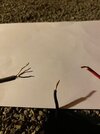
Apologies, I used the term 'ring' incorrectly and edited the post accordingly. Sorry for the confusion. I attached a photo; imagine the three cables you see are all soldered together including ALL the cores in the smaller 3 core cable (this was how I found it). As I say, I will have someone qualified do a proper inspection but I wondered before that if a) this is in any way typical on a lighting circuit and b) if it could be dangerous.
 

Attachments

  • IMG_0143.jpg
    IMG_0143.jpg
    71.3 KB · Views: 115
What does it look like in the fitting. By soldered together do you mean all cores in each of the wires?
 
I cannot easily trace the wires all the way but I believe the red wire is the neutral coming back from a ceiling lamp. And, yes, all the cores of all wires in this picture were twisted together and soldered.

I removed that joint because it was in a terrible location and reconnected using a connector block. But it seems very odd to use a 3 core cable in this way; I suppose all the cores are shorted together as if they are a single core?

This is clearly very old wiring, I am guessing perhaps that the spark at the time had some spare 3 core cable and decided to use it like this?

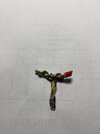
Additional: I took a photo of the removed soldered joint where you can see all cores twisted and soldered. This looks pretty terrible to my untrained eye.
 

Attachments

  • IMG_0145.jpg
    IMG_0145.jpg
    37.4 KB · Views: 104
Last edited:
Looks amazingly dodgy to me! I‘m fairly certain the 3-core isn‘t meant for mains wiring and the person who installed it knew that. The cores are much too small and the original bodger tried to circumvent that by using all three in parallel. Needs to be replaced completely.
 
I cannot easily trace the wires all the way but I believe the red wire is the neutral coming back from a ceiling lamp. And, yes, all the cores of all wires in this picture were twisted together and soldered.

I removed that joint because it was in a terrible location and reconnected using a connector block. But it seems very odd to use a 3 core cable in this way; I suppose all the cores are shorted together as if they are a single core?

This is clearly very old wiring, I am guessing perhaps that the spark at the time had some spare 3 core cable and decided to use it like this?

Additional: I took a photo of the removed soldered joint where you can see all cores twisted and soldered. This looks pretty terrible to my untrained eye.
Unless you can trace where the wires lead to and replace them with a single neutral core and jb (if that is what is required) you will need a sparky, so it makes sense to leave it for the EICR.
 
Thanks all. You have confirmed there is no sane reason to do this, simply a bodge. I will accelerate the EICR!
 
Get the EICR done and this problem will be flagged in the EICR.
Maybe, but it would probably be advisable for the OP to bring this issue to the attention to the person undertaking the EICR, since what we've been shown is not necessarily in a place where it would inevitably be seen/inspected by an 'inspector'.
 
Just make sure the spark doing the EICR spends a decent amount of time looking at the installation and every circuit
 
Maybe, but it would probably be advisable for the OP to bring this issue to the attention to the person undertaking the EICR, since what we've been shown is not necessarily in a place where it would inevitably be seen/inspected by an 'inspector'.
Exactly my reasoning for understanding my own house prior to getting a professional in. The wiring in question is in fact in a loft above the garage and utility and probably installed many decades ago so I don't want any chance of an inspector missing something on the basis that it's hidden or inaccessible.
 
Exactly my reasoning for understanding my own house prior to getting a professional in. The wiring in question is in fact in a loft above the garage and utility and probably installed many decades ago so I don't want any chance of an inspector missing something on the basis that it's hidden or inaccessible.
Indeed. Virtually no EICR involves looking inside every switch, light fitting, junction box etc. etc. - so there's always a chance of something, even something 'horrendous' being missed if one is not prompted to look in places of concern.
 

If you need to find a tradesperson to get your job done, please try our local search below, or if you are doing it yourself you can find suppliers local to you.

Select the supplier or trade you require, enter your location to begin your search.


Are you a trade or supplier? You can create your listing free at DIYnot Local

 
Back
Top