
Vibrating/ droning sound since new hot water cylinder was installed.

Re the Honeywell zone valves. With the valve de energized, the "manual" lever can be pulled across against a fairly stiff motor resistance and then pushed up and latched almost fully open, this (on Honeywells), does not fire the boiler, its main purpose is to manually open the valves when draining/filling the system. If the valve is then energized the motor will drive the valve very fully open, the lever will fall down out of its latch, the auxiliary end switch in the actuator will then close to fire the boiler, when the valve is de energized then the valve will reclose because its no longer latched in.

Next time the droning is at its worst, ensure both zone valves de energized, then fire up the boiler on heating (rads) only, see does the noise return, if not, manually latch open the HW zone valve and check for noise.
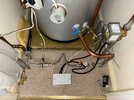
 
When droning noise started, I ran the hot tap, the noise stopped instantly. The longer I ran the hot tap the longer it takes for sound to return. It’s droning continuously this morning, not initially… when it first comes on at 6.20am (timed on the programmer) because it hasn’t been on all night, it initially heats quietly. It’s when the cylinder must be full of hot water, when it’s at its worst. So when the boiler fires up intermittently. The droning starts. It has just droned constantly for 5 minutes more, had a 2 minute rest and then starts again.
Once you run off a few litres of HW then there is no expansion effect even if the cylinder is still being heated so a bit strange that the noise returns with the HW still opened?.
Again, until my dying day, I will never understand why a pressure vessel like a unvented HW Cylinder doesn't have a pressure gauge.
 
No, it wasn’t an open vented.

Arrow on the brass valve body: indicates the intended direction of water flow. The valve must be installed in the correct direction for that model and circuit.
Motorised head: on many Honeywell 2-port valves, the actuator head can be fitted in several permitted orientations, depending on the exact model. It doesn’t generally have to point in the same direction as the arrow.
 
I found another forum, with a guy who had the same cylinder as me installed, with the same annoying aircraft droning sound. Apparently Gledhill cylinders are known for their coil vibration. In this particular instance, the issue was resolved by the plumber adjusting the gate valve.
If I don’t have a gate valve, shouldn’t I have a ABV installed? Like Mister Banks said
 
A ABV normally opens when the (last) zone valve closes to enable the boiler circ pump to overrun and circulate water for a minute or so to cool down the boiler heat exchanger after it shuts down.

This gate valve may have been installed on the cylinder heating coil return and throttled in.
 
are you referring to separate manual isolation valves on the HW circuit?
This is a manual valve I was thinking of, looks like it's on the cylinder primary outlet. There might be other valves we can't see.
 

Attachments

  • IMG_0505-1.jpeg
    IMG_0505-1.jpeg
    722.8 KB · Views: 9
When droning noise started, I ran the hot tap, the noise stopped instantly. The longer I ran the hot tap the longer it takes for sound to return. It’s droning continuously this morning, not initially… when it first comes on at 6.20am (timed on the programmer) because it hasn’t been on all night, it initially heats quietly. It’s when the cylinder must be full of hot water, when it’s at its worst. So when the boiler fires up intermittently. The droning starts. It has just droned constantly for 5 minutes more, had a 2 minute rest and then starts again.
That sounds to me like it's reaching HW setpoint, so the HW motorised valve closes, but the pump continues to run.
 
That sounds to me like it's reaching HW setpoint, so the HW motorised valve closes, but the pump continues to run.
That's well worth investigating if the droning only occurs after/when the HW zone valve closes and stops droning when the circ pump finishes its overrun time, assumes HW heating only on.
 
The vibration and droning noise is most intense on the pipe that feeds into the cylinder. Pipe with HW 2 port valve on. The nearer the cylinder the more it vibrates, which in my opinion confirms the cylinder’s coil vibration.?
 
At least this narrows down the problem now.

Just confirm that the pipe with the highlighted valve is the return from the cylinder coil, to be sure to be sure, feel it while the cylinder is being heated, it will/should be cooler (around 15C) than the coil inlet pipe (with zone valve).
That valve (IF) on the coil return is now not normally installed (and might even be against regulations), its also a bit "special" in that it requires a key to open/shut ibstead of just the normal wheel type gate valve, the coil on these cylinders is I'm pretty sure, corrugated, to give more turbulence/better heat transfer in the 16kW heating coil, this coil, with a 15C dT will require a flowrate of ~ 15LPM to heat 200L from 15C to 60C in 30 minutes. I know in some cases (corrugated coil) that the flowrate is from bottom to top to avoid noisy operation but don't recall any return throttling valve being installed.
So, suggest check direction of coil flow by feeling coil flow/return pipes, then get something to check the valve opening, if throttled in, open it fully and see how it goes, you could also ask your installer if that valve is part of the Gledhill supply or his own idea.

Inlet/outlet or flow/return might be labelled where the coil pipes enter the cylinder or it might state it in the MIs.

Edit: OR, maybe throttle in that valve if fully open to 3/4 to 1 full turn open.

1791873874151.png
 
Last edited:

If you need to find a tradesperson to get your job done, please try our local search below, or if you are doing it yourself you can find suppliers local to you.

Select the supplier or trade you require, enter your location to begin your search.


Are you a trade or supplier? You can create your listing free at DIYnot Local

 
Back
Top