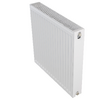
In the main, we balance installation cost with performance. But reaction time can be important. So two ways to heat a home, 24/7 or as required. We hear arguments for both, but I go for as required, this means time taken to heat the room is important. But also the space taken by the radiator is also important, so we have two completely different types of radiator, convection and fan assisted.
In the days before the modulating boiler, we could mix and match, but today return water temperature is important, as it turns down the boiler output. And the two radiators use two very different control methods, the convection radiator used water flow control, and the fan assisted uses air flow control.
So the convection use parallel plumbing and a by-pass valve, and the fan assisted used series plumbing and has no need for a by-pass valve.
There has been an attempt to combine
and also using kick space radiators in kitchens, having just one fan assisted with parallel plumbing seems to work.
The main advantage with fan assisted is it does not matter if mounted high or low, it will still heat the room, so if we are looking at globule warming and having to both heat and cool the home, the fan assisted works far better, as it can connect to either a heat pump to cool or a gas boiler/water heater, to heat, and use the same radiators.
However, when I looked at the ivector with that idea in mind, the cost of the building management system was silly, so really does not matter how good it is, it will only be used in large commercial buildings, not our homes. It is just a pipe dream.
The same with multi-fuel
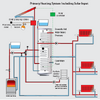
it looks good, but installation costs are silly. I have seen it used once, and yes worked well, but in real life, that tank is two massive 80 gallon cylinders, which need a reinforced floor to take the weight, so only really an option with a new build.
To become an engineer, one needs to go to University and get a degree, and if one has invested in that education, one wants pay to match, so paying for a heating and ventilation engineer to design the system is something most don't do.
To look at an existing home, we already have info as to how much gas/oil is being used, I know my boiler (20 kW) can keep this three story house warm, and I know the living room radiators are around 4 kW and they keep the living room warm, I know a 2 kW fan heater is enough to keep any room in the house warm, so without loads of calculations, I have a reasonable idea of what I need to maintain the temperature. Around 10 kW for whole of house on coldest days of the year.
What however I don't know, is if I want to re-heat my living room from 14°C to 22°C in ½ an hour, what I would need. That's where the engineer earns his money. He can work out a delta whatever, and tell me how much energy to heat 20 x 8 x 7 foot room 8°C is needed. The losses when looking at ½ an hour are not really an issue. But if I want it in 2 hours, then losses matter a lot more.
So with a modulating boiler the aim I am told, is not to turn it off, but to turn it up/down, there will be a point where it can't modulate any more, so just as important not to be too big, as not to be too small. And where every possible we want modulating controls. But modulating controls cost more.
So in the main we are looking at near enough engineering. And what is near enough for you, may not be near enough for me. There is no magic wand.