• Looking for a smarter way to manage your heating this winter? We’ve been testing the new Aqara Radiator Thermostat W600 to see how quiet, accurate and easy it is to use around the home. Click here read our review.

(Water running through) Cellar construction (Ed.)

Joined
2 Oct 2024
Messages
8
Reaction score
1
Country
United Kingdom
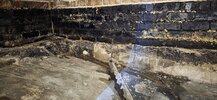
Good morning. I am not a builder and the photos are from an inherited property. This is the cellar that extends throughout the whole footprint of the 1934 built bungalow in Blackpool. Water runs through the cellar from front to back (the property is below street level and the cellar floor has a good fall from front to back). I am trying to understand the build method here as the bricks appear to sit on top of the material underneath which is falling away in little bits at various areas. I am also of course wishing to know if I should be doing something from a building perspective. Thank you

 

Attachments

  • 20250419_072741.jpg
    20250419_072741.jpg
    505.4 KB · Views: 80
  • 20250419_072753.jpg
    20250419_072753.jpg
    448.7 KB · Views: 77
  • 20250419_072817.jpg
    20250419_072817.jpg
    418.1 KB · Views: 77
Is the material a cement render, are there bricks behind it? You could carefully dig some trial holes but if water is flowing freely it’s a bigger picture.
 
If the cellar is sloping, and water is running through it, it may be that you are on a hill and groundwater from a stream or other source is running in the ground. It would reduce in times of drought. It is possible to intercept such water and lead it past the side of the building.

However, if the source is a broken drain or a leaking pipe, it would be possible to repair it. Pipes and drains 90 years old commonly leak.

Do neighbours with similar homes have the same problem?

Dig some holes uphill of your house and see if they have water in them.

Does the water get worse after rain? Or after a bath?

Is the water worse close to to pipes, sewers, manholes?

Are you in an area of hard water, leading to lime scale in kettles? This leads to white deposits on bricks. Leaking sewers contain traces of soap, and organic matter.

Lime mortar is softened and washed away by long term water, but cement mortar and concrete are undamaged, and actually gain strength. You will be able to tell by scratching it with a fingernail. A house of your age could contain either or both.

Are the black bricks painted? It might be bituminous paint in an attempt to hold back damp.
 
Is the material a cement render, are there bricks behind it? You could carefully dig some trial holes but if water is flowing freely it’s a bigger picture.
Thanks for your response. I do not know what the material is but i would say it was concrete. There are areas around the walls where it is breaking down and coming away in bits. It is also soft and compressable in places. I dug a hole from the inner towards the out leaf and all i found was soil so the bricks above are unsupported. I am really worried about this and considering a structural survey now. A building survey made no mention not gave any concerns about the foundation, only mentioning that water passes through the concrete / screed cellar floor following mortar 'paths' that the previous owner had ade to direct it out into the back garden.
 
If the cellar is sloping, and water is running through it, it may be that you are on a hill and groundwater from a stream or other source is running in the ground. It would reduce in times of drought. It is possible to intercept such water and lead it past the side of the building.

However, if the source is a broken drain or a leaking pipe, it would be possible to repair it. Pipes and drains 90 years old commonly leak.

Do neighbours with similar homes have the same problem?

Dig some holes uphill of your house and see if they have water in them.

Does the water get worse after rain? Or after a bath?

Is the water worse close to to pipes, sewers, manholes?

Are you in an area of hard water, leading to lime scale in kettles? This leads to white deposits on bricks. Leaking sewers contain traces of soap, and organic matter.

Lime mortar is softened and washed away by long term water, but cement mortar and concrete are undamaged, and actually gain strength. You will be able to tell by scratching it with a fingernail. A house of your age could contain either or both.

Are the black bricks painted? It might be bituminous paint in an attempt to hold back damp.
Thank you John. I am in the UK btw, so we get little in the way of drought.
The cellar slopes front to back. A buidling survey recommended an ACO drain at the front to reduce water run off to the outside wall. That has yet to be installed. The water comes in at the front about 4 feet below the ground level. It just comes / soaks through the ?concrete foundation in the photos / the bricks.

Post building survey I had 2 CCTV drain inspections and although there are joint issues, the drains are serviceable and do not leak in such a way that this could be the cause so I am content I only see the water during times of rain.

I assume your mention of lime mortar is that used to build the walls. I am unsure what it is but it seems in sound enough condition.

I think the black paint is regular brick paint as there has been some useage on the outside.
 
Thanks for your response. I do not know what the material is but i would say it was concrete. There are areas around the walls where it is breaking down and coming away in bits. It is also soft and compressable in places. I dug a hole from the inner towards the out leaf and all i found was soil so the bricks above are unsupported. I am really worried about this and considering a structural survey now. A building survey made no mention not gave any concerns about the foundation, only mentioning that water passes through the concrete / screed cellar floor following mortar 'paths' that the previous owner had ade to direct it out into the back garden.
It’s lasted 90 years without modern footings. I would get an estate agent with knowledge of the area to do a valuation. Then test the market. The onus is on the buyer to do a valuation and survey. Otherwise you are spending money with an uncertain outcome. Or do it up and let it out as it is.
 
It’s lasted 90 years without modern footings. I would get an estate agent with knowledge of the area to do a valuation. Then test the market. The onus is on the buyer to do a valuation and survey. Otherwise you are spending money with an uncertain outcome. Or do it up and let it out as it is.
Thanks. My intention was to live in the property and let mine out, being like my pension, so i would really like o keep two properties. I have had cavity wall insulation removed to address minor damp issues, i have a full rewire booked in, I am having cavity wall ties replaced and after that I shall be decorating each room. Perhaps I should continue as I am, make sure the building is insured adequately, let out my house and live in the new one for 10 years (which would fit my plans) and then sell and move. Hopefully the foundations will remain intact and not present issues in this time and i can sell and recoup monies (just need to draw even, not lose). Apologies, I inherited from my Mum and had every intention of taking the property over, my head has been all over the place and perhaps I am worrying too much about these things.
 
Thanks. My intention was to live in the property and let mine out, being like my pension, so i would really like o keep two properties. I have had cavity wall insulation removed to address minor damp issues, i have a full rewire booked in, I am having cavity wall ties replaced and after that I shall be decorating each room. Perhaps I should continue as I am, make sure the building is insured adequately, let out my house and live in the new one for 10 years (which would fit my plans) and then sell and move. Hopefully the foundations will remain intact and not present issues in this time and i can sell and recoup monies (just need to draw even, not lose). Apologies, I inherited from my Mum and had every intention of taking the property over, my head has been all over the place and perhaps I am worrying too much about these things.
If the cellar channels are doing the job and there are no structural issues, doing it up and living there seems an equally sensible option.
 
If the cellar channels are doing the job and there are no structural issues, doing it up and living there seems an equally sensible option.
The water is not massive amounts but it just caused me concern as to its effect on the building materials. The channels work well so water is not sat in the cellar. There were some minor internal cracks in plaster but think this is old and / or due to temperature. There are no bulges in walls or zig zag cracking and everything to date points to the property being structurally sound. I think because I am an engineer I look deep into stuff, perhaps too much. I just want to assure myself hence my thought about a structural survey, but I have already shelled out over £1500 on building and damp surveys. I appreciate your comments that put my mind a little at ease. I guess also its about how I would stand with buidlings insurance in the event of something 'big' happenning.
 

If you need to find a tradesperson to get your job done, please try our local search below, or if you are doing it yourself you can find suppliers local to you.

Select the supplier or trade you require, enter your location to begin your search.


Are you a trade or supplier? You can create your listing free at DIYnot Local

 
Back
Top