• Looking for a smarter way to manage your heating this winter? We’ve been testing the new Aqara Radiator Thermostat W600 to see how quiet, accurate and easy it is to use around the home. Click here read our review.

Waterproofing a bunker?

Joined
15 May 2013
Messages
389
Reaction score
5
Country
United Kingdom
Hi all, around 4years ago I decided to build a bunker in our garden. It was fine for the 1st year then water has started to fill up the inside. It has been built with concrete blocks laid sideways. Painted with tanking slurry inside and out but also bitumen paint on outside and wrapped in 4 layers of plastic sheets. Also French drain on the outside. We have two pumps buried in the gravel of the French drain working from solar power. We plan to put another pump internally linked to a float switch. I was wanting to rescue this build this summer whilst the water table is low. Has anyone got any advice on what I could add to the tanking slurry on the inside to make it less permeable to water ingress? I'm hoping there's some kinda of swimming pool coating that might work. It's 1.9m deep.
Any advice would be greatly appreciated, thanks
 
Very doubtful any kind of coating you add will be effective, you need a physical barrier held against the wall with a block wall or to utilise a drained and pumped system from the likes of Newton or Permagard or similar. What's the purpose of the bunker?
 
Very doubtful any kind of coating you add will be effective, you need a physical barrier held against the wall with a block wall or to utilise a drained and pumped system from the likes of Newton or Permagard or similar. What's the purpose of the bunker?
Increased risk of nuclear war.
 
Thanks for the reply. No purpose other than I like building quirky things. I have also built a summerhouse which goes 1m underground... a hobbit house and shepherd's hut. All in a rather large countryside garden. I tend to do this stuff so I don't end up wasting time on Netflix and negate the need to goto the gym
I'll add the internal pump and see how it fairs up. I was looking at a product called bostik aquaprufe but it says it dries tacky and needs 50mm of screed to be effective. I was also looking into epoxy based coatings. Whatever I choose to use it needs to adhere to the 17 or so layers of tanking slurry I've put on the inside. Outside had around 3 layers of tanking slurry and black jack bitumen paint. It would be nice to rescue it as I've had a knackered elbow ever since building this anyhow... no pain no gain they say.
Also I wonder if hydrostatic pressure plays a part in water ingress which is different in my case from say a swimming pool as swimming pools are usually filled providing positive pressure from the inside. That being said when a swimming pool is drained it still doesn't seem to have leaky walls or floor.
Thanks again for any pointers
 
Just to note the walls are made from concrete blocks laid on there side so around 22cm thick wall. Slab is 6inch thick with added waterproofer in the mix. Where the floor meets the wall I have sloped up some mortar a bit like cap and coving you see in commercial bathrooms/toilets etc. The ceiling is rsjs with suspended ceiling on top and 2 layers of reinforcing mesh embedded in the slab, a bit like multi storey car park construction...ish.
Thanks
 
Swimming pools tend to be built with waterproof concrete or are tanked on the outside, hydrostatic pressure plays a huge part in any tanking and can be used to your advantage as you figured, meticulous application of suitable products is required, tanking slurry and black jack are no match for 1.9m and were destined to fail. Anything applied to the inside will just be pushed off by hydrostatic pressure (as evidently you know, to your cost), If you look at the technical blurb for Vandex and the like they will say what hyrdostatic pressure they can cope with but to the layman and without understanding your ground (soil) characteristics and water table etc the figures mean very little.

Hence you have to build a block wall against whatever you apply internally to prevent that from happening, or have a free draining system as mentioned.

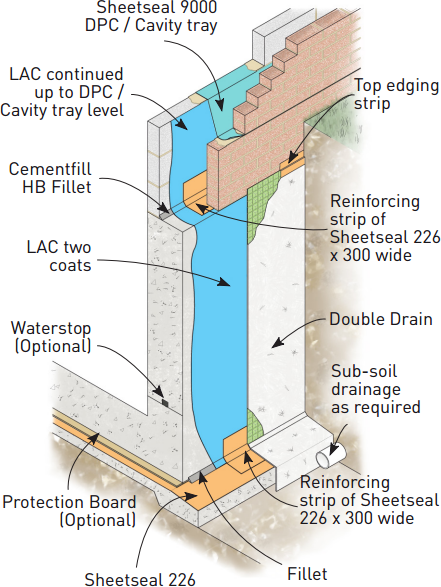
Have a look at the likes of RIW or Visqueen for guidance as to what should have been done on the outside (but too late now of course) eg:


lac-detail-1.png
 
Thankyou for your reply. Yes it would be quite alot of hassle taking out all the French drain. Not impossible in the future as I'm planning to get my own digger in the next couple of years. We did put antinox sheets outside the outside of the plastic dpm sheets also. Mainly to prevent the 4 layers of dpm being pierced by stones. Just wondered at this point if there's any additive to put on the inside to slow the ingress but I think an internal pump is the answer.
Originally I had this mad idea about putting a pool table down there and building around it but by now it would of disintegrated to mush.
Maybe turning this project into a biodisc water harvester for pumping water to crops would be a more realistic use.
The bostik aquaprufe dries tacky and needs a 50mm screed to work properly. That might be an alternative to building a wall on the inside of the wall. But somehow I can't see the screed holding back the hydrostatic pressure.
If all else fails I could use it to grow lionsmane mushrooms which seem to be all the rage at the moment
 
Thankyou for your reply. Yes it would be quite alot of hassle taking out all the French drain. Not impossible in the future as I'm planning to get my own digger in the next couple of years. We did put antinox sheets outside the outside of the plastic dpm sheets also. Mainly to prevent the 4 layers of dpm being pierced by stones. Just wondered at this point if there's any additive to put on the inside to slow the ingress but I think an internal pump is the answer.
Originally I had this mad idea about putting a pool table down there and building around it but by now it would of disintegrated to mush.
Maybe turning this project into a biodisc water harvester for pumping water to crops would be a more realistic use.
The bostik aquaprufe dries tacky and needs a 50mm screed to work properly. That might be an alternative to building a wall on the inside of the wall. But somehow I can't see the screed holding back the hydrostatic pressure.
If all else fails I could use it to grow lionsmane mushrooms which seem to be all the rage at the moment
I have yet to see an (ordinary spec') sub-terranean structure, that could serve as a habitable room. The battle to keep out damp and that mouldy cold feel, is an enormous and costly undertaking. Even then, after chucking tens of thousands at 'em, they can still disappoint.
 
I blame Colin Furze for this nonsense.

It looks like he has exceptionally unusual ground, in that it's crumbly and free-draining very deep sandstone. Most who are inspired by him will end up with a boggy ditch in the clay gloop that most of the country is based upon.

Fill it in and find a fun sport to do!
 

If you need to find a tradesperson to get your job done, please try our local search below, or if you are doing it yourself you can find suppliers local to you.

Select the supplier or trade you require, enter your location to begin your search.


Are you a trade or supplier? You can create your listing free at DIYnot Local

 
Back
Top