• Looking for a smarter way to manage your heating this winter? We’ve been testing the new Aqara Radiator Thermostat W600 to see how quiet, accurate and easy it is to use around the home. Click here read our review.

What is a "suitable meter"?

If you say so - and want to do everything in the middle of the night.
I don't think that cheap periods are by any means all 'in the middle of the night'.

Indeed, as I've often said, if/when EVs become very widely deployed, it wouldn't surprise me if we see a 'circadian reversal', with the cheapest electricity being in 'the middle of the day' (which sounds as if it would suit you :-) ) !
 
The point you are missing is that "cheap periods" and "cheapest" are relative.

If you are being ripped-off some or most of the time the rest will be "cheaper" (and not a "saving").
 
If the time signals on R4 offered value to enough people, then the valves would be worth producing. Obviously they do not..
The cost of replacement valves or other parts is irrelevant.

It's the ongoing cost of operating the transmitters to control obsolete teleswitches for which the replacement already exists, and for the ever decreasing number of people who might need to listen to R4 on longwave.
The electricity for the primary transmitter alone will be in excess of £1m per year.
 
You have the freedom to switch suppliers, within days, your supplier must advise you in advance of any changes in your tariff - so what's the problem?
I went, in hindsight in error, to British Gas EV rate. Yes, could leave, but a £75 charge for leaving, resulted in my remaining until the term had expired. I note some Octopus tariffs also have a leaving charge, but not as high.

I note a variation in both start and stop of off-peak, with start times from 11:30pm to 2am, and finish from 5am to 7:30am. With no solar or no battery, it would not matter, but with solar and batteries, one does not want to pay to charge a battery, then have to export that power for less money. 11:30pm to 1am would suit me, but clearly not there to suit me, it is to suit the supplier.

But for someone like me, who can have a smart meter, and can afford solar, and batteries, it is not really a problem, annoying to pay over the odds, but not a problem.

Where the problem lies, is someone living on a shoe string, being told their storage radiators will stop working, and there seems to be nothing published to tell them how to get around the problem.

If before the 11th hour, we know how to do it, then we can advise, but "suitable meter" does not really help anyone.

For my tumble drier, it takes around 2.5 hours, as I go further from the start time, it moves from ½ hour to 1 hour increments, and one of the Octopus tariffs was only for 3 hours, 2am to 5am, so to set it to run in that slot could be a challenge.

The off-peak rate of 17.1p/kWh also seems a bit high, when other tariffs have 7p/kWh 23:30-05:30 much longer and much cheaper and also cheaper standard rate 27.26p against 28.5p standard and 39.9p peak, it seems EV owners are being given preferential treatment, although more likely because Octopus can control the EV charger.

Those with solar inverters that allow the supplier to control when batteries charge and discharge are also given special rates.
Your smart meter will have a fixed off-peak 7 hour period from 00:30 to 07:30. This time period takes place according to Coordinated Universal Time (UTC), so during British Summer Time (BST) the 7 hour period will take place between 01:30 and 08:30. This may differ from your existing off-peak period on your current non-smart meter.
Octopus Energy's Flexible Octopus Economy 7 tariff has a peak rate of 34.44p/kWh and an off-peak rate of 14.45p/kWh as of May 1, 2025, at 17:00:05.
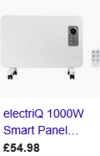
That is one heck of a price for electric. I pay 25.37p/kWh and 68.17p/day standing charge. Considering the 34.44p is summer and winter, it would seem those with storage radiators are being ripped off. I would think most people would be better off with panel heaters, and only heat a room as and when required.

But I could afford some panel heaters 1746209626047.pngbut often people with economy 7 are not flush with money, I would need 15 for this house, that's £850, OK a large house, but my daughter would end up with one and carry it room to room, as to heating a bathroom, maybe need to go back to old tin bath on back of out house door?

 
I went, in hindsight in error, to British Gas EV rate. Yes, could leave, but a £75 charge for leaving, resulted in my remaining until the term had expired. I note some Octopus tariffs also have a leaving charge, but not as high.

A recent introduction I understood, to relieve their staffs workload, from people switching too frequently.
 
For my tumble drier, it takes around 2.5 hours, as I go further from the start time, it moves from ½ hour to 1 hour increments, and one of the Octopus tariffs was only for 3 hours, 2am to 5am, so to set it to run in that slot could be a challenge.

All it needs, is some intelligent system, to look at the cost, and to turn it on at the right time.
 
The point you are missing is that "cheap periods" and "cheapest" are relative. .... If you are being ripped-off some or most of the time the rest will be "cheaper" (and not a "saving").
I'm not sure whether the problem is that you don't understand the arithmetic of these tariffs, or what.

Do I take t that when you talk of "being ripped-off some or most of the time" you are referring to the fact that if price at some times of day is less than would be the case with a single-rate tariff, it is usually the case that price is higher at other times of day than would be the case with a single-rate tariff?

If so, then people would only get 'ripped off' if they ('stupidly') chose a tariff which was (financially) unsuitable for their usage pattern. With any of these TOU tariffs, there is inevitably a point of usage pattern beyond which one's total bill will be less than it would have been with a single-rate tariff ("a saving") - and (sensible) people should only chose a tariff if they were (or could become) 'beyond that threshold usage pattern' for the tariff concerned.

Take my E7, which is the simplest example for such a tariff. Whilst I pay less than single-rate price for "cheap rate" ('night') electricity, as you imply, I pay a bit more than single-rate price for 'peak rate' ('day') electricity. However, it requires only very simple arithmetic to work out the proportion of one's usage at "cheap rate" beyond which the total bill ('peak' + 'off-peak') is less than it would be with a single rate tariff - so, if one's proportion of 'off-peak usage' is above that threshold (which mine is) , there will, indeed, be a true 'saving' (in comparison with single-rate tariff)

Exactly the same is true of any TOU tariff, no matter how complex, although the arithmetic obviously becomes a it more involved with increasing complexity of the tariff.
 
The cost of replacement valves or other parts is irrelevant.
Indeed not. In fact, the cost of completely replacing the transmitter with a modern one using currently readily-available components/devices would undoubtedly be trivial in the context of the big picture.

As you go on to say, I'm sure the issue is the 'running costs' for a service for which there is little, and decreasing, demand from 'BBC listeners'. Of course, if the electricity supply industry were prepared to pay most/all of those running costs, then the goalposts would move!
 
I don't think that cheap periods are by any means all 'in the middle of the night'.

Indeed, as I've often said, if/when EVs become very widely deployed, it wouldn't surprise me if we see a 'circadian reversal', with the cheapest electricity being in 'the middle of the day' (which sounds as if it would suit you :) ) !
Quite:

1746216116057.png
 
Take my E7, which is the simplest example for such a tariff. Whilst I pay less than single-rate price for "cheap rate" ('night') electricity, as you imply, I pay a bit more than single-rate price for 'peak rate' ('day') electricity. However, it requires only very simple arithmetic to work out the proportion of one's usage at "cheap rate" beyond which the total bill ('peak' + 'off-peak') is less than it would be with a single rate tariff - so, if one's proportion of 'off-peak usage' is above that threshold (which mine is) , there will, indeed, be a true 'saving' (in comparison with single-rate tariff)
I can't work out what my use will be. I am sure heart of winter off-peak works well, but also paying over the odds in summer. I use around 12 kWh per day, so if I had 4 batteries and no solar, I could run with off-peak 24/7 with a 3 hour charging slot.

But I only have 2 batteries, and I have got solar, this time of year, don't want off-peak, many days I don't use any grid power, but have to balance it with Winter use.

For me, three machines, use most of the power, and I can delay their use. But to move from storage radiators to panel heaters costs money. And those who rent, likely don't have the option. So back to the question, what is a suitable meter?
 
I'll bet the most expensive electricity remains in the evening though.
That will certainly be true for the foreseeable future, but I'm far from sure about what will happen 'eventually'.

If/when we approach the situation when all vehicles (including commercial ones) being EVs, a pretty high proportion of those being charged overnight, I think that could well come to overshadow the usage for cooking etc. which currently results in the early evening peak demand.
 
I'll bet the most expensive electricity remains in the evening though.
This is what I looked at, 4:00pm to 7:00pm at 39.9p/kWh one needs to be sure you will not run out of battery. Yes, could force charge it at 28.5p/kWh before then, but would I remember? I have had a year putting the three machines on either when there is solar or off-peak, and really is it worth the effort? The washing machine and dishwasher have a high use to start with, then used very little, and the drier only 600 watt, but for 2.5 hours, getting it on early enough was a problem.

But with British Gas at 8.95p/kWh off-peak, likely worth the effort, but Octopus Flux 17.1p/kWh and only for 3 hours, and the feed in tariff also less at 10.54p/kWh so a straight 25.37p/kWh import and 15p/kWh export seems a better option with no messing around.

However, this is all well and good for someone without electric storage heaters. My bill is around £60 a month average, but I am sure with storage heaters we are looking at a lot more, and it is easy to say move to a heat pump, but the installation costs and disruption means for many this is not an option.

So back to the original question, for someone who smart meters will not work, what is that "suitable meter" as the question is bound to be asked, teleswitch has stopped working, what do I do now?
1746257520835.png
1746257702952.png
1746257880984.png
contactor, not a huge amount, neither is the timer, latter rated 16 amps, but there would not be room in my consumer unit. So add one of them. And now looking at a £65 bill without labour.

So the user wants a unit which also does the switching, which will be fitted by the supply company. Specially if the property is a rented one, the tenant does not want to pay out, and neither will the landlord. So we look at the retired couple in the Welsh hills, those working could not live there, as could not get to work in the Winter, where some time in the distance past, someone has ripped out the Aga stove etc. And fitted storage radiators. Which unless they get that "suitable meter" will stop working.

So what is that "suitable meter" before we get the "my gran" questions on here, so we at least know the answer.
 
Do I take t that when you talk of "being ripped-off some or most of the time" you are referring to the fact that if price at some times of day is less than would be the case with a single-rate tariff, it is usually the case that price is higher at other times of day than would be the case with a single-rate tariff?
No, I am talking of the huge price rises in the U.K. in recent years.
 
I can't work out what my use will be.
You surely can make a reasonable estimate of your (total) electricity usage, since that depends only on practices, habits and lifestyle?

For those with 'just' a 'smart' meter (no solar or batteries, the calculations ae very simple/straightforward, as described in my previous post.

However, when one adds solar (alone - no batteries) to the equation, things get a bit more complicated, since what matters is import, not 'usage'. With the example of my simple E7 tariff I used as an example, the proportion of import during ('night') 'cheap hours' will vary during the year - the proportion being greatest in mid-summer, when 'peak time' ('day') import will be at its lowest (possibly zero). It therefore could be that such a tariff would be financial advantageous (in comparison with a single-rate one) in summer, but financially disadvantageous during Winter - one would therefore have to try to work out whether, on balance, there was net advantage or disadvantage over a year as a whole.

If one has batteries as well as solar, it gets even more complicated, since if the batteries are allow solar-generated electricity to be used during what would be 'cheap import hours', the effect will be to reduce the proportion of one's import during those 'cheap hours', possibly making such a tariff financially disadvantageous.

Having said all that, you are obviously not alone in having solar _+ batteries, so I imagine that some suppliers (particularly Octopus) probably offer tariffs that are specifically tailored for such customers.
 

If you need to find a tradesperson to get your job done, please try our local search below, or if you are doing it yourself you can find suppliers local to you.

Select the supplier or trade you require, enter your location to begin your search.


Are you a trade or supplier? You can create your listing free at DIYnot Local

 
Back
Top