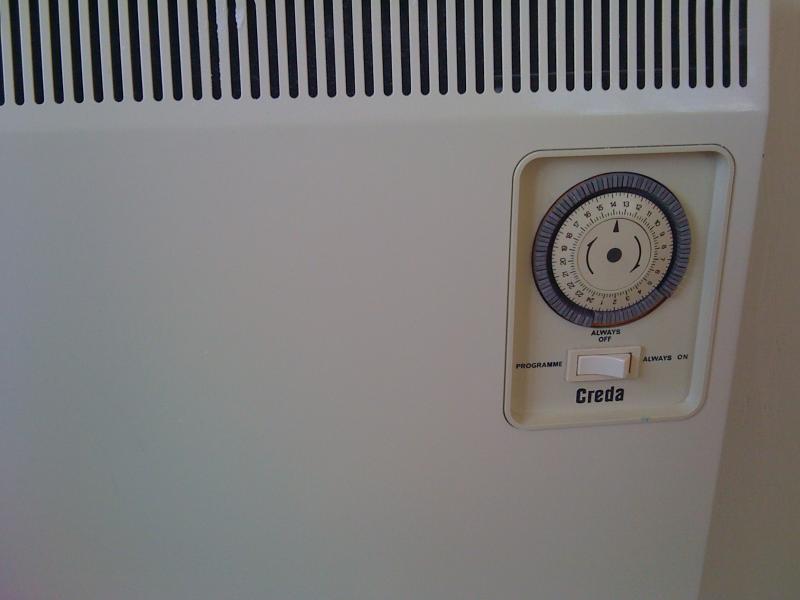
What model is my storage heater

Joined
10 Mar 2010
Messages
2
Reaction score
0
Location
Dorset
Country
United Kingdom
I have a storage heater.
It is a Creda model but I need a manual for it.
Can anyone help please.

I am trying to find out how best to use the settings as I am running up horrendous electricity bills. If I have a better understanding of the amount of electricity it uses during its cycle I am hoping to work out the most economical method/times to run it.
:?
 
That doesn't look much like a storage heater, but it does look an awful lot like a convector/panel heater, which will consume electricity when it's on, and not when it's off.
 
A photo of the whole heater would be useful, it's a bit hard to tell from a picture of the timer.

However, it looks to me like a panel heater, not a storage heater. Storage heaters don't usually have a timer on because they are wired direct to a timed supply. If it is a panel heater it will be expensive because it uses full price electricity during the day, unlike storage heaters that store up heat from the night rate supply at about one third of the day price.

Of course it could be a storage heater with a panel heater built into the front but it's impossible to say from your photo.

Have a look for a rating plate underneath, or where the cable enters the appliance.

Bah beaten by b-a-s, at least we came to the same conclusion.
 
This is the first time I have encountered storage heaters etc.
When we moved into the property the agents told us that it was all night storage heating so we have been trying to work out which was the most effective way of using all the storage heaters down stairs, which are one sort" and all the heaters upstairs "a different type".

However thank you so much because we now know that they are convector heaters and not all storage heaters as the agents told us.

Now all I have to do is convince them to help pay my enormous electric bill
......Fat Chance

Many thanks again guys
 
Ah, Estate Agents. A lovely, honest bunch of people with their clients' best interests at heart . . . .

:lol: :lol: :lol: :lol: :lol: :lol: :lol: :lol: :lol: :lol: :lol: :lol: :lol: :lol: :lol: :lol: :lol: :lol: :lol: :lol: :lol: :lol: :lol: :lol: :lol: :lol: :lol: :lol: :lol: :lol: :lol: :lol: :lol: :lol: :lol: :lol: :lol: :lol: :lol: :lol: :lol: :lol: :lol: :lol: :lol: :lol: :lol: :lol: :lol: :lol: :lol: :lol: :lol: :lol: :lol: :lol: :lol: :lol: :lol: :lol: :lol: :lol: :lol: :lol: :lol: :lol: :lol: :lol: :lol: :lol: :lol: :lol: :lol: :lol: :lol: :lol: :lol: :lol: :lol: :lol: :lol: :lol: :lol: :lol: :lol: :lol: :lol: :lol: :lol: :lol: :lol: :lol: :lol: :lol: :lol: :lol: :lol: :lol: :lol: :lol: :lol: :lol: :lol: :lol:
 
For ease of identification, Storage heaters are usually wired into switched fused connectors.
 
When we moved into the property the agents told us that it was all night storage heating so we have been trying to work out which was the most effective way of using all the storage heaters down stairs, which are one sort" and all the heaters upstairs "a different type".
That's normal. Night storage heaters in the living rooms and Panel Heaters with timers in the bedrooms. One of the drawbacks of storage heaters is that although they can be turned down, once they have a charge of heat, they still emit some of it. This would be far too hot for most people in their bedroom, so panel heaters with thermostats and timers are used, that can be set to be 'on' only when needed. Probably the agent should have described it as all electric heating i.e no gas or other type of fuel.

Your should use the upstairs panel heaters as little as possible. If that means setting the storage heaters a little higher downstairs and leaving the bedroom doors open to let some heat go up that may help. Remember the downstairs storage heaters will store up heat during the night using electricity at about one third of the price of the panel heaters upstairs. Depending on what tariff you have from your energy supplier.
 

If you need to find a tradesperson to get your job done, please try our local search below, or if you are doing it yourself you can find suppliers local to you.

Select the supplier or trade you require, enter your location to begin your search.


Are you a trade or supplier? You can create your listing free at DIYnot Local

 
Back
Top