
The automotive LED needs smooth DC, 10 - 30 volt, and are more expensive to standard house hold types.
Not the ones I bought, it's been a few years, but they were dirt cheap and for 12v, well 12 to 15v.

The automotive LED needs smooth DC, 10 - 30 volt, and are more expensive to standard house hold types.


you can use any 12 V AC 'transformer" (or DC "Power Supply") which has the capacity to supply the required current.


I have wondered if a capacitor is used as a driver in any extra low voltage lamps? I know used a lot with low voltage, but extra low voltage tend to use resistors or PWM chips.Some 12 volt AC LED lamps rely on a capacity to limit the current, these will NOT work on a 12 volt DC supply
is not quite right, as electricians we may see the difference between an "electronic transformer" and a " toroidal transformer" but the man in the street is unlikely to understand the difference, they clearly both transform the supply, but the "electronic transformer" is really a switch mode power supply, which often have a minimum output and tend to have an output in the MHz range, which will also impact on what @bernardgreen says, as the amount of current which will pass through a capacitor at 50 Hz is not the same as when in the MHz range, and I have noted some MR16 compatibles with G5.3 pins with 50 Hz written on them.you can use any 12 V AC 'transformer"
I have wondered if a capacitor is used as a driver in any extra low voltage lamps?
Interesting, this means neither would a DC power supply, often called drivers, and the AC supply would need to be 50 Hz, I have seen as said MR16 type bulbs marked 50 Hz, but assumed it was so a switch mode supply which would not work from zero was not used, since my lights had a massive 250 VA toroidal transformer I was not worried, but they are not small or light and can't see them being fitted inside a lamp.A number of table lanterns rated as 12 Volt AC were planned for a reception. To avoid the need to bring wired power to each table the event manager proposed using 12 volt batteries. The lanterns did not work on the DC from the batteries.
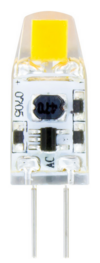 with AC between the pins does seem to suggest AC only. Yet the use of a chip seems to point to power being rectified and smoothed. But on going to company web site a couple were marked DC only, but nothing found saying AC, and they seemed to be marketing drivers which were DC to power them.
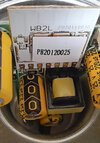 and clearly some large smoothing capacitors, so seem less likely to produce a strobe effect, but one is hardly likely to cram that lot found in a GU10 into a G4 bulb.
But the government is very keen for us to move to LED, but it seems not so keen to tell us how.
 there is nearly 58 watt of lighting when those lights are turned up full, three sets of strip lights. So 106 watt with everything turned up full, OK not normally turned up full, but the fact remains the 100 watt tungsten has been replaced with 106 watt LED, how is that a saving?
seems LED lights do not attract insects in the same way as tungsten,

If you need to find a tradesperson to get your job done, please try our local search below, or if you are doing it yourself you can find suppliers local to you.
Select the supplier or trade you require, enter your location to begin your search.
Are you a trade or supplier? You can create your listing free at DIYnot Local


