Wylex plug in mcb availability

Here we are


"The majority of these boxes cannot have devices over 30A fitted. Those which can are easily identified, as one of the fuseways will have a different appearance.
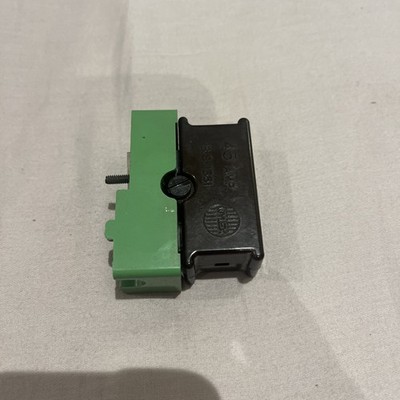
Normally, the high rated fuseway will have additional contacts and either be next to the main switch, or be separate to the other fuseways. In all cases, the plastic moulding behind the contacts has an extra cutout section near the top right. Devices over 30A have a notch which fits into this cutout, the idea being that this notch prevents the device being fitted to a normal fuseway.

Unfortunately, some people just cut the notch away. Some newer devices don't even have the notch - quality design thrown away and ignored!

Connecting a high current load such as a 10kW shower to one of these fuseboxes results in various failures:
1. The fuse contacts overheat and become loose.
2. The plastic holding the contacts becomes discoloured and brittle.
3. The loose contacts eventually spot-weld to the fuse carrier."


I've probably got one somewhere

@flameport
 
Devices over 30A have a notch which fits into this cutout, the idea being that this notch prevents the device being fitted to a normal fuseway. ... Unfortunately, some people just cut the notch away.
Where are these alleged notches, and how does one 'cut away a notch'? However ...
Some newer devices don't even have the notch - quality design thrown away and ignored!
Maybe the ones I have are 'newer', then? However, is it necessarily a case of "quality design thrown away and ignored" - might it not be that they eventually decided that the 'notch' was unnecessary?
Connecting a high current load such as a 10kW shower to one of these fuseboxes results in various failures:
1. The fuse contacts overheat and become loose.
2. The plastic holding the contacts becomes discoloured and brittle.
3. The loose contacts eventually spot-weld to the fuse carrier."
That makes me smile/laugh a little. They are certainly 'obsolete', for a whole host of reasons, but, at least in my opinion, the quality of the engineering outshone almost everything that was produced in subsequent decades !
 
might it not be that they eventually decided that the 'notch' was unnecessary?
They may have decided that, but shoving >30A through the standard contacts does damage them, as on the example here https://flameport.com/electric_museum/wylex_fuse_boxes/wylex_standard_2.cs4
The difference between them is the standard 30A versions have a spring piece made from the copper busbar, and the high load versions have a steel spring to apply far more pressure to the contacts.

In any case, no one should be connecting a new circuit to one of these fuseboxes, and certainly not a high rated one which it wasn't designed for.
 
As @flameport says, the 40 amp version needed a special box, with special spring,
1773349967091.png
and the standard isolator was only 60 amp, so was only supplied with a 60 amp DNO fuse, any item needing a 40 rather than 32 amps supply would clearly be a new circuit so will need notifying, which to get the DNO to upgrade the fuse one really has no option, it has to be done all correct or DNO should walk away without upgrading.

I had the same here, in fact I still have, even with a new consumer unit, still have a 60 amp fuse, and since I have now solar, I could not have a 100 amp fitted, maybe an 80 amp.

Sorry not a DIY job, well theory you could contact the LABC and register the work, before you start, but the fees are such, it may be possible on paper, but in practice a non-starter. It would cost more to DIY than to get a scheme member to do the job.
 
Since you can't buy the fuse box any more, and a new circuit needs it to comply with current regulations, what is the point in talking about a notch?

I had the same discussion over wife's idea of a hot tub, it not the cost of the hot tub, it's the cost to wire it up. Earth rods, TT supplies etc. Be it a new shower, and if using DHW or just cold supply, or anything else, one has to look at whole cost, not just the mixer tap etc.

The damage Wylex burnt contacts.jpg I would think due to removing or inserting the fuse, so with an MCB not really the same problem, as one has no reason to insert or remove it with it switched on. But the 60 amp main isolator is still a problem. My showers are 7 kW as got when we also had a Wylex fuse box, even with a new consumer unit, the supply fuse has not been changed so we still have a 60 amp limit and two instant showers both using 30 amps each, it is unlikely both used together, and we have never blown the DNO fuse.

But as yet not told why he wants a 40 amp supply, and I question if without a lot of changes he can get a 40 amp supply. It would be like me trying to fit a 7kW EV charging unit, I know I would need a fuse to supply my consumer unit, and the DNO fuse changing. So have an outside 13 amp socket which can be used when son visits, but I know for me to have an EV, means having the supply upgraded.
 
second picture at the top
I'm afraid that I still don't really get t :-)
I don’t think it’s older than yours. It’s when they changed from fuse wire to cartridge fuses.
Ah, I hadn't noticed that it was a cartridge fuse holder. I've never had anything to do with those, and thought we were only talking about the MCBs!
 
Put your glasses on John. It’s more of a small tab sticking out.

Yes, wylex cartridge fuses did come out rather late when everyone had moved on.
Never the less, it’s a second example showing the tab.
 
the MCBs fit in either moulding - fuse wire or cartridge types.

Personally I've never seen an orange unit before, only ever green for 40 or 45A MCBs - by that I'm obviously saying I've never seen a 40A fuse.

This shows the difference, the green has the tab quarter way up on the left, the red doesn't.
1773418934476.png
1773418784898.png
 
Last edited:
Put your glasses on John. It’s more of a small tab sticking out.
Oh - the tab is obvious enough - but it's been a 'notch' (really the opposite of a 'tab') that I have been looking for :-)

One of mine I illustrated has such a tab, but the other shows no signs of ever having had one. In any event, that tab would not stop the device being plugged into it's socket (although it might prevent the front cover of the box being put on)
 

If you need to find a tradesperson to get your job done, please try our local search below, or if you are doing it yourself you can find suppliers local to you.

Select the supplier or trade you require, enter your location to begin your search.


Are you a trade or supplier? You can create your listing free at DIYnot Local

 
Back
Top