Removing & replacing mildew ridden plasterboard from sho

Joined
14 Jun 2009
Messages
6
Reaction score
0
Location
Bristol
Country
United Kingdom
Hello all, this is my 1st post!

I'm a fairly inexperienced handyman, mainly because I've always lived in new builds and moved before any serious maintenance required doing. But I am looking after a house for my friends who are abroad. they have a 3 storey town house (newish build) with a shower on the 3rd floor. To cut a long story short the shower was leaking and as it was lined with plasterboard it had become plasetered with mildew (can you get ill breathing that stuff in btw?) I've removed the old tiles, 1/3 of it fell off after I removed the enclosure, 1/3 needed a gentle tap and the last 3rd needed sever brute force!

I now want to reline the walls so that this problem does not happen again, I am planning to use aquaboard or something similar. My question is, the plasterboard that is damaged the most is glued (dot & dabbed) directly to the concrete wall. How do I get this off with the minimum amount of fuss? Also what is the best way to "join" the new aquaboard to the plasterboard?

On the other wall (corner shower) the plasterboard is pinned to partition wall, and despite my best efforts following the guidline on here, I've still ended up with some sizeable holes, would it be best to chop that out also or just to board over it? I have a feeling it will be the 1st more diffficult method, but would appreciate any advce.


Cheers

J
 
it would probably be easiest and cheapest if doing it yourself to remove the PB on the studwork and the solid wall and replace it with standard plasterboard and then tank the lot. It will give you a waterproof seal and that is what you want. The dot and dabbed board on the wall will just have to be hacked at and ripped off as will the adhesive, no magic tips for that one sorry.

Aquapanel or similar are great products but are totally water resistant not waterproof so you need to treat the junctions anyway and they are pretty dear and slightly more awkward to work with compared to plasterboard. Spend the money saved on a good BAL tanking kit and it will be a better job too.

Oh and when you remove the PB make sure you cut the junction of wall and ceiling well to try and cut through the scrim/tape to save having too much to make good
 
Thanks r896neo for your response. What is strange is that before I posted this message I read in 3 different forums how it was not a good idea to use P/B or Ply and that aquaboard or hardiebacker board or similar product was the way to go. I posted a question about how best to remove the old P/B etc in 2 different forums and both times the 1st reccomendation I got was to replace with PB! :roll:

I'm still greatly appreciative for your help and feedback but now I'm confused if I should go down the route of PB or aquaboard type product, the relatively nominal cost of he aquaboard wasn't really the problem, but fitting it, might be.
 
If using plasterboard in bathrooms/shower rooms always use Moisture Resistant (green) & tank the wet areas behind the bath or inside shower cubicle.

From choice I always use Aquapanel in wet areas;
http://www.knaufdrywall.co.uk/aquapanel/index.html

It IS waterproof in the sense that it won’t disintegrate if it gets wet (unlike plasterboard), it will however, still absorb water; this also applies to water proof adhesive & grout unless it’s a very expensive 2 part epoxy; not generally necessary. Always use a trade quality adhesive & grout, & avoid the cheapo DIY shed products; it’s expensive by comparison but you only get what you pay for with this stuff.

Although Knauf don’t recommend it, you can dot & dab Aquapanel to brick/block walls as long as you use through fixings.

For lots more detailed info, visit the Tiling forum & read through the Tiling Sticky & archive posts where this comes up regularly basis’ also have a look in the Plastering Forum archive posts where you will find additional info.

Come back with specifics if your still not clear.
 
As Richard says you can dot and dab aqua-panel but it needs to be screwed as well. It's not that hard to work with or anything its just that it comes in smaller sheets and they need work to get them joined etc anyway. For me a well tanked plasterboard option is just as good and cheaper and easier. If you have the time and enjoy projects the aqua-panel in all wet areas fully tanked is full proof should you not apply the tanking right but its over engineered if you ask me.

You can not of course use plasterboard if your not going to tank it.
 
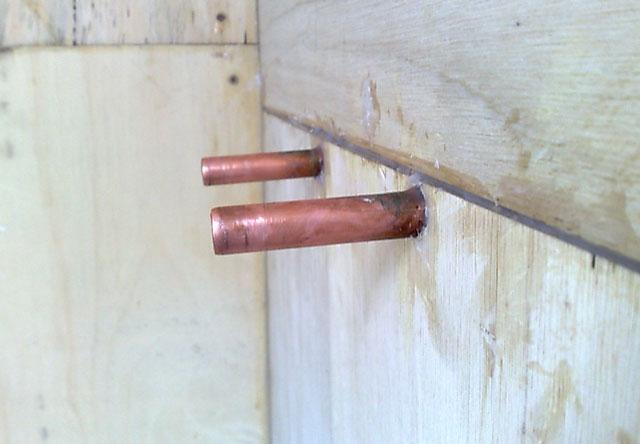
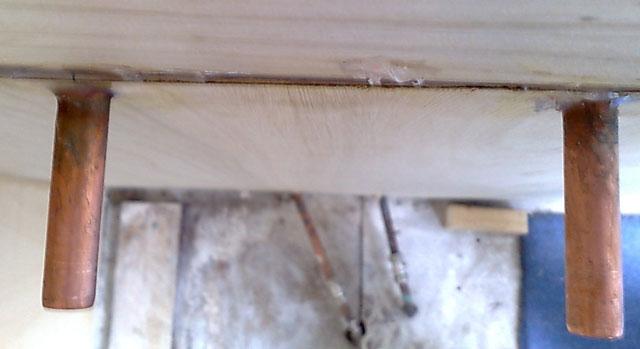
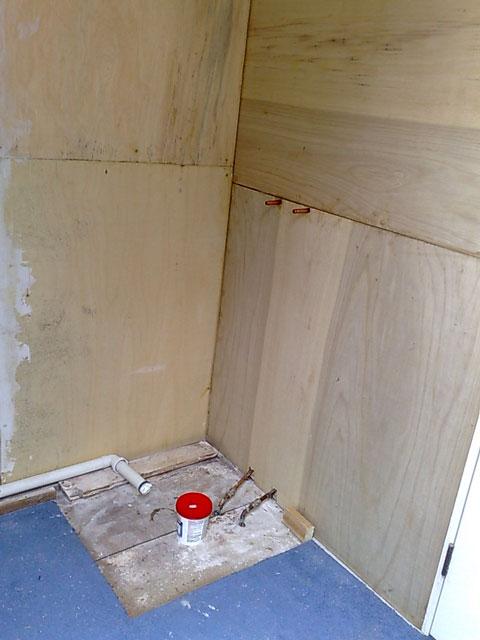
OK the tradesman convinced me that external grade ply will be more than edequate for this job, so I have bowed to his expertise. I am a little concerned about the ridge that appears between the different partys of the ply, he assured me that after it was tiled it would not be visible at all and would not affect the effectiveness of the tiling and grouting.

I will post a pic, does it look ok? Or should I ask him to make sure its flat?


OK the tradesman convinced me that external grade ply will be more than edequate for this job, so I have bowed to his expertise.
Why on earth did you opt for ply in a wet area, I hope he's gonna tank it. :roll:
 
He told me this was how his own shower was done at home and it was the way things were always done before aquaboard came along. He is very addamant that it will be a long lasting solution. :oops:
 
Folks also used to think the world was flat & that blood letting was a cure for the pox! The fact that he has done his own shower at home like that is irrelevant, how many others has he done?

Here are some facts;

• Waterproof adhesive & grout is only waterproof in the sense that it won’t disintegrate when wet, it will still absorb water. The exception is 2 part epoxy products which are very expensive.

• WBP (exterior grade) & marine ply use waterproof adhesives to bond the plies so it won’t de-laminate when wet; it’s still wood, expands when wet and so does not remain dimensionally stable.

• Given the above, it’s not difficult to see that unless it’s tanked (waterproofed), ply is really no better than plasterboard in wet areas; it won’t disintegrate like PB but can cause just as many problems with the tiles. If water gets back to the ply (& it will) it will expand, the grout & adhesive cracks letting more water in & so the cycle starts; moisture build up & mould behind there & your tiles eventually end up on the floor.

• Many still use plywood but why bother if you have to tank wet areas; you may as well use a modern, cement based tile backer board which remains dimensionally stable when wet. Take the cost of tanking materials into account & a decent backer board works out no more expensive.

• You can take up a certain amount of unevenness with adhesive but if you’ve got ridges like that (looks like it’s 3-4mm) between the lumps of ply he’s used how can he lay the tiles flat, it gets even worse if using large tiles; unless, god forbid, he’s going to dot & dab them onto the ply.

As I said previously, do yourself a favour & do some more research; start by reading the Tiling Forum sticky & the archive posts.
 
What would dot & dab look like? I have to say I was suprised at the fact that I could not see ANY adhesive at the edge of the tiles when he was tiling, but this is an "advanced" plumber we are talking about. When they stand there and tell you catergorically that it will be ok ad you yourself are not an expert.... I have never even done anything like this myself before. But to my untrained eye I would say that he has dot & dabbed. :twisted:
 
What would dot & dab look like?
Instead of putting the adhesive on the wall & forming a continuous bed with a notched trowel, you put 4 or 5 large globs (dots) of adhesive on the back of the tile & use this to level the tiles. A good dodge with uneven walls but the tiles can end up looking a bit higgledy pigledy instead of flat, if you get what I mean. Another problem is that the tiles won’t be as securely fixed as they should be & if they are large & heavy, they could even fall of in time; it also leaves voids between the tiles & the base board (ply in your case) which can trap moisture, grow mould & smell.

I have to say I was suprised at the fact that I could not see ANY adhesive at the edge of the tiles when he was tiling,
You should be able to see the adhesive on the wall between the tiles but it shouldn’t be oozing out between & over the tiles.

but this is an "advanced" plumber we are talking about.
Well there you go then. :roll: :lol: :wink:

When they stand there and tell you catergorically that it will be ok ad you yourself are not an expert.... I have never even done anything like this myself before. But to my untrained eye I would say that he has dot & dabbed. :twisted:
No much more I can add really; cross your fingers & hope it will be OK. I would be more concerned if he’s tiled straight onto the ply in a wet area without tanking it.

Out of interest, do you know what adhesive is he using & what grout he proposes to use?
 

If you need to find a tradesperson to get your job done, please try our local search below, or if you are doing it yourself you can find suppliers local to you.

Select the supplier or trade you require, enter your location to begin your search.


Are you a trade or supplier? You can create your listing free at DIYnot Local

 
Back
Top