Standard accessories used with DC

Joined
31 Mar 2006
Messages
20,033
Reaction score
1,397
Location
Leeds
Country
United Kingdom
Hello all.

Here's an interesting one for you.

What are you thoughts on using standard electrical accersories such as schneider circuit breakers and MK grid switches for a lighting circuit supplied at ~240V DC?

Is there likely to be any problems with it? The only thing I can think of will be the magnetic trip in the circuit breaker wont work, but I can't see that really being too much of an issue.
 
The problem you will have is arcing at the switch contacts when the switch is turned off. With AC the arc dies when the voltage goes through zero which it does 100 times a second. With DC there is no zero crossing point so the arc lasts much longer and will damage switches designed for AC only.

Contactors for switching DC have much wider gaps between contacts than contactors for switching AC. This is to stretch and hopefully break the arc. Some have magnets beside the contacts to force the arc into a curve to stretch even further.

If the DC is smoothed ( capacitors fitted in the power unit ) and derived directly from rectified 230 volt mains then the DC voltage will be around 325 volts ( the peak voltage of 230 vold AC RMS ( Root Mean Square )
 
What are you thoughts on using standard electrical accersories such as schneider circuit breakers and MK grid switches for a lighting circuit supplied at ~240V DC?
Is there likely to be any problems with it? ....
Do you think you're going to find any switches or contacts (in breakers etc) rated for anything like as high as 240V DC? Things like toggle switches, relay contacts etc with a 240V AC rating commonly have a DC rating of only 28V or 30V (sometimes a bit higher). I don't think that standard electrical accessories even come with a DC rating - MK plate switches and Grid Switches certainly don't seem to.

Kind Regards, John.
 
True the magnetic trip won't work. RCD (if you are using one) may not work unless it is pulsating DC?

What is the load? Lighting? How much current?
 
It's an existing system I've just been working on.

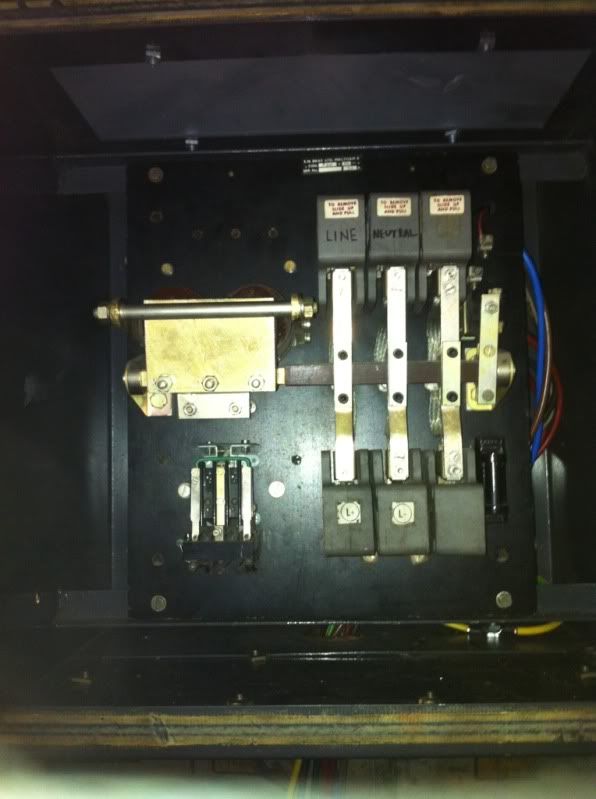
It's some lights in the auditorium of a theatre. The feed comes in from the mains as usual at 240V AC, and then goes through a dimmer and feeds the top of a change-over contactor. The contactor coil is fed from this supply before it goes thru the dimmer.

Then there is a 240V DC supply from a large bank of batteries in the cellar. This feeds through a DP merlin gerin MCB straight on to the bottom of the change-over contactor.

The middle of the contactor then feeds out to a 4 way merlin gerin fuseboard, which feeds a 24 gang MK grid switch, and this feeds out to the various lighting points around the theatre.

The setup is around 60 years old at a guess, The merlin board and the grid switch appear to about 10 years old, and look to be direct replacements for original parts.

It's possibly the most elaborate emergency lighting system I've ever seen, but it actually works incredibly well :D

The load is about 30A total.
 
Here's the contactor:

a8c99c29.jpg
 
Cool project. You might try to split out some of the circuits (if possible) to reduce current on individual switching devices (though it sounds like they are already quite well distributed)


Do you know what the prospective fault current is on the battery bank?

Are there any suppression capacitors on the existing switches?

What is the dimmer technology? rheostat? or semiconductor?
 
No, I have no idea of the Ipfc or even how to find it out!

We were there just to replace some dimmers. All the other circuits were just standard dimmed AC circuits, but this one was a bit different!!!

I'm not aware of any surpressors. I suspect there probably isn't any though.

The dimmers are just your standard triac dimmers rated to 50A per channel.

I now want one of these systems in my house. I'll keep you posted :lol:
 
In terms of switches you should be OK. 230/240v AC-RMS is equivalent to 230/240 DC. It's the arcing that will get them. That's where the suppression caps can help.
 
No, I have no idea of the Ipfc or even how to find it out!

Yes that is tricky. you need to know the battery internal resistance. You may need to contact the manufacturer of the batteries for that then multiply by the number of batteries in parallel.
 
The dimmers are just your standard triac dimmers rated to 50A per channel.


That's interesting. You can use a Triac for DC but it will only conduct in one direction essentially making it a thyristor (in old money :) )
 
The DC isn't dimmed. It's a fail safe system so if the mains is lost, the house lights come on at full power regardless of what state they were in for show purposes.
 
The DC isn't dimmed. It's a fail safe system so if the mains is lost, the house lights come on at full power regardless of what state they were in for show purposes.

Aha in which case erase from your mind any memories of me mentioning thyristors :lol:
 
apart from arcing at contacts in MCBs (which will also break down the switch contacts) there is an odd effect with DC, where IIRC there is a migration of molecules (or possibly a smaller particle, I can't remember) shifting the metal from one point to the other. I learned about this ages ago and have forgotten. With an AC circuit, the particles move one way, then back again every cycle so it doesn't matter.

DC switches are much more expensive than AC switches once you move away from little torch-battery applications.
 

If you need to find a tradesperson to get your job done, please try our local search below, or if you are doing it yourself you can find suppliers local to you.

Select the supplier or trade you require, enter your location to begin your search.


Are you a trade or supplier? You can create your listing free at DIYnot Local

 
Back
Top