• Looking for a smarter way to manage your heating this winter? We’ve been testing the new Aqara Radiator Thermostat W600 to see how quiet, accurate and easy it is to use around the home. Click here read our review.

Phase Identification

Joined
28 Jan 2011
Messages
60,850
Reaction score
4,676
Location
Buckinghamshire
Country
United Kingdom
A pretty trivial question, but a feature of my installation that I've often wondered about.

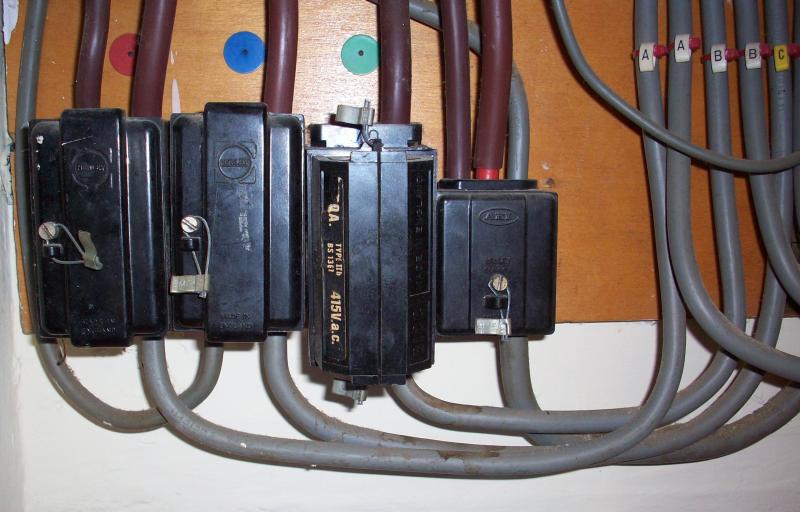
The L conductors in/out of my 3-phase meter have always been labelled 'A', 'B' and 'C' and that persists to this day; at the last meter change, probably less than 5 years ago, they attached new 'A', 'B' and 'C' cable markers to the cables. For this reason, I have always used the 'A', 'B' & 'C' as part of the identification of sub-mains and final circuits throughout the installation.

Was this A/B/C (rather than L1/L2/L3) identification ever actually the norm, and is it common practice that it is still used today?

Kind Regards, John.
 
As far as i know it is not common practice at this time. We use L1, L2, L3 & N for Neutral. The phases are white on black and the neutral is white on blue. I use the same marker tapes when i am doing instals as i belive it helps lesson confusion when you are dealing with pre-harmonized and harmonized colours in a buzz bar chamber say.
 
I must admit I have rarely (if ever) seen ABC used.

Quite common was/is RYB (including red.yellow, blue tape) and very common L1,L2.L3. Sadly with the new colour codes you can't really write BBGB :|
 
As far as the Wiring Regs. are concerned, they used to contain references to phase R, phase Y, and phase B, for obvious reasons (or to R, W, and B before yellow was adopted in place of white). For numerically identified conductors, there was no specific mention of how to identify each phase, but that the numbers 1, 2, and 3 should be used for live conductors and 0 for the neutral.

The use of A, B, and C to identify phases is common in North America.
 
As far as i know it is not common practice at this time. We use L1, L2, L3 & N for Neutral.
Thanks. That's what I thought. However, the folk that did the last meter change clearly had A, B & C cable markers in their toolbox, so I suspect it wasn't a particularly unusual practice for them. Maybe the rules they worked under required them to stick with the existing (A,B,C) labeling?

The phases are white on black and the neutral is white on blue. I use the same marker tapes when i am doing instals ...
I think that 'all bets are probably off' as regards colours, at least insulation colours, in my installation. I can't see the colours of insulation of any of the incoming phase conductors (PVC singles), since they have been terminated properly into the fuse carriers with no insulation visible - but, as I recently mentioned, one can see that the incoming neutral has red insulation!

Kind Regards, John.
 
as I recently mentioned, one can see that the incoming neutral has red insulation!


Not often, but I have been guilty myself of using red/brown tails for neutral. Of course I cut the outer PVC in such a way as to mask the internal colour and use blue tape as an identifier. Sometimes I am just reluctant to double up on the amount of tails I have in stock at any one time. Of course with three phase it is quite common these days to use brown for all phase conductors.
 
I must admit I have rarely (if ever) seen ABC used.
Thanks. Albeit my exposure has been very limited, it's certainly not something I've ever seen or heard of.

Quite common was/is RYB (including red.yellow, blue tape) ....
Sure. Just to add to the fun, there are (pretty old looking) coloured discs attached to the backboard adjacent to the fuse carriers, but they are red, green and blue - again another 'new one on me'!!

Kind Regards, John.
 
As far as the Wiring Regs. are concerned, they used to contain references to phase R, phase Y, and phase B, for obvious reasons (or to R, W, and B before yellow was adopted in place of white).
Yes, I'm familiar with that - but,as I've been saying, the fact that the neutral has red insulation makes me wonder what the phase colours may be - not to mention the red, green and blue discs!

The use of A, B, and C to identify phases is common in North America.
Interesting - but there's certainly nothing American about my installation - nor, I presume, those who last changed my meter!

Kind Regards, John.
 
(pretty old looking) coloured discs attached to the backboard adjacent to the fuse carriers, but they are red, green and blue - again another 'new one on me'!!

HaHa, that sounds like the DNO got their "pantone charts" mixed up :lol:
 
Not often, but I have been guilty myself of using red/brown tails for neutral. Of course I cut the outer PVC in such a way as to mask the internal colour and use blue tape as an identifier. Sometimes I am just reluctant to double up on the amount of tails I have in stock at any one time.
Yes, I would guess that it was probably 'what was available' to those installing the cable. It's however a bit ironic that the neutral is the only one they left with visible (red) insulation, and with no tape or anything to 'contradict' that red.

I am, of course, not talking about 'tails', but of the infamous 20 (or whatever) metre external runs from my overhead supply. They've certainly been there for the 24 years I've been in occupation, and quite probably were there for a decade or two prior to that; as such, they were presumably fairly early PVC cables.

Kind Regards, John.
 
Just to add to the fun, there are (pretty old looking) coloured discs attached to the backboard adjacent to the fuse carriers, but they are red, green and blue - again another 'new one on me'!!

It might be yellow which has faded or bleached to green through years of exposure to sunlight, but some of the old area electricity boards did used to use different identification schemes before red/white/blue became the standard.
 
(pretty old looking) coloured discs attached to the backboard adjacent to the fuse carriers, but they are red, green and blue - again another 'new one on me'!!
HaHa, that sounds like the DNO got their "pantone charts" mixed up :lol:
Yes, maybe! Mind you, I'd say that those discs are well in excess of 50 years old.

Kind Regards, John.
 
Yes, I would guess that it was probably 'what was available' to those installing the cable. It's however a bit ironic that the neutral is the only one they left with visible (red) insulation, and with no tape or anything to 'contradict' that red.

Yes on a significantly larger scale a DNO probably keep a keen eye on overstocking too. What is interesting is the lack of identification. Of course the DNO do not have to comply with BS7671 (as far as I know) and by that I do not imply that they work anything less than safely but not identifying a conductor is a bit off in my book especially when the "wrong colour" is visible.
 
It might be yellow which has faded or bleached to green through years of exposure to sunlight ...
Conceivably (although I would intuitively have expected green more likely to fade to yellow than the converse) - but can you believe this was ever yellow? (also, the order R/B/Y would have been unusual, wouldn't it?):


The A/B/C labelling of cables and red neutral can also be seen here.

Before anyone makes comments about 'free electricity', the cables coming out of the supply side of the LH phase and N go to the meter of an adjacent property, which was once part of what is now my house!

Kind Regards, John.
 
Thanks for the photo John, that makes it much clearer. I'd say that's almost certainly a case of the second possibility I mentioned then, i.e. of the local board using one of a variety of different identification schemes before red/white/blue became the standard.

P.S. Although I believe some area boards were still using their own old schemes at the time of the adoption of red/yellow/blue into the Wiring Regs., so in some cases an area electricity board probably never actually used red/white/blue on its network at all.
 

If you need to find a tradesperson to get your job done, please try our local search below, or if you are doing it yourself you can find suppliers local to you.

Select the supplier or trade you require, enter your location to begin your search.


Are you a trade or supplier? You can create your listing free at DIYnot Local

 
Back
Top