
Light switch reversed after transformer blew in the ceiling

JohnW2";p="2916403 said:
Fair enough - that's a 'real' transformer, not one of the electronic gizmos people often call transformers these days. /quote]

It is switched mode

data sheet here
http://www.kaoyi.com/oneproducts.aspx?ProductsCateID=377&CateID=377&CurrCateID=328

Therefore as has been said it is feasible that a wiring error has put the switch across the output and the lamp goes out when the switch is on and shorting the output.

Another remote possiblity is the switch was damaged by a current surge when the original transformer failed. In one design the moving contact is operated by a spring loaded ball that rolls from end to end of the contact as the switch is operated, if that ball welds to the moving contact then the action of the switch can be reversed. The switch may no longer have a click action when operated.
 
We have been scratching our heads for days now, trying to come up with a logical electrical explanation for the switch problem. We have not found one.
Indeed - or, rather, we are seeing increasing exotic/esoteric suggestions as to what might be going on.
It is in my opinion, and this is not a dig at the OP, that the switch has always been wired that way, and that its location next to a two-way switch, which may too normally operate in reverse, has caused it to never be noticed until the testing of such arrangement, following replacement of the transformer, resulted in a bit of thinking and realisation that something wasn't 'quite right'.
Indeed. I think we have to take that possibility very seriously. As I asked back on page 1:
... Are you certain that it's changed?
Given the uncertainties, and some of those esoteric suggestions, I think the first think I would do would be to eliminate (or confirm the guilt of!) the switch (I personally very much doubt it has anything to do with it). As 333rocky333 said, if the lights remain on with one side of the switch disconnected (and, then, if the lights went off if one joined the two sets of conductors going to the switch), the the switch would be off the hook, and the finger would be firmly pointed at something very wrong (and odd) going on in the circuit.

Kind Regards, John
 
Fair enough - that's a 'real' transformer, not one of the electronic gizmos people often call transformers these days.
It is switched mode ... data sheet here ....
So it is! Goodness knows what I looked up - clearly not the right one - apologies for the confusion :oops:
Therefore as has been said it is feasible that a wiring error has put the switch across the output and the lamp goes out when the switch is on and shorting the output.
'Feasible', I suppose - but as I wrote before, it would require a pretty comprehensive shuffling of the connections to achieve that.
Another remote possiblity is the switch was damaged by a current surge when the original transformer failed. In one design the moving contact is operated by a spring loaded ball that rolls from end to end of the contact as the switch is operated, if that ball welds to the moving contact then the action of the switch can be reversed. The switch may no longer have a click action when operated.
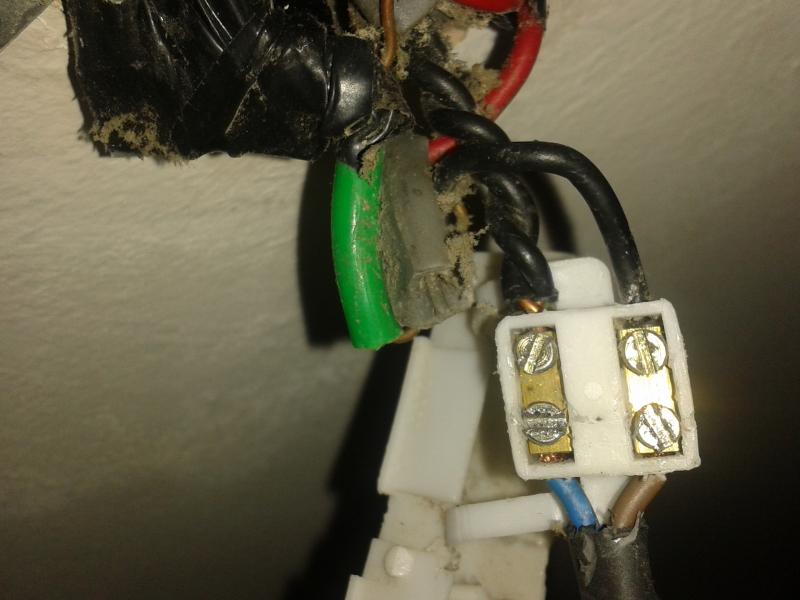
Yep, another very exotic/esoteric possibility! Per what mfarrow has recently written, one of the first things I was taught in my higher education (and had it repeatedly drummed into me thereafter) was that "Common/simple things are common' - a crucial part of education, since 'clever' students are only too quick to come up with obscure and unlikely suggestions, even when a 'common/simple' answer is staring them in the face. As I hinted back on page one, and having established that it's not '2-way switching', if I were a betting man, I think my money would be on mfarrow's suggestion that there is perhaps no 'problem' at all! However, anything's possible!

Kind Regards, John
 
I'll repeat what I said earlier - though some disagree with my approach - preferring to find a fault to explain your problem.

Looking at the first picture of the downstairs switch - move the two reds from their current terminal (L2?) to the L1 terminal.
 
I'll repeat what I said earlier - though some disagree with my approach - preferring to find a fault to explain your problem.
Looking at the first picture of the downstairs switch - move the two reds from their current terminal (L2?) to the L1 terminal.
I personally don't disagree with you approach at all. However, I would 'take it one step at a time'. I wouldn't jump straight to moving the reds to a different terminal. I would first discover what happened when I simply removed them from their present terminal (and did something safe with them - like putting into a bit of connector block). As I wrote recently:
...I think the first think I would do would be to eliminate (or confirm the guilt of!) the switch (I personally very much doubt it has anything to do with it). As 333rocky333 said, if the lights remain on with one side of the switch disconnected (and, then, if the lights went off if one joined the two sets of conductors going to the switch), the the switch would be off the hook, and the finger would be firmly pointed at something very wrong (and odd) going on in the circuit.

Kind Regards, John
 
moved it over to L1 and HEY presto down is on :D :D :D :D :D :D :D ... so should it all be safe as it still doesn't solve why it reversed
That it has 'worked' is no surprise. As I wrote yesterday ...
... one assumes that such a move of the two reds would almost certainly 'cure' the problem that the OP reported. However, given that we are assured that there have been no changes at the switch, I would personally be very uncomfortable (to say the least) about using that as a 'solution', since it would leave totally unanswered the question of what on earth had happened (and presumably was still 'happening') to bring about the change reported by the OP, wouldn't you?
So, as I said, it was all but certain that such a change would have the effect you wanted. However, if you are really certain that down was always 'on' in the past, then something very odd, and potentially dangerous, has happened to bring about the change - so you certainly can't be sure that the situation you now have is safe. If you are certain that the behaviour of the switch did change, then I would strongly suggest that you should get an electrician to check things out.

Kind Regards, John
 
So, as I said, it was all but certain that such a change would have the effect you wanted. However, if you are really certain that down was always 'on' in the past, then something very odd, and potentially dangerous, has happened to bring about the change
What would that be John?
 
ok should I change the red wires back to the original position, would that be safer :?
No - I'm sure that which way you connect the switch will have no effect on anything other than 'which way up' the switch works. It will be equally safe (or unsafe) either way.

Kind Regards, John
 
ok should I change the red wires back to the original position, would that be safer :?
No! You need to find out why the operation of the switch reversed. It doesn't make sense that that would happen unless either:
a) you've made a major mistake in the wiring or
b) there was a major mistake in the wiring before you changed the 'transformer', and you've now put it right.

You need to know which is the case.
 
So, as I said, it was all but certain that such a change would have the effect you wanted. However, if you are really certain that down was always 'on' in the past, then something very odd, and potentially dangerous, has happened to bring about the change
What would that be John?
Who knows - but you've seen some of the suggestions above, just as I have.

For example, would you regard it as particularly 'safe' (or, at least, desirable) if the light is being switched off by shorting the output of it's (always powered) 'transformer'? If it were your house, would you be happy to leave such a situation possibly persisting?

This is precisely why I suggested the 'step by step' approach (rather than jumping straight to the L1/L2 swap). If the light remained on when one side of the switch was disconnected, one would know that something very odd, and potentially worrying, was going on. If the light was off with one side of the switch disconnected then, despite the assertions, I would be back to strongly suspecting that the operation of the switch had not actually ever changed.

Kind Regards, John
 
If I made a mistake in the wiring wouldn't it trip the trip switch. I have connected the transformer and to the ceiling electrics exactly as it was previously, :? could it be the transformer????
 

If you need to find a tradesperson to get your job done, please try our local search below, or if you are doing it yourself you can find suppliers local to you.

Select the supplier or trade you require, enter your location to begin your search.


Are you a trade or supplier? You can create your listing free at DIYnot Local

 
Back
Top