Help with a double switch...please

Joined
11 Feb 2014
Messages
4
Reaction score
0
Location
Cambridgeshire
Country
United Kingdom
Hi,

I've had a search, and can't find anything that exactly answers what I'm trying to do, at least not with the same wires.

I'm trying to wire up a double light switch for my ceiling light, and wall light. Both lights are only controlled by one switch. The old switch was a dimmer, I'm not sure if this makes a difference?

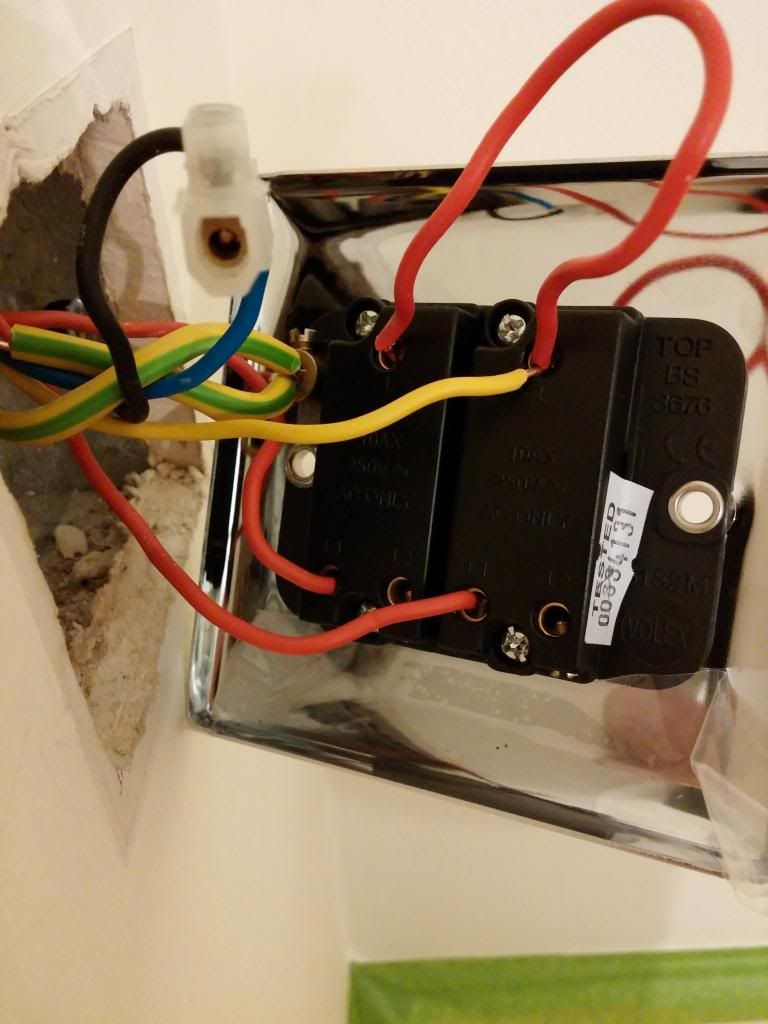
I have attached a picture which shows the old switch and how it was wired. It has L1, L2 and com.

The new switch has L1, L2, and L (L being the equivalent of com?)

I wired it up (or so I thought!) exactly the same as the old one, and neither light works. I then followed the wiring diagram provided, and can only get one of the lights to work (I did swap the wires around, so I know both lights actually work).

The wire on the left in the picture is red, blue, yellow and earth, the wire on the right has red, black and earth. The black and blue wires were joined together as you can see in the picture. There is a red bridging wire from L2 to com.

Could anyone please give me any advice as to what wires should go where? Any help would be gratefully received!
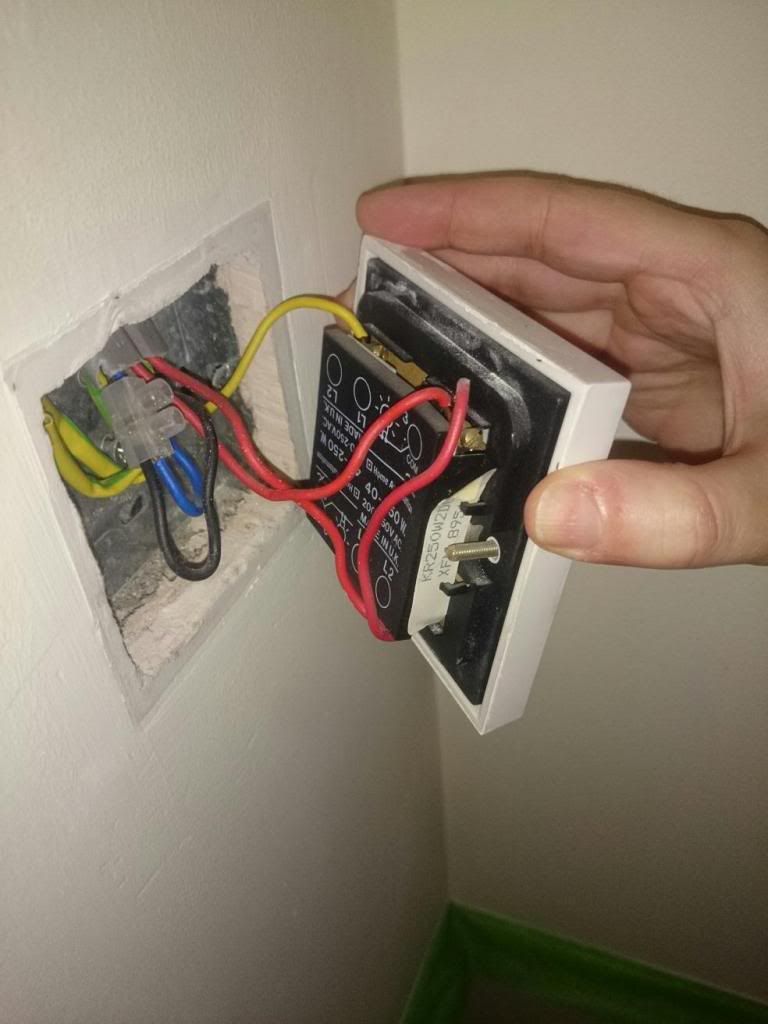

DSC_0255_zps435d8393.jpg
 
Looks like the current comes in via the yellow wire. When the light it turned on, it flows to the red wire to the light and via the link wire to the other red wire to light the other light.

Kudos for taking a photo before destroying it :-)

Wire the yellow to com
Use the red link wire to link the two com's together
Put one red wire to one L1 and the other to the other L1

That, I believe should work. If the light switch appears upside down, ie the light it on when you think the switch is off and vice verse, move the red wires from L1 to L2.

Put some red insulating tape around the yellow wire to indicate that it's a line conductor.
 
does the new switch have 2 switches on the front or 1 ?

What is going on under the switch ? Any wires we can't see
 
Thank you for the replies.

Ekmgdrf, I will try that when i get home and report back.

AndyPRK, the new one is also a double switch. I am unsure whether there is anything going on out of sight, so I will pull the old switch apart later to check.

Thanks again.
 
Do you have a safe means (approved voltage indicator) to test for voltage.
If so you need to determine which cable between reds and yellow is permanently live, as this will be your common/L connection. Once you have proved which is perm live this would be terminated at the L of switch gang 1 and a small red link cable fitted between this and L of switch gang 2 (please double check the markings on the switch before making the connections, sometimes they are not as they seem and one gang is configured differently to the other)

So once we have com/L and link across gang 1 and 2.
Then you install the two spares red and red or possibly red and yellow!
One each into L1 of gang 1 and 2 respectively.

So you will then have perm live and link in L of 1 & 2
And a single conductor for each light one in L1 of gang 1 and one in L1 of gang 2.

And that should do the trick! Providing the configuration of these cables where originally designed to be able to switch each light separately!
It could be worth confirming continuity of the switch lives individually, between each conductor end at the switch and at the light fittings!
Remember to safely isolate circuit and prove dead prior to any work being carried out.
If the new switch plate is metallic, this must also be connected to the CPC/earth cables and continuity of these conductors proved to have a path back to earth, at the main earth terminal at the supply.
 
Thanks to all for the advice.

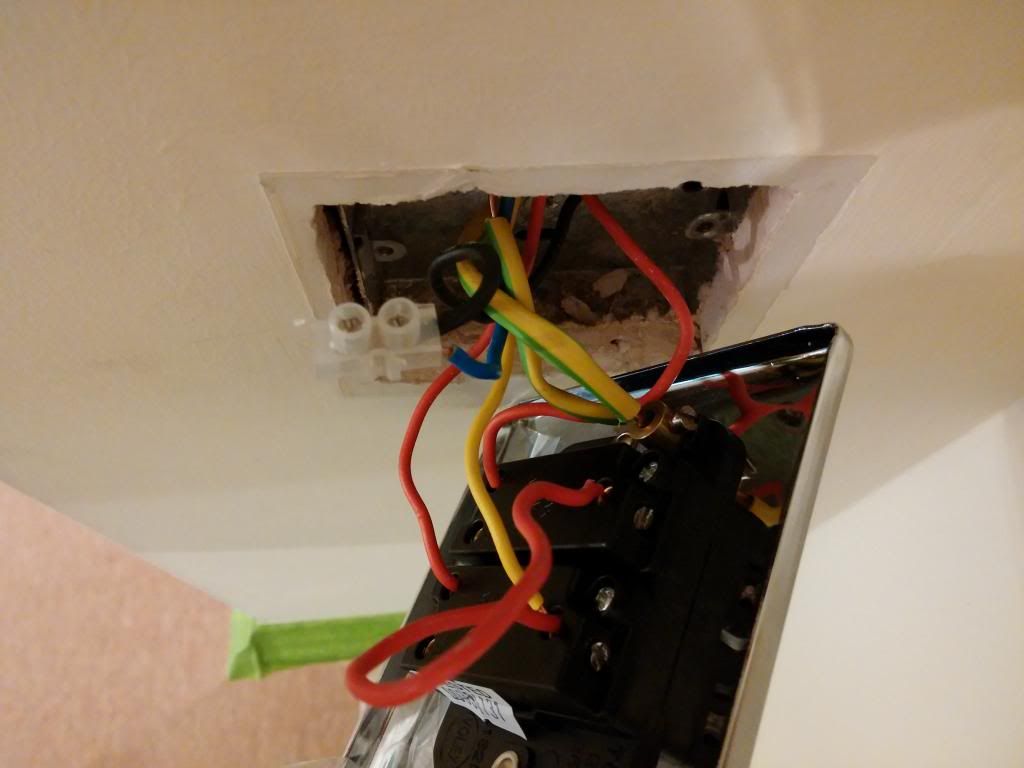
I have now got it sorted. I've put a couple of pictures below showing how I did it in case it is of use to anyone else.

If anyone can see any obvious mistakes, please let me know. I would point out that a couple of the wires are not fully in in the pictures, but I have now put them right in.

CAM00036_zpsdd678c66.jpg


CAM00034_zps36d41642.jpg
[/img]
 
Aaarggghhh! After finally getting this sorted I thought I'd take on the simple task of replacing the single switch in the dining room (we're decorating the living room and dining room, which are all but one room anyway). I merrily took the old switch off, ready to replace it with our nice new shiny metal one only to find......NO EARTH! Just live and neutral.

Short of pulling the walls apart to rewire/earth it, do we have any other option than getting crome effect plastic switches?

Thanks again in advance.
 
I have now got it sorted. I've put a couple of pictures below showing how I did it in case it is of use to anyone else.
I think you will find out the picture show how I instructed you to configure, only I suggested identifying conductor using safe methods.
If anyone can see any obvious mistakes, please let me know. I would point out that a couple of the wires are not fully in in the pictures, but I have now put them right in.
Other then the exposed conductors, you should sleeve the yellow line conductor red, to identify it as a line conductor.
And you really need as a matter of utmost importance confirm that you have a path back to the supply earth, as have not heard any mention of any testing being made. It is very dangerous to assume that you have an earth path and then connect metallic switch plates.
 
I merrily took the old switch off, ready to replace it with our nice new shiny metal one only to find......NO EARTH! Just live and neutral.
The CPC/Earth may have been cut back, if you split the sheath of the cable you maybe able to pick it up, this will then need extending via a connector block and again confirming continuity to earth before using metallic plates!
Short of pulling the walls apart to rewire/earth it, do we have any other option than getting crome effect plastic switches?
As above look for CPC within sheath, the only other non invasive option would be to source class II switch plates.
 
As above look for CPC within sheath, the only other non invasive option would be to source class II switch plates.

I believe that there is an offer on this here forum (possibly from RF Lighting) of £50 to anyone who can find Class II switch plates. That should pay for the switches :-)
 

If you need to find a tradesperson to get your job done, please try our local search below, or if you are doing it yourself you can find suppliers local to you.

Select the supplier or trade you require, enter your location to begin your search.


Are you a trade or supplier? You can create your listing free at DIYnot Local

 
Back
Top