Supply size

Going to try a couple of different sized heaters first and see if that works as I can cobble it together out of stuff I've knocking around the workshop. :D
And ? You've had a whole weekend :D We want to know if it worked, or if you blew the workshop up :roll:
Indeed.

I see no reason why it shouldn't work, and 'safely'. I presume that there would be a 'secondary inrush' when one suddenly removed the series resistance, but that didn't ought to be large enough to be a problem. [a continuously varying series resistance, such as the NCR thermistor suggested above would avoid that - but I'm doubtful as to whether a suitable component could be found, at all or at a sensible price].

Kind Regards, John
 
Indeed, there may be a secondary inrush - but again it would depend at the point in the mains cycle the switch got closed. But ...

My thinking is that with the transformer unloaded, the magnetisation current will be quite low - hence there will be little voltage dropped across the resistor once the initial core saturation has been eliminated.
So assume worst case - zero point switch on through the resistor. The transformer current rises and then the core saturates. Instead of drawing a large current through this now low impedance device, the resistor limits the current - to around 13A if the series resistor is a 3kW heater. After a few seconds, the core should have desaturated, the current drops to whatever the no-load magnetisation current of the transformer is. As this is quite low, the fairly low value resistor should drop very little voltage - hence the transformer is now running on near-enough full mains voltage.

Hence, when the series resistor is shunted, there will be very little change in voltage and the risk of the transformer core saturating is low - and if it does, it'll be "only just" rather than a deep saturation which is tripping breakers at the moment.

I could be wrong though :roll:
 
Hence, when the series resistor is shunted, there will be very little change in voltage and the risk of the transformer core saturating is low - and if it does, it'll be "only just" rather than a deep saturation which is tripping breakers at the moment.
Exactly - as I said, I would not expect the 'secondary inrush' to be a significant problem.

Kind Regards, John
 
Sorry for the delayed update, ended up working last weekend :cry:

Been having a bit of a play tonight and I've not tripped any breakers at all hooray!!

I've put a 100A isolator from an old CU in the live supply to the transformer and wired a 120W tubular heater across it.

Isolator off = transfrormer in series with the heater, and then close the isolator to remove the heater and give the transformer full power.

There is no inrush at all to start with, and then a fair inrush that really makes the tranny growl for a second or so as I switch the heater out of circuit, but it's low enough to not operate the circit breakers.

Just need to rig up an on delay relay and contactor for automatic soft start and jobs a goodun!

Thanks to everyone for their ideas. I love a bit of creative wiring to solve a problem :D :D
 
I've put a 100A isolator from an old CU in the live supply to the transformer and wired a 120W tubular heater across it. ... Isolator off = transfrormer in series with the heater, and then close the isolator to remove the heater and give the transformer full power. ... There is no inrush at all to start with, and then a fair inrush that really makes the tranny growl for a second or so as I switch the heater out of circuit, but it's low enough to not operate the circit breakers.
If that's enough to stop any breakers operating when you switch the heater out of circuit, I guess it's adequate for your purpose. However, a 120W heater is fairly high resistance (in relation to the potential tranny currents), so I imagine that, although the 'primary inrush' will be very low, the 'secondary inrush' when you take it out of circuit will be fairly high (hence the growl!). If you used a somewhat lower resistance device (e.g. a somewhat higher powered heater), the 'primary inrush' would be a bit greater, but the 'secondary inrush' would be less (hence less growling). I guess you'd have to experiment if you wanted to 'optimise' the situation (in relation to both primary and secondary inrish currents).

Kind Regards, John
 
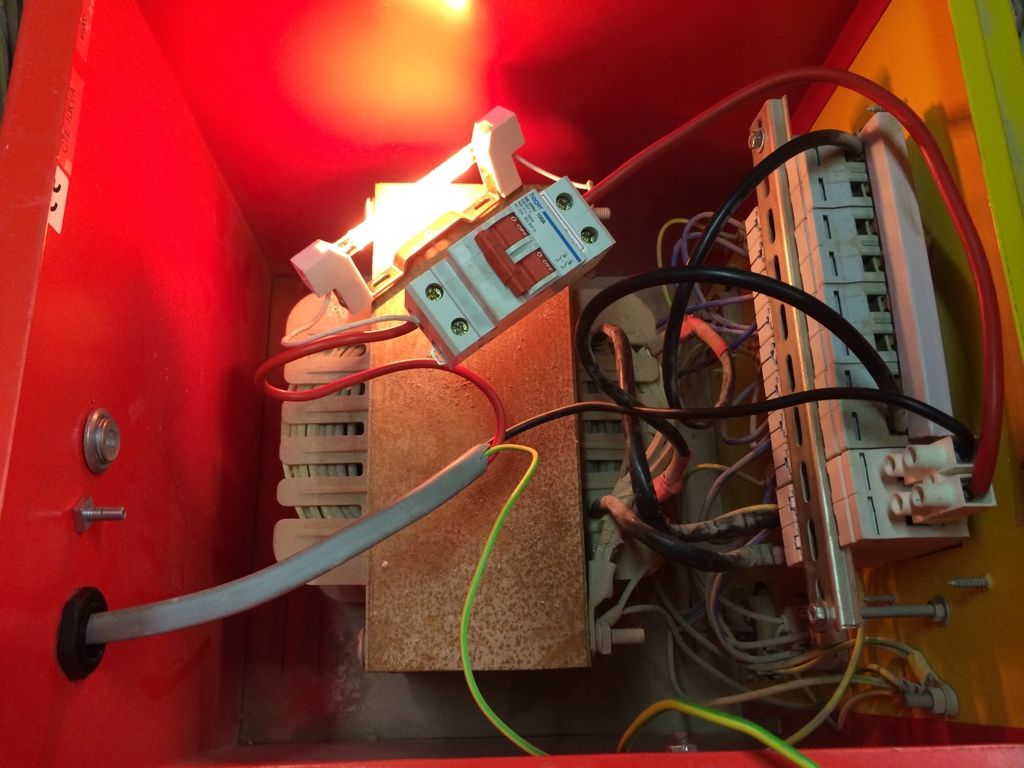
Well had another little play today and now have a 500W halogen lamp as the resistor, and both the primary and secondary inrush has as good as disappeared.

Great result! :D
 
Great result.

Out of interest, is there any faint glow from the 500W lamp at any time ? In theory it ought to flash at first switch on, but I suspect it's thermal inertia prevents that.
 
Well had another little play today and now have a 500W halogen lamp as the resistor, and both the primary and secondary inrush has as good as disappeared. Great result! :D
I told you you could probably do better (than the 120W heater) - that sounds great :-) Well done!!

Kind Regards, John
 
Great result.

Out of interest, is there any faint glow from the 500W lamp at any time ? In theory it ought to flash at first switch on, but I suspect it's thermal inertia prevents that.

More than a faint glow!

I've been giving the transformer 5 seconds or so before dropping the lamp out of the circuit.

566B1607-2283-4FD2-98D7-7C9176FB96C6-14477-00000D4EBE2562F6_zpscb8a805d.jpg
 
More than a faint glow! ... I've been giving the transformer 5 seconds or so before dropping the lamp out of the circuit.
Have you tried putting a clamp meter on that - before and after you take the lamp out of circuit? Do I take it that the tranny is unloaded?

Kind Regards, John
 
Have you measured the currents involved ? I'm surprised by the brightness of the lamp, and hence the current involved.

At least we home users don't pay for VARs :)
 
Have you measured the currents involved ? I'm surprised by the brightness of the lamp, and hence the current involved.
Yes, an interesting question to which we await an answer ....
Have you tried putting a clamp meter on that - before and after you take the lamp out of circuit? Do I take it that the tranny is unloaded?

Kind Regards, John
 
That's a lot less tidy than most of the photos of your work! :shock:
I think he's probably illustrating 'human nature' - many/most of us produce much more perfect work when we are doing it for others (particularly if being paid to do it) than when we do it for ourselves :-)

Kind Regards, John
 

If you need to find a tradesperson to get your job done, please try our local search below, or if you are doing it yourself you can find suppliers local to you.

Select the supplier or trade you require, enter your location to begin your search.


Are you a trade or supplier? You can create your listing free at DIYnot Local

 
Back
Top