

- Joined
- 27 Jan 2008
- Messages
- 29,274
- Reaction score
- 3,594
- Location
- Llanfair Caereinion, Nr Welshpool
- Country

There are two ways to wire lights, either you can follow the old British method of taking the supply from ceiling rose to ceiling rose then running from the ceiling rose to light switch, or the European way of wiring light switch to light switch with supply and then taking a cable from light switch to ceiling rose. Both have plus and minus for method, and you can mix them.
With the British system the earth loop impedance is better, you can fit emergency lights easily, you can fit independent ceiling fans easily, however harder to fit European light fittings and you have no neutral at the light switch.
There are also some wireless options, you can get units which can replace the ceiling rose which can be used to switch on lights from a remote control, which can look like a standard light switch, so you could get away without any drops to switches, however they are expensive, it is cheaper to hard wire.
So step one with any rewire is design, the electrician has to talk to client and agree how it is to be done, there is no one size fits all. As already said the existing conduit may be unsuitable, however it also may be OK, until some one gets on site and looks they will not know. Surface trunking is the easy way, however there are some new rules about where it crosses door ways and using metal retainers in case of fire to stop wires falling on the firemen fighting the fire.
When an electrician looks at the job he will consider door crossings and may alter his design slightly to comply with amendment 3, I have not got amendment 3 I am now retired, but I know it exists and if I was going to work again I would buy a copy. Because I don't have a copy I can't actually say what difference it will make to the design.
I also had a situation where mothers house I knew needed a re-wire, she was in hospital and I knew it would need completing before she came home, although I could rewire myself, I had to consider the time it would take and the cost of replacing my test equipment which had failed, plus in Wales the cost of Part P notification. So I engaged a firm to rewire for me, who had 2 people every day on the job and flooded it with 8 people on last day to complete it, they also had the tools to chase walls and were able to inspect and test and issue all the required paperwork. It did cost more than DIY but really not that much more once one considers the equipment I did not need to buy.
Before the rewire I walked around with the electrician agreeing what should be done, little things like no light half way up the stairs, but two lights on the landing one which would shine down the stairs, this is all part of the design, because of wood cladding on the stairs it would have been hard to get wires to lights.
So I would say start point is get an electrician to look at the problem and give you a quote, two things, one it may not be as expensive as you think, and two he may suggest a method we having not been on site have not considered. Once you have had an electrician around then you will be in a better position if you decide to DIY. Do consider the cost of paying the council their fees, it can work out rather expensive if they will not allow you to inspect and test yourself, they can insist that an electrical firm does the inspecting and testing, but then you don't get the installation certificate you only get a completion certificate. So you could end up handing the council £500 for nothing, that is a huge lump towards getting some one in to do it.
Do look at these they are expensive but may help,
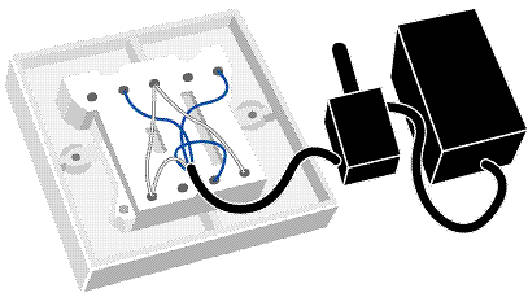 at £40 plus not cheap and personally I would hard wire, but in your design you also have to consider decoration in the rooms, to me wall paper is a nightmare, and I have not fitted sockets to one wall simply because it would need repapering after.
The on site guide does not tell you all you need to know, but goes a good way towards it, if you do go down the DIY route then you really should buy one.
With the British system the earth loop impedance is better, you can fit emergency lights easily, you can fit independent ceiling fans easily, however harder to fit European light fittings and you have no neutral at the light switch.
There are also some wireless options, you can get units which can replace the ceiling rose which can be used to switch on lights from a remote control, which can look like a standard light switch, so you could get away without any drops to switches, however they are expensive, it is cheaper to hard wire.
So step one with any rewire is design, the electrician has to talk to client and agree how it is to be done, there is no one size fits all. As already said the existing conduit may be unsuitable, however it also may be OK, until some one gets on site and looks they will not know. Surface trunking is the easy way, however there are some new rules about where it crosses door ways and using metal retainers in case of fire to stop wires falling on the firemen fighting the fire.
When an electrician looks at the job he will consider door crossings and may alter his design slightly to comply with amendment 3, I have not got amendment 3 I am now retired, but I know it exists and if I was going to work again I would buy a copy. Because I don't have a copy I can't actually say what difference it will make to the design.
I also had a situation where mothers house I knew needed a re-wire, she was in hospital and I knew it would need completing before she came home, although I could rewire myself, I had to consider the time it would take and the cost of replacing my test equipment which had failed, plus in Wales the cost of Part P notification. So I engaged a firm to rewire for me, who had 2 people every day on the job and flooded it with 8 people on last day to complete it, they also had the tools to chase walls and were able to inspect and test and issue all the required paperwork. It did cost more than DIY but really not that much more once one considers the equipment I did not need to buy.
Before the rewire I walked around with the electrician agreeing what should be done, little things like no light half way up the stairs, but two lights on the landing one which would shine down the stairs, this is all part of the design, because of wood cladding on the stairs it would have been hard to get wires to lights.
So I would say start point is get an electrician to look at the problem and give you a quote, two things, one it may not be as expensive as you think, and two he may suggest a method we having not been on site have not considered. Once you have had an electrician around then you will be in a better position if you decide to DIY. Do consider the cost of paying the council their fees, it can work out rather expensive if they will not allow you to inspect and test yourself, they can insist that an electrical firm does the inspecting and testing, but then you don't get the installation certificate you only get a completion certificate. So you could end up handing the council £500 for nothing, that is a huge lump towards getting some one in to do it.
Do look at these they are expensive but may help,
The on site guide does not tell you all you need to know, but goes a good way towards it, if you do go down the DIY route then you really should buy one.


